
Cat Jewelry Ring Guide for Style, Fit and Gifts

You've got a dozen cat rings open on your phone, and every tiny face looks like it deserves a home. Then the practical questions arrive: will those ears catch your sweater, what's underneath the silver-colored finish, and does your usual ring size even fit that finger?
A cat jewelry ring should make you smile without making your hands work around it. Floofie, our feline mascot, gives the paw of approval to three things before cuteness: low snag points, a disclosed metal, and a measured inside opening. 🐱
Cat Jewelry Ring Styles Worth Wearing
A ring can be adorable in the photo and annoying by lunch. The cute face gets attention; the edges, height, and inner opening decide whether it stays on your hand. Use the table to sort styles by how much edge they put near fabric, then read the notes for the checks that matter.
Cat jewelry ring styles at a glance
| Style | Look | Best for | Snag risk | Personalization |
|---|---|---|---|---|
| Engraved band | Name, paw, or date on a smooth shank | Daily office wear | Low | Yes, text or symbol |
| Enamel cat face | Colored ears, eyes, or whiskers | Photos and casual outfits | Medium if raised | Limited, usually color choices |
| Personalized portrait or name | Initials, full name, or tiny cat portrait | Memorials and birthdays | Low to medium | Yes, the main feature |
| Adjustable open band | Gap that flexes to the finger | Unknown size and gifting | Medium at the open ends | Sometimes a small stamp |
| High-relief statement | Standing ears, whiskers, tail, or stones | Parties and photos | High | Rarely, design is fixed |
| Thin stacking band | Narrow cat motif beside other rings | Layering with a wedding band | Low | Light engraving inside |
The engraved band is the quiet office cat. A recessed name, paw, or short date keeps the outside smooth, so it slips beneath a sleeve without announcing itself to every knit cuff. Ask whether the engraving is recessed rather than raised, and whether the band has enough usable surface for your chosen text.
An enamel cat face brings color to casual outfits and photographs. Painted eyes and ears can look expressive without a bulky stone, but a hard knock can chip the enamel. Color selection may be available; engraving usually needs a separate plain area inside the band.
Choose personality without forgetting your hands
A personalized portrait or name ring makes the cat yours, not just a cat. Explore personalized jewelry and cat-themed pieces at FloofChonk, checking each listing for the actual customization offered. A flat portrait can remain unobtrusive, while an applied portrait plaque introduces edges worth inspecting.
An adjustable open band helps when sizing is uncertain, but the opening isn't a magic universal fit. The ends should sit smoothly, not point outward like tiny fabric hooks. Treat adjustment as an occasional fitting task, not something to bend open and closed every morning.
A high-relief statement ring is the party animal. Raised whiskers, tall ears, curled tails, and stone settings make a strong silhouette, but gloves and delicate sweaters aren't its friends. If sparkle is the attraction, the guide to types of gemstones for jewelry can help you distinguish the stone choice from the setting around it.
A thin stacking band shares the spotlight nicely with a wedding band. Check that the cat motif doesn't rub against neighboring settings, and confirm there's room inside for engraving before requesting it.
Separate fashion spending from heirloom buying
Cat rings on the secondhand marketplace 1stDibs span a very wide price range, from modest fashion pieces to five-figure collector items. Treat that as context for rare designs and older pieces, not as a target budget for a playful everyday ring.
Floofie's sorting tray is simple: smooth bands for daily duty, sculptural cats for dress-up. Choose the silhouette your hands can live with, then move on to metal and millimeters. ✨
Metals That Keep Sensitive Fingers Happy
Hypoallergenic sounds reassuring, but by itself it tells you remarkably little about what's touching your finger. A cute cat face can't cancel an itchy, red, or blistered reaction.
Cat ring metals and skin comfort
| Material | Nickel exposure | Daily wear | What to verify | Watch-out |
|---|---|---|---|---|
| Pure sterling silver | Lower when accurately specified | Good | At least 925 purity and no mystery plating | Tarnish and product buildup |
| 18–24 karat yellow gold | Lower | Excellent with suitable construction | Exact karat, not just gold tone | Lower karats add more alloy; softer gold can deform |
| Surgical-grade stainless steel | Lower with a verified grade | Excellent | Grade named, not only stainless | Unspecified alloys need scrutiny |
| Platinum | Lower | Excellent | Platinum stated, not a plated lookalike | Higher purchase cost |
| Titanium | Lower with verified composition | Excellent | Solid titanium, not a coating | Harder to resize |
| Plated base metal | Set by the underlying alloy and coating condition | Occasional | Base metal, plating type, nickel intentionally added or not | Wear at shank and cat ears exposes alloy |
| White gold | Needs scrutiny | Suitable after alloy verification | Alloy and whether nickel is used | Precious-metal appearance doesn't guarantee comfort |
The American Academy of Dermatology identifies nickel-free or hypoallergenic jewelry, surgical-grade stainless steel, platinum, pure sterling silver, and 18–24-karat yellow gold as lower-exposure options for people with nickel allergy. Lower-karat gold contains more alloy metals, so the exact composition deserves attention.
White gold needs its own question rather than an automatic yes. Ask which alloy metals it contains and whether its surface coating hides a nickel-containing alloy.
Ask for a specification, not a soothing adjective
A useful listing names the base metal, plating material, and whether nickel is intentionally added. If you already have a diagnosed allergy, request relevant testing documentation rather than treating any material name as a personal guarantee.
DermNet's jewelry-allergy guidance describes fingers as a common reaction site and notes the EU prolonged-contact nickel-release limit of 0.5 micrograms per square centimeter per week. That's a measurable criterion, unlike an unexplained skin-friendly label.
Floofie's material test: If the seller can describe the sparkle but not the metal underneath it, keep your paws off the checkout button.
Plating isn't a bad choice, but it adds a wearing surface that needs care. Sweat and friction can wear the coating at the inner shank and raised ears, exposing the underlying alloy.
Choose a smooth, rounded interior without rough solder seams. It spreads pressure more comfortably and gives moisture fewer awkward places to collect.
Keep product claims precise
U.S. silver descriptions generally require at least 925 parts per thousand purity, and gold wording shouldn't imply gold content below 10 karats; these are composition checks, not promises that an individual wearer won't react. Ask the seller to substantiate precious-metal descriptions rather than relying on the color in a photograph.
A ring marketed primarily to children 12 or under is a different product category under ASTM F2923, not an adult fashion ring with a younger label.
Floofie approves sparkle that doesn't scratch, pinch, or conceal its ingredients. Once the material is clear, the next purchase test is the opening your finger needs.
How to Size a Cat Ring for Real Hands
Inside diameters for common cat ring sizes
The following inside-diameter matches come from the KAY ring size guide, rather than measurements across decorative ears or settings.
| U.S. size | Inside diameter | European size |
|---|---|---|
| 7 | 17.3 mm | 54 |
| 8 | 18.2 mm | 57 |
| 9 | 19.0 mm | 60 |
| 10 | 19.8 mm | 62 |
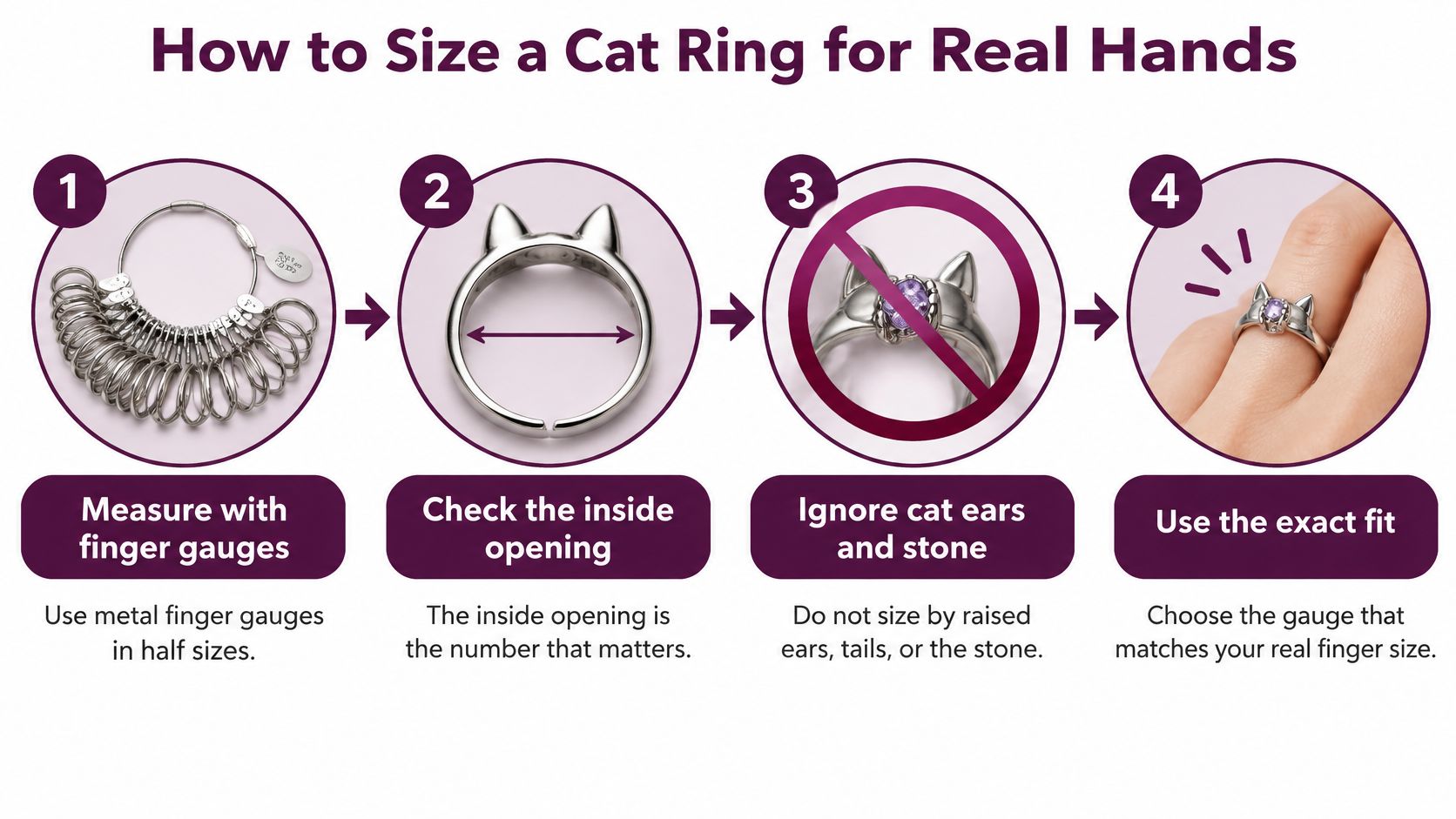
A ring's outside width can be wonderfully dramatic and completely useless for choosing its size. Measure the wearable opening, not the cat's silhouette.
Professional jewelers commonly use metal finger gauges in half-size increments, according to the Gemological Institute of America's sizing guide. A gauge fitting is especially helpful when your knuckle and finger base need different amounts of room.
Follow the inside opening
- Pick the actual finger. Don't substitute the same-looking finger on your other hand. Measure near the end of an ordinary day, avoiding a moment when your hands are unusually cold or swollen.
- Borrow a reliable fit. Choose a ring that already fits that finger comfortably. Lay it flat and use a millimeter ruler or calipers to measure straight across the inside opening, through its center.
- Match the seller's chart. Compare the measurement with the listing's size system, including available half sizes. Don't assume that a familiar size label means every seller uses precisely the same conversion.
- Use circumference correctly. If you only have a nonstretch paper strip, wrap it comfortably around the finger, mark the overlap, and measure that length. Use the seller's circumference chart, not a small, medium, or large guess.
- Resolve a mismatch before ordering. If your favorite ring's measured opening disagrees with a conversion label, use the inside millimeter measurement as your reference and ask the seller to confirm the match. Check that you haven't measured the outer edge by mistake.
- Stop when the size is unknown. Choose an adjustable design within its stated fitting range or an exchange-friendly style. 🐾 Don't turn uncertainty into a permanent engraving order.
The fitting sequence keeps the decorative parts out of the measurement:
Check comfort as well as the label
The right ring should pass over the knuckle without a struggle and settle without squeezing. A wide decorative face or broad contact area can feel tighter than a narrow band with the same opening, so a matching diameter isn't the whole comfort test.
Paper strips can twist, stretch when pulled, or tighten while you mark them. If a result seems surprising, repeat the measurement with a well-fitting ring or visit a jeweler rather than rounding toward whichever size is in stock.
For personalized ring options and sizing questions, confirm the opening measurement and adjustment range before approving customization. Floofie's fitting rule is worth keeping beside your ruler: measure, check the chart, then pounce.
Match the Cat Ring to Real Life
Floofie 🐾 would inspect your calendar before approving the ears. A ring for laptop work, pet care, and coat pockets has a different job from one worn for birthday photographs.
A low-profile design makes sense when your hands spend much of the day at a desk:

Office days and gloves
Say you type, pull on gloves, and carry a pet carrier home. An engraved band or thin stacker leaves fewer projecting details to hook a cuff or interfere with your grip.
Test the ring against the actual tasks, not just a mirror. Close your hand, slide it into a pocket, and check whether the cat's ears press against neighboring fingers.
If the ring should stay quiet while the outfit shouts, pair it with cat-lover apparel and accessories. The guide to cat accessories to wear offers other ways to add feline personality without adding height to your hand.
Handwashing jobs and busy caregiving
Frequent washing, sanitizer, and hands-on childcare make a delicate coated statement ring a demanding companion. Prefer a verified solid-metal band, such as sterling silver, stainless steel, titanium, or suitable high-karat gold, while following any workplace jewelry restrictions.
The choice isn't permission to leave jewelry on for every task. Remove it when hygiene rules, equipment, cleaning products, or safe handling call for bare hands.
Choose the cat for the hands you use all day, not only the photograph you want tonight.
Parties and picture time
Enamel and high-relief designs can be delightfully extra when their job is to complete an outfit. Put them on after getting dressed so tall details don't travel through delicate sleeves.
Keep a small jewelry pouch handy when the evening changes from photographs to carrying bags or cleaning up. Occasional wear is a valid purpose, not a lesser purchase.
Memorials and meaningful daily wear
A name, date, or portrait can feel more personal when the ring is easy to keep nearby through ordinary routines. Choose a smooth interior and a low exterior so the memorial doesn't demand constant attention through snagging.
Heat and workouts can change finger comfort; don't force a tight ring or modify its decorative ears to solve a fitting problem. With a wide-faced design, try a similar-width ring on the intended finger if possible.
The winners are an engraved or stacking band for office days, a verified solid-metal band for demanding routines, enamel or sculpture for parties, and a low-profile personalized band for remembrance.
Gift a Cat Ring Without Guessing Wrong
The birthday is approaching, and your friend has supplied every detail about their cat except their own ring size. Your mission isn't to guess more confidently. It's to choose a gift that leaves room for a good fit.
A guessed small, medium, or large shouldn't become a supposedly precise U.S. size. An adjustable open band, an exchangeable style, or a gift note inviting a fitting is kinder than a beautiful ring that stays in its box.
Make the surprise flexible
If you can borrow a ring the recipient already wears on the intended finger, compare its inside opening with the seller's chart. A ring from a different finger may tell you very little, however convincing it looks beside your own hand.
Check exchange conditions before buying, especially for engraving. Don't promise a resize unless the seller confirms the design and metal can accommodate one.
For a friend whose fit is difficult to establish, a personalized cat bracelet is another format to investigate. It still needs its own fit check, but it may offer a more practical route to a meaningful inscription.
Gift-coach advice: Preserve the surprise in the design, not in whether the recipient can wear it.
When allergy history is unknown, choose a clearly specified material rather than unlabeled gold-tone plating. Sterling silver, surgical-grade stainless steel, titanium, platinum, and high-karat yellow gold are options to investigate, not universal guarantees.
Personalize the message before making it permanent
Confirm the spelling directly from a reliable note or message. A cat called Miso shouldn't become Milo because the checkout field was filled in while you were half-watching television.
Check initials, punctuation, date order, and the preview's orientation. Ask whether the inscription will face the wearer or someone looking at the hand, and whether a portrait proof needs approval.
Match the occasion gently: a memorial often suits a smooth name band, a party-loving friend may enjoy enamel, and a coworker may appreciate a design without tall whiskers. Don't present an adult cat ring as children's jewelry without the appropriate verification.
Compare cat-themed gifts and personalized jewelry, reading the named materials and exchange terms on each individual listing. Floofie's final gift check fits on a tiny card:
- Adjustable or exchangeable: There's a workable plan if the fit isn't right.
- Metal named: The recipient can identify what touches their skin.
- Engraving spelled: Every letter, initial, and date has been checked.
Care for the Ring Then Place the Order
A little care keeps the cat looking intentional rather than battle-worn. Before buying, make sure the maintenance suits your routine as well as the design does.
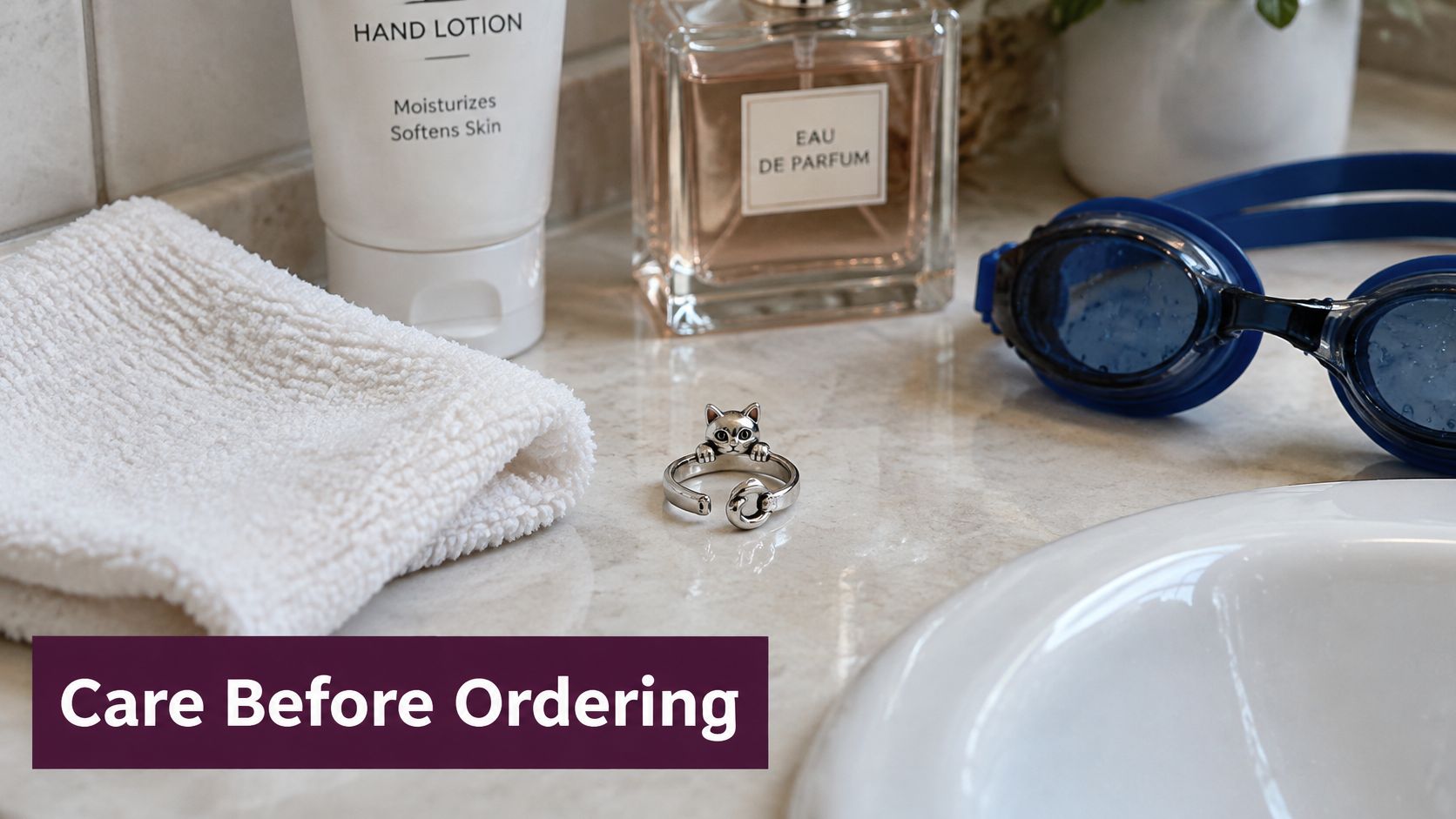
Use the shop's individual listing, rather than a collection photograph, for the final material and fit checks:
Give the finish a gentler routine
- Remove it before wet or chemical-heavy tasks. Take the ring off for swimming, showering, lotion, perfume, and hand sanitizer. Let your hands dry before putting it back on, and follow finish-specific instructions for enamel or stones.
- Wipe after sweaty days. Use a soft, dry cloth to remove residue. Skip abrasive pastes and household cleaners unless the maker specifically approves them for the complete piece.
- Store it separately. A fabric-lined compartment or soft pouch keeps raised ears from scratching neighboring jewelry. Don't drop it loose into a handbag with keys.
- Inspect the contact points periodically. Look at the inner band, open ends, raised ears, and any stone settings. Discoloration, sharp edges, or loose details deserve attention before another full day of wear.
- Pause if your skin reacts. Remove the ring if your finger becomes red or itchy rather than layering cream beneath the same metal. Let the irritation settle, seek medical advice if it persists, and investigate a disclosed lower-exposure alternative.
Check durability before checkout
A ring that meets a release requirement when new still needs a coating that survives normal use. Tukes guidance on chemicals in jewelry explains that coated prolonged-contact items must remain within nickel-release limits through ordinary use for at least two years.
Use the accompanying video as another viewing opportunity, while treating the product listing as the place to confirm specifications:
Before ordering, confirm style, named metal, and inside size on the cat jewelry product listing. Read its return or exchange terms, including any restrictions on personalized pieces, and save the specifications with your order confirmation.
Floofie's paw of approval belongs to quirky pieces you can enjoy wearing. Measure twice, pounce once. 🐱
FloofChonk offers cat-themed accessories and personalized jewelry for feline-loving wardrobes and meaningful gifts. Visit FloofChonk to explore the options, then check your chosen ring's material, inside measurement, and exchange terms before bringing that little cat home.