
Cat Tote Bag Guide: Materials, Sizing, and Care

You're halfway out the door with a laptop under one arm, groceries cutting into the other, and a packet of cat treats mysteriously wedged into your coat pocket. Then your cat's food rolls away, your paper bag creases, and the cute tote you brought along starts looking less like an accessory and more like an emergency rescue vehicle. 🐈
A well-made cat tote bag can handle that daily shuffle with a little more grace. The trick is looking beyond whiskers and witty slogans. Fabric construction, handle attachment, weight distribution, print durability, and actual reuse determine whether your tote becomes a trusted companion or a flattened closet kitty.
Why Every Cat Lover Needs a Signature Tote
Maya leaves home with a slim laptop, a water bottle, library books, and a small bag of premium kibble for the cat waiting at home. Her plain shopping bag technically carries everything, but it has no structure, no personality, and handles that dig into her fingers. A cat tote with a reinforced base gives those same essentials a proper home while announcing, gently and delightfully, that she belongs to the cat people.
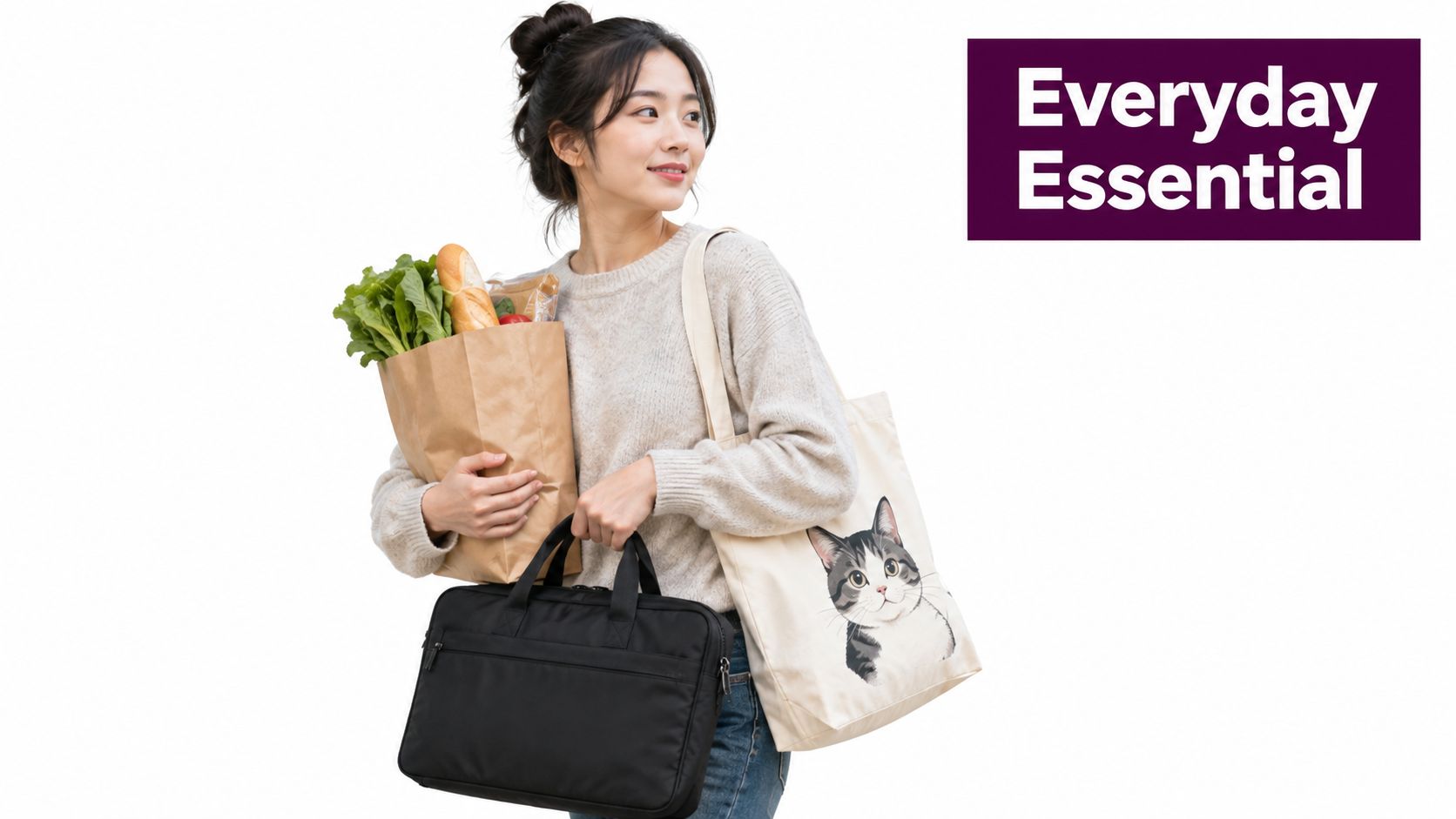
The audience for feline design isn't tiny or tucked away in one corner of the internet. A 2025 global cat-health report estimates that roughly one-quarter of households in the United States and the United Kingdom own cats, corresponding to about 37 million cat-owning households in the US alone. That gives a cat-themed accessory a broad emotional vocabulary. It can be a gift, a work companion, a market bag, or a cheerful signal to the stranger who spots the illustration and immediately says, “Your cat tote is adorable.”
More than a novelty
Floofie, our fluffy quality-control mascot, has a simple standard. A bag earns a paw-approved nod when it looks playful but behaves like useful equipment. It should carry everyday items without collapsing, feel comfortable against the shoulder, and keep its design presentable after regular care.
The print matters, too. A minimalist black cat can work with office clothing, while a colorful illustration brings energy to weekend errands. If you're curious about how metallic effects and other finishes can change a design, this guide to premium tote bag printing methods offers useful visual context before you choose a personalized look.
Floofie's rule: If the bag can start a conversation and survive the trip home, it's earning its treats.
A signature tote also reduces the need to improvise. Instead of juggling a paper bag, a work case, and loose pet supplies, you can assign one dependable carrier to the everyday cat-parent routine. That combination of identity and function is what turns a cute purchase into a bag you naturally reach for.
Decoding Materials and True Eco Impact
Cotton has a wholesome reputation, but the word alone doesn't tell you whether a bag is a responsible choice. A thin cotton tote that loses its shape, fades quickly, or stays unused in a cupboard may have less practical value than a synthetic bag that survives years of regular trips. Reuse is the behavior that gives a reusable bag its environmental purpose.
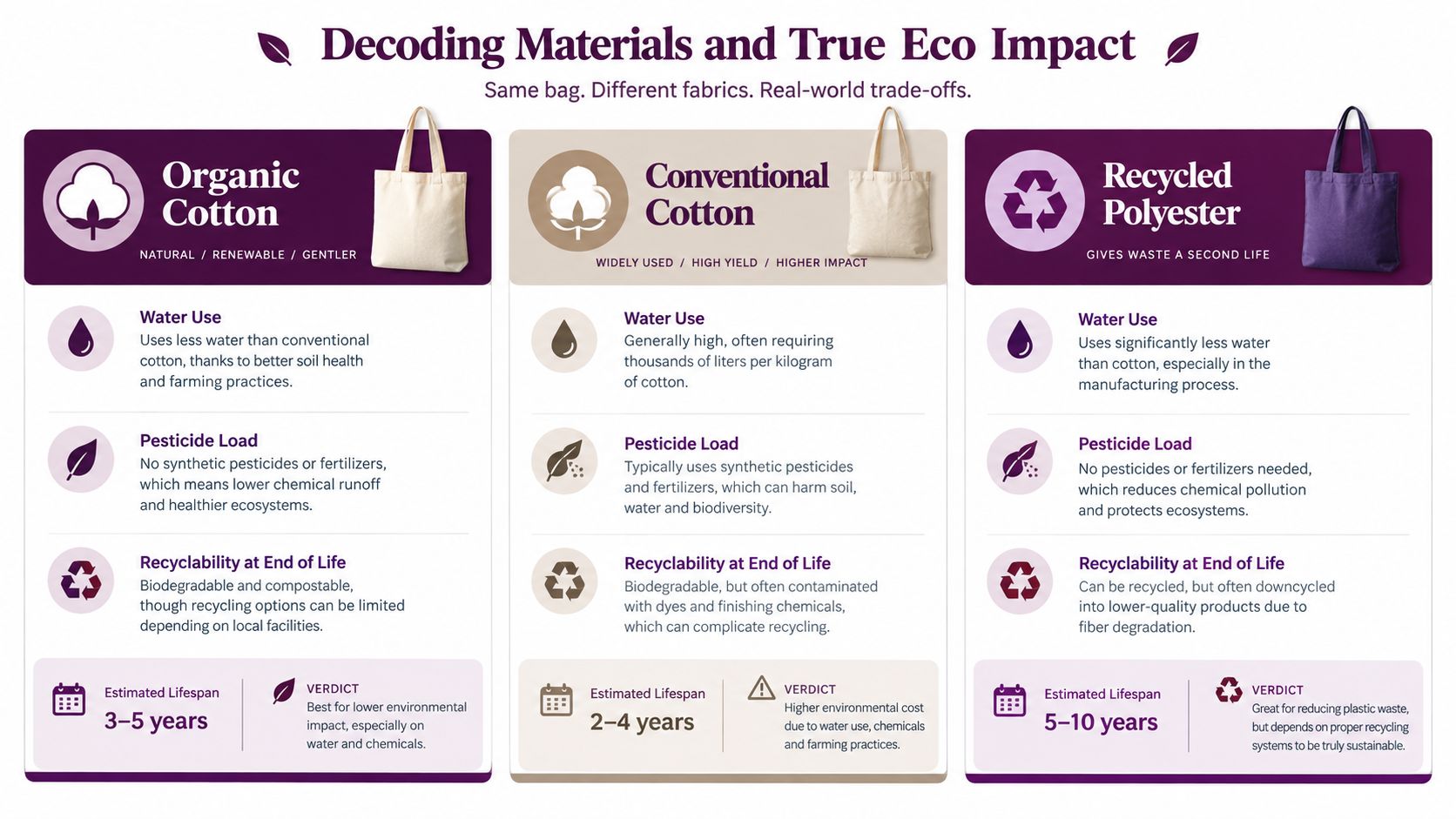
A comparative life-cycle analysis reported that conventional cotton bags need slightly more than 100 uses to match the environmental footprint of single-use options, while sturdy polypropylene bags need only three to four uses. The comparison appears in this analysis of reusable shopping-bag materials, which considered more than the moment a bag reaches the bin.
Read the fabric, not the marketing mood
Canvas generally makes sense for a heavy-use cat tote because its woven construction can offer useful resistance to abrasion and everyday folding. That doesn't make every canvas bag equally strong. Ask whether the product describes its fabric weight, lining, colorfastness, and care limits.
Standard cotton can feel soft and natural, but construction matters more than the fiber label by itself. One textile study reported initial tensile strengths of approximately 14.69 N/mm² for canvas and 14.93 N/mm² for cotton. After four washing cycles, canvas retained about 12.93 N/mm², while cotton fell to approximately 9.13 N/mm², as documented in the textile durability study. Those results don't predict the performance of every tote, but they do show why washing and fabric construction belong in the buying decision.
Nonwoven polypropylene, recycled polyester, organic cotton, and conventional cotton each involve different trade-offs in production, durability, washing, and end-of-life handling. Calling one material automatically “green” skips the part that matters most: whether the customer will keep using the finished bag.
For a useful comparison of available silhouettes and fabric approaches, you can browse FLYP LTD tote options and compare structure, opening, and intended use rather than shopping by fiber name alone. A larger tote may hold more, but extra material doesn't help if the bag becomes uncomfortable or stays at home.
The practical sustainability test
A Singapore government life-cycle assessment found that using 10 reusable bags over one year was functionally equivalent to using 1,248 single-use plastic bags, based on the full life cycle examined in the government assessment. For a cat tote, the conclusion is pleasantly straightforward: library trips, grocery runs, commutes, and veterinary visits all matter.
Before buying, check these details:
- Construction: Look for a substantial woven body, secure handles, and a base that won't sag immediately.
- Maintenance: Confirm whether the print and lining tolerate the cleaning method you'll realistically use.
- Actual routine: Choose a bag that fits your daily life, not an imaginary version of yourself who never carries anything heavy.
- Label transparency: Prefer clear information about fiber content, care, and country of origin.
For more gift ideas that apply the same reuse-first thinking, explore eco-friendly cat-themed gifts. Floofie supports any accessory that leaves the cupboard often enough to earn a little fur on it. 🌱
Sizing, Ergonomics, and Handle Strength
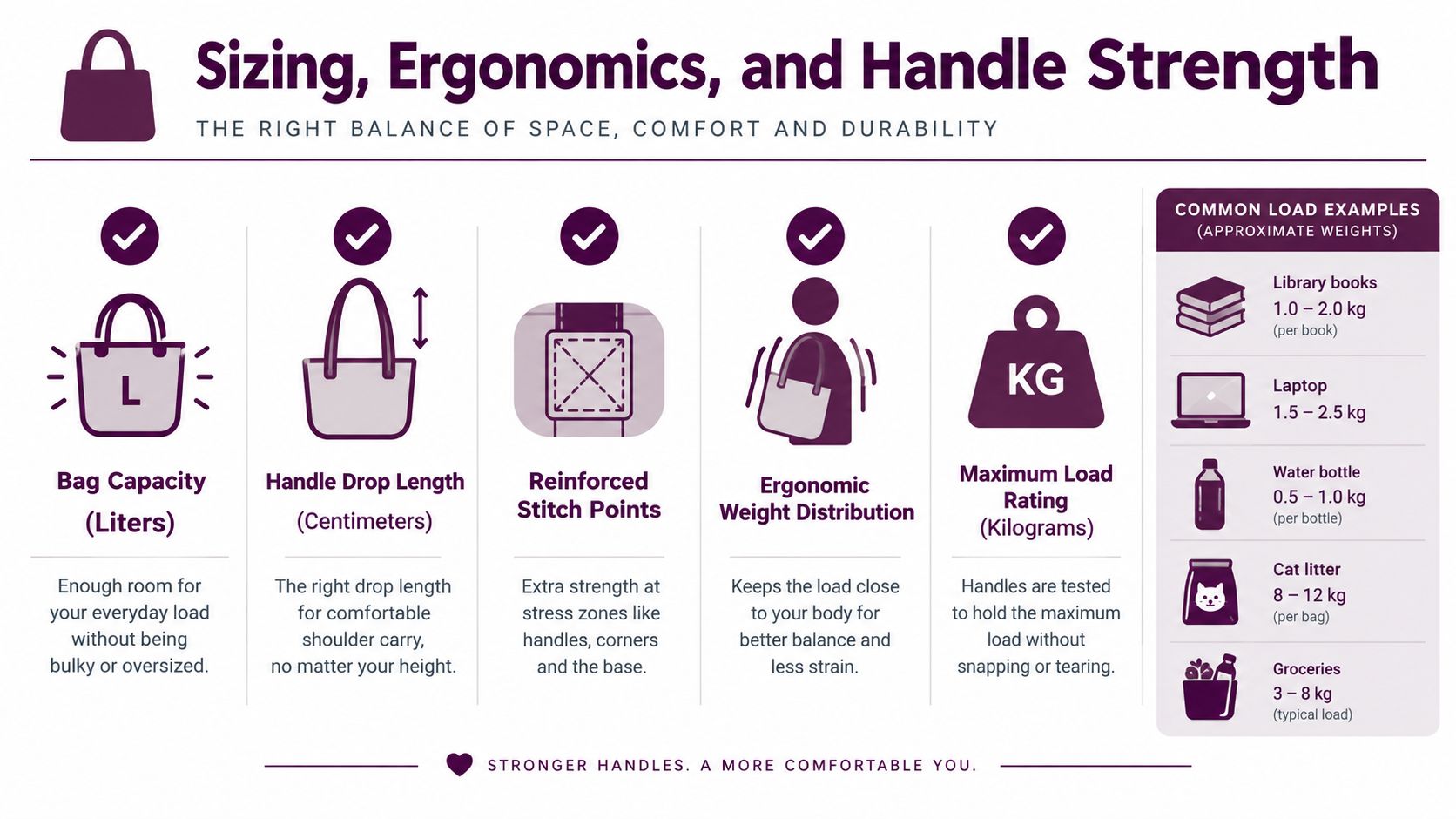
A tote can have a charming cat face and still fail at the exact moment you fill it with books. Fabric strength alone isn't an adequate performance specification, because handle attachment and sewn-joint geometry are common failure points where carrying force gathers in small areas, as explained in this shopping-bag handle guide.
Inspect the stress zones
Turn the tote inside out, or study close-up product photographs. The handle should connect through reinforced stitching rather than a single narrow seam. Bartacks, boxed stitches, a supported top edge, and a stable base all help distribute force instead of asking one row of thread to perform a heroic solo act.
A serious quality-control approach tests the finished bag, not only a fabric swatch. The test should use the actual handle width, lining, print treatment, reinforcement, and sewn geometry. Useful checks include:
- Static suspension: Hang the loaded bag and observe deformation, stitch slippage, tearing, or handle detachment.
- Repeated lifting: Lift and lower the bag repeatedly to expose weaknesses that a single still load can hide.
- Concentrated pulls: Apply force at each handle attachment, where sudden failure is most likely.
Manufacturers can use textile and seam standards such as ISO 13934-1 for peak force and elongation in suitable woven textiles and ISO 13935-2 for rupture force in straight sewn seams. Neither standard creates a universal load limit for a complete tote, so the finished product still deserves direct testing.
Comfort is part of capacity
A bag's advertised size doesn't tell you how it feels on a shoulder. Check the handle drop, strap width, base structure, closure, and weight distribution. A narrow strap carrying dense items can create uncomfortable pressure even when the bag itself remains intact.
Ergonomics-oriented tote research recommends keeping carried weight below approximately 10% of the user's body weight, while also recognizing that single-shoulder bags can create asymmetrical loading. The ergonomics research summary on tote design also identifies a trade-off between easy open access and the weaker biomechanical efficiency of a shoulder tote compared with a backpack.
A comfortable tote isn't simply a larger tote. It's a bag that places the load close enough to the body, spreads pressure sensibly, and gives the user a carrying option that suits the trip.
For work equipment, pet food, bottles, or veterinary supplies, look for a reinforced base, wider handles, a washable lining, and a closure that prevents contents from tumbling out. A guide to teacher tote bag features offers another useful way to evaluate organization and carrying comfort. Floofie gives extra whisker points to designs that make dense items feel manageable rather than mysterious. 📚🐾
Printing Methods, Personalization, and Care
The artwork is often what makes someone stop scrolling, but the printing method determines how that artwork behaves after repeated handling. A black cat silhouette, a custom pet portrait, and a metallic slogan each ask different things from the decoration. Compare the finish with the way you'll use and clean the bag.
| Print Method | Durability & Wash Resistance | Best For |
|---|---|---|
| Screen printing | Can create a bold, tactile design when properly applied, but the finish and care instructions still matter | Simple graphics, strong lettering, limited-color cat art |
| Direct-to-garment printing | Handles detailed artwork and tonal variation well, with wash performance depending on the textile and ink system | Pet portraits, illustrations, and multicolor designs |
| Heat transfer vinyl | Produces crisp shapes and personalized text, but edges and surface finish need careful washing | Names, short phrases, small runs, and high-contrast motifs |
Match the method to the memory
A screen-printed “meow” may suit a clean graphic style, while direct-to-garment printing can preserve the detail in a photo of your own cat. Heat transfer vinyl works nicely for a name, adoption date, or small accent, especially when the design needs sharp edges.
If you're comparing examples of photographic personalization, this guide to a tote bag with picture can help you think through image placement and presentation. You can also collect ideas for meaningful custom presents in this guide to personalized pet photo gifts.
Care starts with the label
The Federal Trade Commission requires textile products sold in the United States to disclose fiber content, country of origin, and care instructions, as outlined in the FTC apparel-labeling guidance. Those details should be easy to find before purchase, particularly when a printed tote includes a lining or a finish that needs special handling.
Floofie's laundry routine is simple:
- Turn the bag inside out before washing when the care label permits machine cleaning.
- Use the recommended water temperature and cycle rather than guessing.
- Avoid harsh treatment that could stress the print, seams, or lining.
- Let the bag dry according to its instructions, and don't assume high heat is harmless.
- Store it flat or upright so the base and handles aren't crushed between heavier items.
Personalization should support longevity, not make the bag too precious to use. The best cat portrait is one that goes to the market, the office, and the café instead of hiding safely in a drawer.
Styling Your Cat Tote for Every Occasion
A cat tote doesn't have to shout. A small embroidered silhouette or restrained graphic can sit comfortably beside a striped sweater, tailored trousers, and simple sneakers. A bold cartoon print can take the opposite route, adding a bright focal point to jeans and a plain shirt during a farmers' market run.
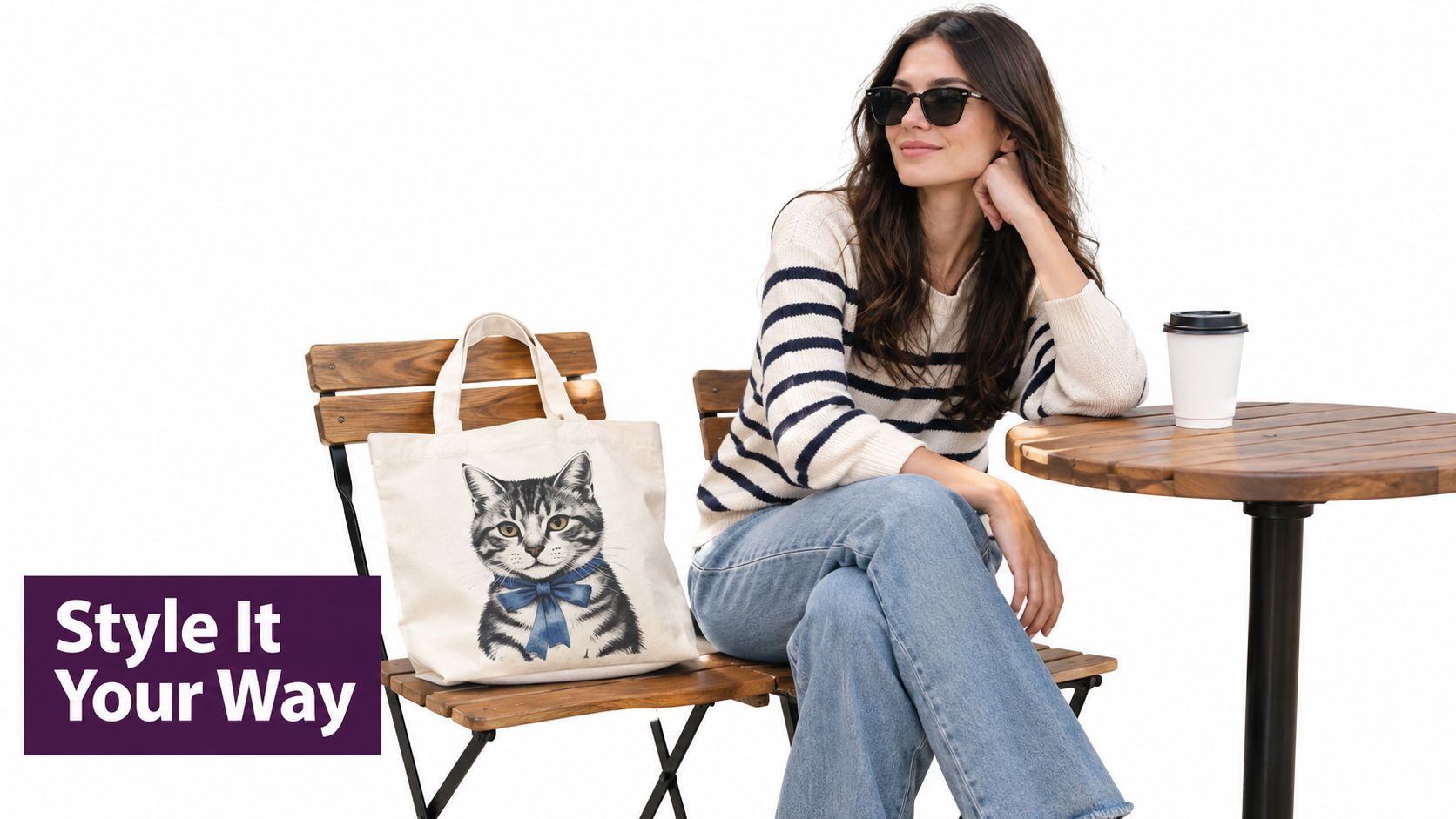
Think of the bag as a small piece of visual storytelling. A monochrome tote can echo black shoes or a dark belt, while a colorful design can pick up the shade of a scarf, hair clip, or enamel pin. Matching every detail can look overly planned, but repeating one color makes the outfit feel intentional without turning you into a walking cat-themed catalogue.
Build a useful daily uniform
For the office, choose a structured canvas body, a quieter illustration, and an interior that keeps work essentials from sinking into a furry-looking abyss. For classes or library visits, prioritize a comfortable handle drop and a base that supports dense books. For weekends, an open tote with a lively print makes quick access easy while giving groceries and small purchases a cheerful carrier.
The same bag can also serve as a dedicated pet-day tote. Keep a washable pouch inside for medication, treats, wipes, or paperwork, and reserve one section for items that shouldn't mingle with snacks. A zip closure is useful in crowded spaces, while a lighter open design may be more convenient when you're moving quickly between the car, shop, and veterinary reception desk.
A cat tote can even replace a generic extra bag for caregivers who need to carry small personal items alongside household essentials. The important distinction is between a fashion tote and a structured daily-carry design. If the contents are dense or fragile, choose reinforcement and organization over an oversized graphic.
The visual side can be playful without sacrificing function. Floofie approves of a subtle cat silhouette for professional mornings, a ridiculous “I need my cat” illustration for casual errands, and a carefully placed pin that makes the design feel like yours. 👜😺
Here's a little visual inspiration for bringing feline flair into an everyday outfit:
Choose accessories that complement the tote rather than competing with it. One cat-themed detail can look polished. Three can look joyful. Seven may indicate that Floofie has taken over your wardrobe.
Floofie's Final Tips for Choosing Your Perfect Bag
The right cat tote bag balances personality, structure, comfort, and honest environmental claims. A charming illustration gets the first glance, but the details below decide whether the bag becomes part of your routine.
- Examine the attachment points: Handles need reinforcement where force concentrates, not just attractive fabric across the main panel.
- Check the carrying experience: Look for a suitable handle drop, wider straps, a stable base, and sensible weight distribution.
- Read the label: Confirm fiber content, country of origin, and care instructions before buying.
- Choose for your real load: A tote for receipts and a phone doesn't need the same construction as one for books, groceries, or pet supplies.
- Think in repeated trips: A reusable bag only earns its environmental advantage when you keep using it.
- Treat material claims carefully: Cotton isn't automatically the lowest-impact option, and a durable synthetic bag may perform better environmentally when it receives frequent use.
The Singapore assessment cited earlier makes the reuse principle tangible. Using 10 reusable bags over one year was functionally equivalent to using 1,248 single-use plastic bags in that analysis. A tote that travels regularly has a stronger practical case than a premium-looking bag that stays folded in a drawer.
Floofie's final inspection is wonderfully strict: stroke the fabric, check the seams, test the handles gently, study the care label, and ask whether the design makes you want to carry it tomorrow. If the answer is yes, the bag has a chance to become a long-term companion instead of another cute object waiting for a special occasion.
Find a cat-themed tote, personalized accessory, or everyday feline favorite at FloofChonk, where playful designs meet the practical routines of cat lovers. Choose a bag that suits your style, inspect its construction, and let Floofie accompany your next grocery run, commute, or veterinary adventure.