
Cat Toys for Picky Cats: The Playbook Floofie Swears By

The toy is sitting in the middle of the rug, perfectly ignored. Your cat gives it one polite sniff, walks away, and settles beside the empty cardboard box that came with your last online order. Meanwhile, the basket is overflowing with crinkle balls, plush mice, kickers, feathers, and a toy that promised to capture your floof's inner hunter. 🐾
That doesn't mean your cat is impossible to please. A “picky” cat is often following a very specific play rule. Maybe the toy must move sideways, smell interesting, feel rough under the paws, disappear behind furniture, or be controlled by you. Floofie, our resident toy critic, would call this quality control.
The trick is to stop asking, “Which toy is best?” and start asking, “What kind of prey does my cat believe this toy is?” Once you identify that rule, you can match the right format, test triggers without overspending, and bring rejected toys back into circulation.
When Your Cat Snubs the Toy Pile
You set a feather wand on the rug. Your cat sniffs it, gives the crinkle ball one polite bat, and then climbs into the cardboard box from your last delivery. The toy basket is full, yet the box wins the evening. Floofie would file this under “strong opinions, limited evidence.”
A snub often reflects a mismatch between the toy and your cat's hunting rules. The object may move incorrectly, smell uninteresting, feel wrong under the paws, or ask your cat to play without your involvement. Read the rejection as a clue, not a verdict on your cat's interest in play.
Indoor-cat enrichment guidance favors variety without leaving every toy out forever. One survey reported an average of 7 toys or activities per cat, while older advice suggested keeping 20 toys available and rotating only 4–5 at a time. A crowded basket can turn exciting objects into background furniture. The original enrichment guidance appears in Toys, Activities, and Behavior Problems in Indoor Cats.
Treat the snub as information
Notice the exact moment interest fades:
- One sniff, no paw movement: scent or texture may be the mismatch.
- A fast chase, then abandonment: the motion worked, but the catch did not feel satisfying.
- Interest only when you move it: your participation is part of the trigger.
- Excitement behind furniture: stalking and ambushing may matter more than open-floor action.
- Ignored in the open, attacked under a towel: presentation may matter as much as the toy itself.
A controlled study found that cats interacted significantly more with moving toys than stationary ones. Scented stationary toys also held attention longer than unscented stationary toys. Catnip-style smells produced a response in roughly 60%–70% of cats in the controlled study. That range explains why catnip can delight one floof and leave another completely unimpressed.
Before shopping again, test one rejected toy in three forms: still on the floor, dragged slowly, and hidden behind a towel or chair. Record the smallest response, such as an ear turn, focused stare, paw lift, or crouch. Those tiny signals reveal which rule to test next, so your next purchase matches your cat instead of merely enlarging the pile.
What “Picky” Really Means in Cat Play
Cats don't hunt in one single motion. Their natural sequence moves through stalk, chase, pounce, catch, kill, and groom. Floofie calls it the “six-act living-room opera,” with the curtain rising behind a chair and the final scene ending in a dignified paw wash. 😺
Many commercial toys deliver only one part of that performance. A ball may roll away, but it may not let your cat stalk. A dangling lure may create a chase, but if it never becomes catchable, the hunt feels unfinished. A plush kicker may offer the final wrestle while skipping the suspense that makes your cat care.
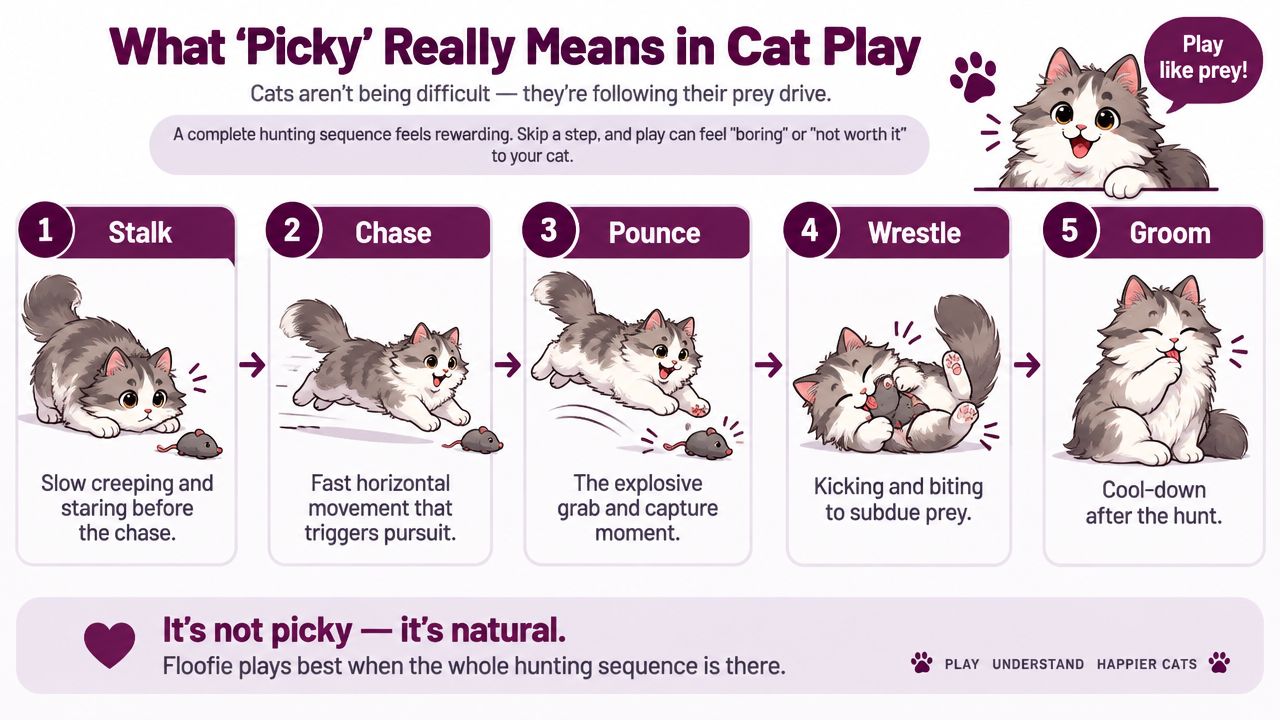
Read the stage your cat chooses
Give your cat a calm five-minute observation session. Don't try to force a complete hunt. Instead, notice which stage appears without much encouragement.
- Stalk: Your cat freezes behind furniture, crouches low, or watches a toy for a long time before moving. Offer hiding places, tunnels, and slow movements that reward patience.
- Chase: Your cat springs into action when a toy skitters horizontally. Use a wand or lightweight lure that darts along the floor, disappears, and reappears.
- Pounce: Your cat waits for the perfect moment, then launches with both paws. A toy that pauses near a rug edge or furniture leg can give this hunter a clear target.
- Catch and kill: Your cat grabs, bites, bunny-kicks, or hugs a toy against the floor. A sturdy kicker or prey-shaped plush can provide the missing payoff.
- Groom: Your cat settles, licks a paw, or relaxes after a successful capture. This cooldown is part of the rhythm, not a sign that the session failed.
A cat that hides behind the sofa may not be lazy. They may be waiting for prey to enter the ambush zone. A cat that flings a toy across the room may care more about the catch than the chase. A cat that bites your toes may be asking for a safer object that satisfies the same capture-and-wrestle urge.
If you're also noticing extra hiding, appetite changes, or a sudden loss of interest in familiar activities, explore this guide on is my cat bored and consider a veterinary check when the change is abrupt. Play preferences can be quirky, but a sudden shift deserves attention.
The Toy Formats Worth Trying First
Toy format is only half the decision. Still, choosing a format that matches the stage your cat naturally performs gives you a much better starting point than grabbing another random multipack.
| Toy Format | Prey Stage Tested | Best For |
|---|---|---|
| Wand or teaser | Chase and pounce | High-energy cats that ignore stationary toys |
| Kicker toy | Catch, bite, and wrestle | Toe-nippers and cats that bunny-kick blankets |
| Food puzzle | Stalk, search, and problem-solving | Curious cats and gentle indoor enrichment |
| Ball or ping-pong ball | Chase and catch | Solo batters who enjoy quick changes of direction |
| Tunnel or box | Stalk and ambush | Shy cats and cats that attack from cover |
| Smart or app-connected toy | Independent chase | Cats that need movement while you're away |
Match the format to the behavior
Wand toys need a human partner, but they're often the clearest test for a cat that ignores still objects. Drag the lure along the floor, pause near a corner, then let your cat catch it. A wand becomes far more convincing when it behaves like prey instead of hovering like a helicopter.
Kicker toys suit cats that want contact. If your cat grabs blankets, bites sleeves, or bunny-kicks your ankles, offer a long fabric toy they can hug safely. Look for secure stitching and inspect it regularly, particularly if your floof plays with impressive chomping enthusiasm.
Food puzzles shift the focus from speed to investigation. They're useful for cats that prefer sniffing, pawing, and working out a small problem. Start with an easy setup so the cat gets a successful result rather than giving up at the puzzle entrance.
Balls work well for independent players, especially when they enjoy batting objects across hard floors. Ping-pong balls and cat-specific balls can test whether your cat prefers small, fast-moving prey. Tunnels and boxes add the cover that many cautious cats need before they'll commit to a pounce.
For browsing options beyond toys, PetScy cat care products provides a broader cat-care collection that can help you think about play alongside the rest of the home setup. FloofChonk also has a practical guide to pet toys for cats, including wand and teaser considerations.
Smart toys can provide movement when you're unavailable, but they shouldn't become the only play outlet. A machine can move unpredictably, while you can notice hesitation, adjust the speed, create a hiding moment, and deliver the satisfying catch. That personal timing is often the difference between “interesting” and “I must hunt this immediately.”
Motion, Scent, Texture, and You
Your cat may chase one toy across the room, then inspect an identical-looking mouse and walk away. The difference often comes from the toy's motion, smell, texture, sound, or the way you control it. Read those preferences first, then choose formats that follow your floof's play rules.
As noted earlier, cats showed more interest in moving toys than stationary toys, while scented stationary toys held attention longer than unscented ones. That pattern does not crown one universal winner. It gives you a useful testing plan: change one trigger at a time instead of trusting the toy's label.
Score each category from 1 to 5 during short home tests. The score is not a scientific personality type. It is a personal shopping shortcut that helps you remember what made your cat's whiskers point forward.
| Trigger | What It Activates | Quick Home Test | Stacking Tip |
|---|---|---|---|
| Motion | Pursuit and pounce | Drag paper slowly, then dart it sideways | Pair motion with a hiding place |
| Scent | Investigation and play interest | Present unscented and scented objects separately | Add an appropriate scent to a prey-shaped toy |
| Texture | Paw and mouth feedback | Compare plush, crinkle, and rough fabric | Match texture to the preferred bite or bat |
| Sound | Attention and orientation | Rustle paper near, not on, the cat | Use quiet sound for cautious players |
| Human involvement | Timing and hunt structure | Move the same toy in several patterns | Combine your timing with pauses and a catch |
Catnip isn't the whole scent story
Catnip appeals to many cats, yet some ignore it entirely. A cat that rejects a catnip mouse may still enjoy scented play. Silver vine offers another scent to test, and the silver-vine study reported increased play behavior with that olfactory enrichment.
For a plain-language explanation of why responses vary, read what catnip does to cats. Test one trigger first, like a scent on a motionless toy. Once you know what earns attention, combine compatible cues, such as a moving prey-shaped toy with a texture your cat likes to bite or bat. More cues do not automatically mean more excitement. Floofie votes for small experiments, careful observation, and a satisfying catch. 🐈
The Joy of Rotating Just a Few Toys
A toy pile can become background furniture, even for a cat who once chased everything. Keep the larger collection stored and present only a small selection. Older advice suggests keeping 4–5 toys in rotation from a collection of 20, as described in the enrichment guidance noted earlier. The practical lesson is simple: novelty comes from presentation, not endless purchasing.
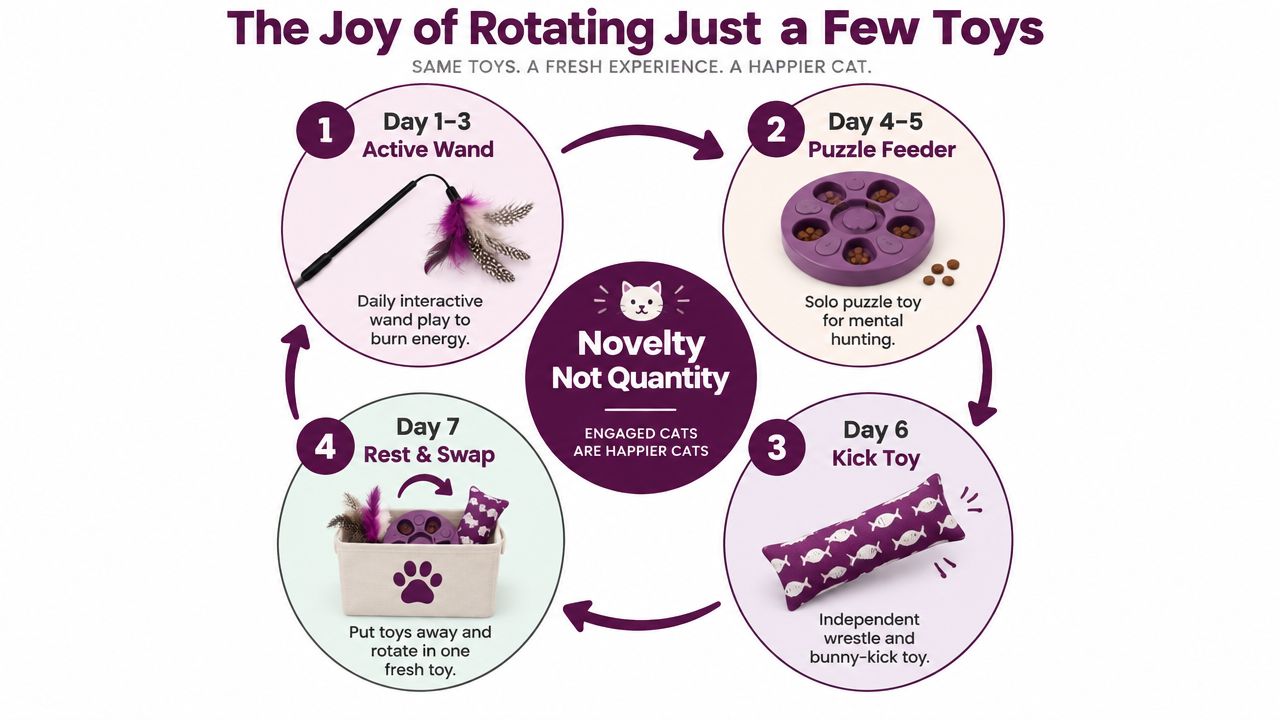
A small cycle for a kicker-loving cat
Keep one active toy visible and store the rest in a labelled bin. A weekly pattern could work like this:
- Days 1–3: Use a wand for interactive play, then leave one trusted kicker out for independent wrestling.
- Days 4–5: Store the wand and offer a scent-infused kicker or puzzle feeder.
- Day 6: Move the kicker to a new location and introduce a ball or tunnel for contrast.
- Day 7: Put away the visible toy, then return the original from a different presentation spot.
If your cat adores kickers and ignores other formats, change the setting before buying another product. Place the kicker inside a paper bag with its handles removed, tuck it beneath a towel ridge, or position it behind a sofa corner. The same toy can become interesting again when it appears like prey, vanishes briefly, and invites an ambush. Floofie's favourite toy may need a better entrance.
Rotation rule: Keep one toy out and place three in storage. Label the bin by trigger, such as “scent,” “chase,” or “wrestle,” so the next experiment is easy to choose.
A weekly rotation takes only a few minutes. Inspect or wash toys when appropriate, remove damaged pieces, and record which presentation earned attention. Over time, the toy closet becomes a small library of play rules rather than a junk drawer.
DIY Cat Toy Tests You Can Run Tonight
Before buying a specialised toy, run a low-cost preference test with safe household materials. These probes won't diagnose every play rule, but they can tell you whether your cat leans toward ambush, batting, enclosed spaces, scent, or wrestling. Floofie calls this “market research with whiskers.” 🐾
The toilet-roll peek-a-boo tube
Materials: An empty cardboard toilet roll and a small toy or treat.
Setup: Fold or pinch one end, place the object inside, and leave the opening easy to access. Roll it a short distance across the floor, then let it stop near a piece of furniture.
Watch for: Does your cat reach into the tube, stalk it, or strike at the opening? Pawing and waiting suggest an interest in enclosed prey and ambush play.
Buying decision: Strong engagement points toward tunnels, boxes, and interactive toys that disappear from view. If your cat ignores the tube but reacts to a moving lure, test a wand before investing in hideaway formats.
The ping-pong-in-a-box puzzle
Materials: A shallow cardboard box and a ping-pong ball.
Setup: Place the ball inside and make sure your cat can reach it comfortably. Move the box slightly, then leave it still.
Watch for: Does your cat bat through the opening, chase the ball when it escapes, or lose interest once the ball stops? This test separates batting interest from a need for open-floor motion.
Buying decision: Paw strikes and repeated attempts support ball tracks, puzzle toys, or lightweight solo toys. No reaction may mean the enclosed space is more confusing than engaging.
The sock kicker
Materials: A clean sock, dried silvervine, and a small piece of mylar.
Setup: Put the filling inside, knot the sock securely, and supervise the first session. The toy should be large enough that your cat can't swallow it.
Watch for: Sniffing, hugging, biting, and bunny-kicking suggest a scent-driven catch-and-kill preference. If your cat ignores the sock entirely, skip kickers for now and invest your testing time in a wand or tunnel.
For more household experiments, see DIY cat toy ideas. Remove loose string, buttons, feathers, mylar scraps, and any part that begins to tear before play starts. Supervise new DIY toys, and retire anything that breaks into swallowable pieces.
Myths About Picky Cats Worth Forgetting
Picky-cat advice often goes wrong because it treats a mismatch as a personality flaw. These five beliefs make play harder than it needs to be.
| Myth | Truth | Try Instead |
|---|---|---|
| Cats outgrow play as adults | Adult cats can still need prey-like enrichment | Match intensity to age and comfort |
| A rejected toy is dead forever | Presentation and novelty can change the response | Reintroduce it in a new location or movement pattern |
| An inactive cat is lazy | Low engagement can reflect a mismatch, discomfort, or illness | Watch for sudden changes and contact a vet when needed |
| Battery toys replace people | Machines can move, but they can't read your cat's timing | Use automated toys as a supplement |
| Expensive means better | A simple object can win when it matches the prey profile | Test the format before the price |
Myth one and two
Adult cats may play differently from kittens. They might prefer deliberate stalking, a short ambush, or a quiet wrestle instead of frantic bouncing. Don't judge success by noise or athleticism. Look for focused attention, purposeful movement, and a satisfied cooldown.
A toy ignored on its first outing may need a different introduction. Store it, change its location, refresh the movement, or present it near a favourite hiding place. A scent that was overwhelming in the open may become more appealing when the object appears as part of a short hunt.
Myth three and four
A sudden drop in play deserves more than a new shopping spree. Pain, stress, or illness can change how a cat moves and responds. If the change comes with hiding, appetite shifts, or other unusual behavior, schedule a veterinary assessment.
Battery-powered toys can help when you're busy, but random movement doesn't always complete the hunt. Your wand technique can create pauses, escapes, cover, and a deliberate catch. Use automation for variety, then keep human-led play in the routine.
Myth five
Price doesn't reveal prey fit. A basic ping-pong ball may be thrilling to a cat that loves fast batting, while a robotic mouse may fail if its motion or size feels wrong. Test the preference first, then shop for durability and safety within that format.
Floofie's Purr-fect Play Checklist
Your cat doesn't need a larger basket. They need a clearer experiment. Use this checklist to turn every ignored toy into useful information.
- Watch for two days. Note whether your cat reacts to fast horizontal movement, fluttering motion, crinkle, a particular texture, scent, or your direct participation. Record the moment attention begins, not only whether a full chase follows.
- Match one format to the strongest trigger. Choose a wand for chase, a kicker for wrestling, a puzzle for investigative pawing, a ball for solo batting, a tunnel for ambush, or a smart toy for extra independent movement. Start with one focused test instead of filling the room with options.
- Run the three DIY probes. Try the cardboard tube, ping-pong box, and sock kicker. These simple tests help separate hiding, batting, scent, and capture preferences before you commit to another commercial purchase.
- Create a small rotation. Keep four or five toys available from a wider collection, then swap them on a weekly rhythm. Store the rest in labelled bins by trigger, and reintroduce favourites in new locations.
- Keep a short play log. For 14 days, write down the time of day, session length, toy format, trigger, and pounce rate. The number 14 days comes from this practical tracking plan, not from a cited study, so treat it as a useful editorial experiment rather than a scientific benchmark.
Let the clues guide the next purchase
If your cat watches but won't chase, slow the toy down and add cover. If they chase but don't settle, make the toy catchable. If they sniff catnip and leave, test silvervine or remove scent from the experiment entirely. If they suddenly stop playing, pause the toy search and consider their health.
Picky cats are connoisseurs, not problems. Every snub narrows the mystery. Floofie's official verdict: observe first, test cheaply, rotate thoughtfully, and let your cat write the rules. 😸
FloofChonk offers cat supplies and toys, including the handmade Leaf Stick Chunkle Puff catnip toy, alongside playful cat-themed apparel and accessories. Visit FloofChonk to find a feline-friendly option for your next play experiment and give your discerning floof something worth investigating.