
How to Read Cat Body Language: Ears, Tail and Eyes

Your cat slow blinks at you from the sofa, flops onto her side, and shows that irresistible belly. You reach in for a gentle rub, and she grabs your hand, kicks, and bolts. 🐾 Don't worry, you haven't failed cat parenting. You've just met the classic mix up that learning how to read cat body language helps you avoid.
Cat Body Signals at a Glance
That slow blink probably did mean trust. The exposed belly probably meant comfort too. Neither one, on its own, meant "please touch my tummy."
Cats rarely send one clear signal at a time. They send a bundle, and your job is to read the bundle before you act. Think of it as checking the whole weather forecast, not just looking at one cloud. ☁️
That bundle is bigger than many first expect. In work reported by Science on cats and their nearly 300 facial expressions, researchers studied 53 domestic shorthair cats, recorded 194 minutes of cat to cat interactions, and used CatFACS, a facial movement coding system, to sort what they saw.
They found 26 distinct facial movements that combined into 276 different facial expressions. About 45% were clearly friendly, 37% were clearly aggressive, and 18% were ambiguous. Friendly moments tended to show ears and whiskers turned toward the other cat. Unfriendly moments more often showed those features turned away.
Your Quick Reference Table
Use this table like a cheat sheet. Find what you're seeing, then check whether two or three rows point the same way before you reach in.
| Signal | Relaxed and friendly | Uneasy | Fearful or defensive |
|---|---|---|---|
| Ears | Upright or turned forward | Turned sideways or slightly back | Flattened or rotated backward |
| Eyes and pupils | Soft, half closed, slow blinks | Wide open, pupils a little larger | Wide, pupils dilated, staring |
| Whiskers | Relaxed and forward | Pulled slightly back or stiff | Pulled back flat or splayed out |
| Tail carriage | Upright, tip gently curved | Lowered or held close to the body | Puffed up or tucked tightly |
| Body posture | Loose, sitting or lying, belly may show | Low, limbs tucked, head level | Flattened near the ground, head lowered, ready to flee |
How to Use the Table in Real Life
Say your cat has forward ears and soft eyes, which look welcoming. Then you notice a stiff, puffed tail and a body that isn't loose at all. That's not a green light. That's a mixed message, and mixed messages mean pause.
Floofie's rule: One friendly signal is a hint. Two or three signals pointing the same way are a reading. 😺
Screenshot the table for your phone. It's handy when guests visit, when kids want to say hello, and when you're trying to describe what you saw at a vet appointment. A little paws and check moment now saves a lot of confusion later.
How to Assess Your Cat in Five Steps
A cat can look pettable from the doorway and still be asking for breathing room up close. Run this routine before petting, not after a scratch. It takes a couple of minutes, then it starts feeling like second nature. 🐾
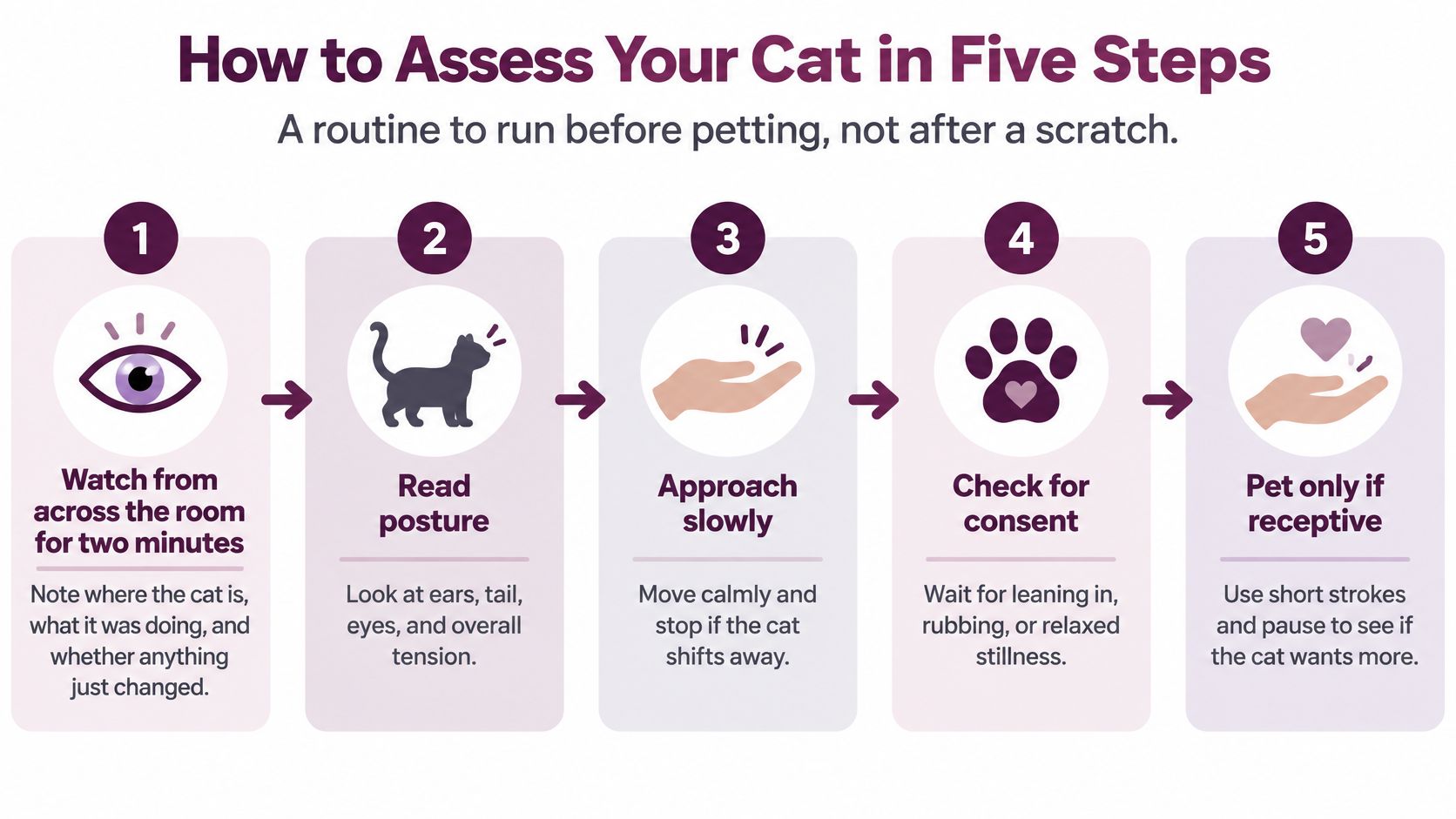
The Five Step Check
- Watch from across the room for two minutes. Note where your cat is, what she was just doing, and whether anything changed: a visitor arriving, the vacuum starting, dinner landing in the bowl. Context changes what every cue means. Slip to avoid: walking straight up while staring, because many cats read a direct stare as a challenge.
- Set your baseline. Ask how this cat normally looks when she is content. Some cats have a naturally stern resting face, while others look worried when they are only listening to a noise in the hall. Slip to avoid: comparing your cat to a cat in an online photo instead of to herself yesterday.
- Check ears, eyes, whiskers, and tail in order. Count how many cues agree. One signal is a hint, while three converging signals give you a reading you can act on. Slip to avoid: stopping at the tail because it is the easiest part to see.
- Read posture and movement together. A loose, sprawled body tells a different story from a low, tucked body or a completely frozen one. Movement matters too, since a cat who leans in is choosing contact and a cat who shifts away is choosing space. Slip to avoid: treating stillness as consent, because a frozen cat can be frightened while looking quiet.
- Watch whether signals ease or intensify. Give it five to ten minutes when you can, and reassess whenever the room changes. A doorbell, a new dog smell, or a child running past can flip the picture fast. Slip to avoid: locking in your first impression and ignoring the update.
Why Snapshots Mislead You
This slower method matters because quick guesses are often unreliable. Research on people judging cats' emotional states from video suggests that fast reads miss a lot, even when the person feels confident. Several observations across time beat one confident glance every time. 🧶
A useful habit is to name the change out loud: "Ears were forward, now they are sideways," or "She was stretched out, now she is tucked." It keeps you honest and shows you which way the mood is moving.
If your cat's signals drop suddenly from her normal baseline, treat it as a health question rather than a mood puzzle.
Withdrawal, a hunched posture, reduced movement, or persistent facial tension all deserve that shift in thinking. You are being observant, and that is exactly what your cat needs from you.
Tail Flicks, Purrs and Hisses Decoded
Start with the tail, but watch its speed as much as its position. A slow curl or gentle wave of the tip during a calm approach is friendly. Rapid swishing tells a very different story.
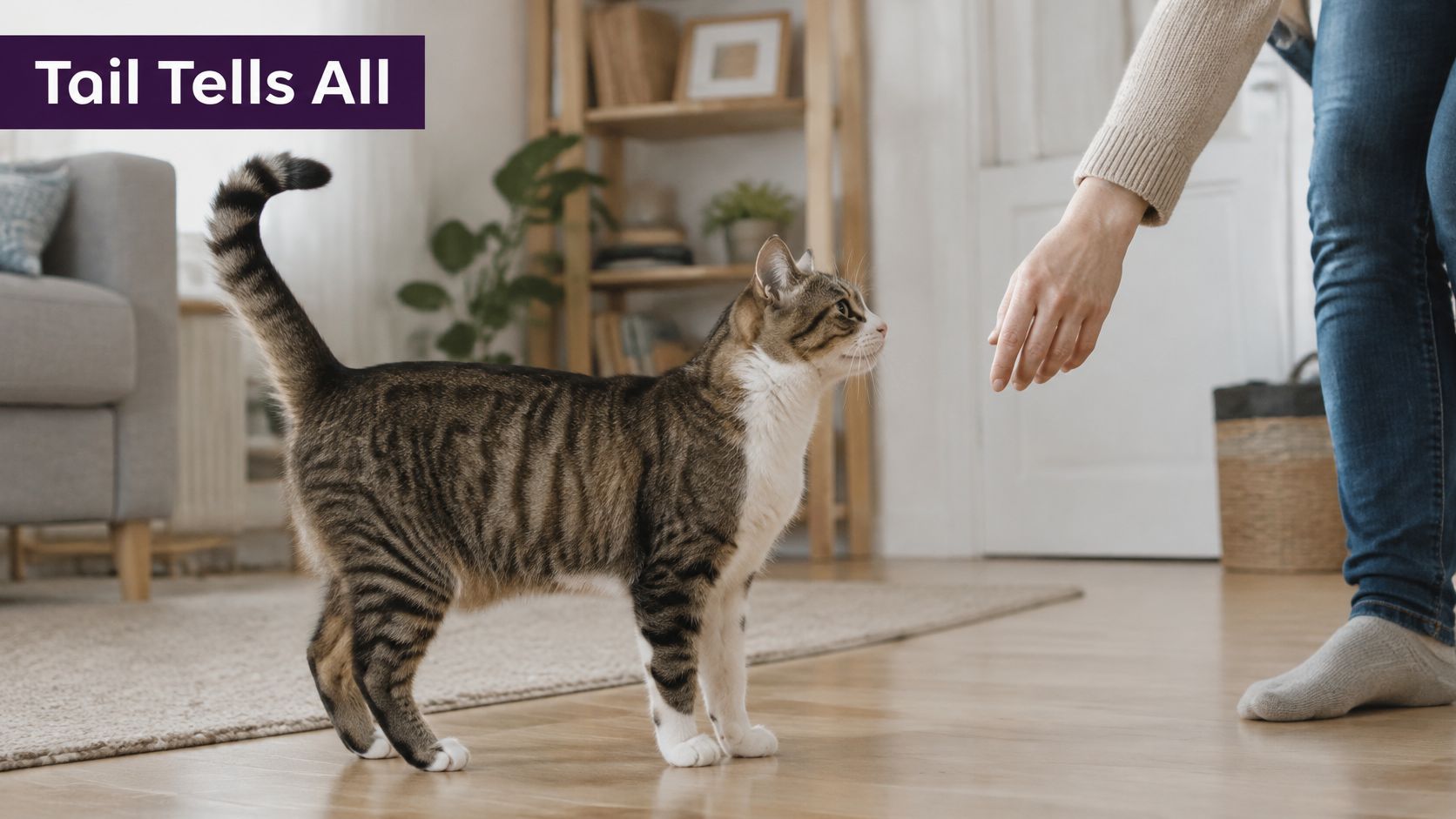
VCA Hospitals guidance on cat sounds and tail movement explains that rapid wagging, swishing, thumping, or thrashing usually indicates irritation or anger, including discomfort with petting or the end of play. A low tail or tail tucked between the legs may indicate fear, anxiety, or pain, and a puffed tail commonly signals that the cat feels threatened.
A small tail tip twitch is the exception that catches people out. If your cat is locked onto a bird outside the window, that twitch is likely hunting focus, not annoyance. Same body part, different context, different meaning.
Sounds and Signals in Context
| Signal | Usual meaning | Context to check | Good response |
|---|---|---|---|
| Slow tail tip curl or wave | Friendly, relaxed | Calm approach, relaxed body | Offer a finger to sniff |
| Rapid swish, thump or thrash | Irritation or overstimulation | Just after petting or ending play | Pause and step back |
| Small tail tip twitch | Focused hunting | Watching a bird at the window | Let it watch and add a toy |
| Purring | Contentment, sometimes self soothing | Is the body loose or tense? | Keep petting only if the body stays relaxed |
| Chirp or trill | Greeting or asking for attention | Friendly face and upright tail | Greet back softly |
| Hiss or growl | Warning or defense | Cornered, unfamiliar, or in pain | Give space and do not reach |
| Yowl | Distress, mating, pain or confusion | Repeated or at unusual hours | Compare to baseline and call a vet if new |
| Spraying | Territory marking or stress | Vertical spray on walls or new objects | Clean with an enzyme cleaner, look for stressors, and call a vet if sudden |
| Cheek rubbing | Friendly scent marking | Rubs on you, furniture or doorframes | Accept it as a comfort signal |
Purring deserves a special note because it fools almost everyone. A loose, kneading, slow blinking cat who purrs is usually content. A tense, hiding, ears back cat who purrs may be soothing herself while she hurts or feels stressed, so always check the body alongside the sound. 🎵
If you want to go deeper on tail positions alone, our guide to what cat tail positions mean walks through each shape with examples you can compare at home.
Watch how these signals combine in motion, then try naming the context before you name the emotion.
When you're unsure anywhere, ask three questions. Where is the cat, how fast is she moving, and what happened right before? Those answers will steer you better than any single flick, purr, or hiss.
Telling Fear, Play and Overstimulation Apart
A cat who pounces, shows huge pupils, and grabs your sleeve might be playing. She might also be overstimulated and about two seconds from biting. A cat who crouches and freezes isn't playing at all, even if the crouch looks identical at first glance.
Single cues are unreliable here, because the same signal shows up in all three states. Pupils widen for fun and for fear, and a twitching tail can mean either mood. So read the whole cat: play tends to stay loose, bouncy, and easy to interrupt, fear goes low, tight, and still, and overstimulation builds tension until it spills over. Compare what you see with your cat's everyday look, then watch whether the signals ease or climb.
The Posture Traffic Light
Many cat behavior guides sort posture into a green, amber, red framework. In the relaxed zone, a cat may lie on her side or sit upright without obvious tension, stretch out or expose her tummy, and hold her tail vertically with a gently curved or waving tip.
A more concerned cat sits low with her limbs tucked, shows partially backward or downward ears, and may swish or twitch her tail. A highly fearful cat flattens her body close to the ground or presses into a corner, keeps all four paws ready for escape, lowers her head and neck, tucks her tail tightly, or raises her fur.
Think green, amber, red. 🚦 Green means you can offer interaction and let your cat decide. Amber means slow down, reduce noise and movement, and watch which direction she moves. Red means stop, create distance, and let her recover without being followed, picked up, or coaxed out for a cuddle.
Your Situation Playbook
| Situation | Signals to expect | Safe response | Stop when |
|---|---|---|---|
| Petting | Slow blinks, leaning in | Stroke cheeks and chin, keep sessions short | First skin twitch or tail thrash |
| Meeting a guest | Calm and curious, or hiding with flattened ears | Let the cat approach, sit still, toss a toy from a distance | Cat hides or hisses |
| Play session | Pouncing with a loose body, or tense body with frantic bites | Use a wand toy and take a break every few minutes | Tail lashing, ears pinned back, aggressive grabs |
| Carrier or vet visit | Relaxed and sniffing, or crouched with ears back | Cover the carrier, keep voices low, pair with treats | Panting, huge pupils, frozen or hissing |
| New shirt or collar | Ignoring it, or rubbing the face and freezing | Short try on sessions with treats nearby | Repeated pawing, shedding or hiding |
Say a guest arrives and your cat trots in with an upright tail, sniffs a shoe, and rubs a chair leg. That's curiosity, so let her set the pace. If she instead slides under the bed with flattened ears, that's a clear no, and the kindest response is to close the bedroom door and let her skip the party. 🎉
Play sessions follow the same logic. A loose body, sideways hops, and breaks where your cat looks away and resets are healthy signs. Frantic grabs, pinned ears, hard biting, and a lashing tail mean the game has tipped over, even if it started happily two minutes ago. The giveaway is the shift: fun play pauses and restarts, while overstimulation only escalates.
New accessories need the same respect. A cat who freezes in a new shirt is overwhelmed, and repeated pawing at a collar is a stress signal worth taking seriously. Short try on sessions with treats help, and if stress keeps showing up, our advice on how to calm a stressed cat gives you gentle ways to lower the pressure.
The stop point matters more than the start. When the tail starts lashing or the skin along the back starts twitching, end the stroke or put down the toy instead of pushing for one more minute.
Ending early builds trust. It's how your cat learns that you listen, and cats who feel heard tend to come back for more interaction later. That's the purrks of paying attention, if you'll forgive Floofie one pun. 😸
When Body Language Signals Pain or Illness
A quiet cat can still hurt. That's the assumption worth challenging, because pain in cats rarely arrives with a dramatic yelp. Think back to the whole-cat method: compare what you see with your cat's own baseline, combine several signals, and watch whether things ease or escalate over days.
Instead, you might notice reluctance to jump onto a favorite perch, less grooming, a smaller appetite, or changes in litter box habits. Play may shrink, sleep may shift, and a normally patient cat may snap when a sore spot is touched. One signal alone proves nothing, and a cat doesn't need to show all of them to need help. A single skipped meal is a blip; a skipped meal plus a hunched posture plus hiding is a pattern worth acting on.
Using the Feline Grimace Scale as a Screen
The Feline Grimace Scale gives you a repeatable way to check the face. The validated Feline Grimace Scale study in Scientific Reports used four observers and 110 images, reporting strong correlation with another pain instrument at ρ = 0.86, good inter rater reliability at ICC = 0.89, and excellent intra rater reliability at ICC > 0.91.
Score five facial action units, namely ear position, orbital tightening, muzzle tension, whisker change, and head position. Give each one 0 for absent, 1 for moderate, or 2 for clearly present, for a total from 0 to 10. Squinted eyes, ears rotated outward, whiskers pushed forward, a tense muzzle, and a lowered head are the pieces to look for.
Score from a distance before handling, then repeat after a short interval. Skip the scoring if your cat is grooming, eating, heavily sedated, or hard to see clearly, because those moments distort the face you're trying to read.
Know the Limits of Any Score
A number helps you track change, but it doesn't remove judgment. Feline pain scales often agree only partially when different tools or observers score the same cat, which is exactly why your own observations matter so much.
So don't trust one score taken once. Write down repeated scores, add notes about appetite, movement, grooming, and touch tolerance, and look at the trend. A friendly cat can still be uncomfortable, and a defensive cat may be protecting a sore spot rather than showing a bad temperament.
Litter box changes deserve prompt attention too. Straining, frequent small trips, crying in the box, or blood in the urine should never be dismissed as spite or mood. If that is what you're seeing, blood in cat urine explained from Bandana Rx is a helpful next read while you contact your vet.
Urgent Signs That Need a Vet
- Not eating for a day or more: Especially if it's paired with hiding or lethargy.
- Straining in the litter box: Repeated attempts with little or no urine passed.
- Labored or open mouth breathing: Treat this as urgent, not as simple stress.
- Hiding far beyond normal: A sudden, persistent change from baseline.
- Sudden aggression or crying when touched: A possible pain response, not naughtiness.
Here's the line where your reading skills hand over to professional help. Body language supports observation, and it never replaces a veterinarian's assessment or rules out illness on its own. When in doubt, call. 📞
Build Trust and Start Reading Your Cat Tonight
Reading your cat well turns into trust surprisingly fast. Cats notice when you respect a no, and they remember when you stop before things get tense. 🐾
Three Habits That Build Trust
- Slow blink back: Soften your eyes and blink slowly, then look slightly away. It's a classic trust signal, and many cats answer in kind.
- Offer a finger to sniff: Hold it still at nose level and let your cat come to you. If she rubs her cheek against it, she's choosing contact.
- Leave easy exits and high perches: A cat who can leave freely is a cat who can relax near you. Choice is what makes closeness feel safe.
Keep play sessions short and finish while things are still going well. A wand toy works beautifully, and an interactive option like the UFO cat toy from FloofChonk can keep curious paws busy while you watch ears, pupils, and tail speed for the first signs of too much excitement. Stop at the first tail thrash, offer a calm pause, and let your cat reset. 🧶
Floofie, our mascot and chief toy tester, has one house rule. Check three cues before you decide. Ears, eyes, and tail will usually tell you whether to lean in, slow down, or back off, and posture confirms the call.
If you'd like more trust building ideas, our guide on how to build trust with a cat breaks the process into small, cat led steps you can use with shy, new, or rescue cats.
Your Two Week Practice
Try a one minute daily log at the same time each day for two weeks. Note ears, eyes, tail, and posture, plus one line about context, like after dinner, during a storm, or when guests arrived. By the end of the first week, you'll know your cat's normal. By the end of the second, changes will stand out without guesswork.
Tonight, pick one cat and one situation, perhaps petting on the sofa or play before dinner. Observe before you touch, count three cues, and write down what you saw. Small, repeatable, and very doable, even on a busy evening. 🌙
Read the whole cat, then decide.
FloofChonk offers cat themed apparel, accessories, home décor, and playful pet products, including interactive toys you can use for short, cat led play sessions while you practice reading ears, eyes, tail, and posture. Every item gets a paw of approval from Floofie before it joins the shop. Visit FloofChonk to find a toy or gift that fits your cat's personality and your new whole cat reading skills.