
Cat Head Bump Meaning: Why Cats Bonk and What to Do

A cat head bump, called bunting, is usually a friendly, scent-based greeting rather than random contact; the context table below will help you read your cat's message. 🐾
You've barely settled into your chair when a furry forehead meets your chin. Before you lean in for another bonk, notice what your cat does next: staying close invites a different response from walking away. Floofie, our mascot, would approve of enjoying the greeting without turning it into an unexpected cuddle appointment.
What a Cat Head Bump Usually Means
A head bump can combine greeting, social bonding, scent marking, attention seeking, and reassurance. Cornell's CatWatch guidance on head rubbing describes it as normal feline communication that helps make people and objects feel familiar; cats may also rub when anxious as part of a comforting routine.
Head bump contexts and what they usually mean
| Context | Usual meaning | Best response |
|---|---|---|
| Greeting when you walk in | Hello, familiarity and a scent check | Return a slow blink and say hi |
| Bumping your hand or face while you sit | Affection and a request for attention | Stroke briefly, then pause |
| Bumping a new bag, box or chair | Marking a new object as familiar and safe | Let it happen, no action needed |
| Bumping you after time apart | Reassurance and rebuilding shared scent | Stay calm and offer a quiet greeting |
| Bump followed by flattened ears or tail lashing | Overstimulation or a wish for space | Stop touching and give room |
Read the greeting rows as invitations, not demands. A cat approaching your hand might welcome attention, while a cat investigating a delivery box may be busy making that interesting new object feel familiar.
Read the Whole Cat
Relaxed posture, slow blinks, purring, and continued proximity support a positive interpretation. A stiff body, flattened ears, or a quick retreat means you should leave room rather than pursue another interaction.
Say your cat bonks your chin when you sit down after work. That can be a hello combined with familiar scent communication, rather than a request to be picked up.
A friendly bump tells you something about this moment. It doesn't grant permission for everything that follows.
The important exception is a cat persistently pressing its head into a wall or corner without a social target. That's a different behavior, and it needs a different response.
Head Pressing Versus Head Bumping and When to Call the Vet
Bunting is brief and social; head pressing is sustained pushing against a hard surface without a social target. Don't judge by the furniture alone. A relaxed cheek rub along a sofa isn't the same as a cat holding its forehead against a corner.
Head bunting versus head pressing
| Sign | Head bunting | Head pressing (see a vet) |
|---|---|---|
| Target | A person, animal or familiar object | A wall, corner, floor or furniture with no social target |
| Force and repetition | Brief, gentle bumps followed by normal movement | Persistent, sometimes forceful pushing that continues |
| Body language | Relaxed, purring, slow blinks | Disoriented, pacing, circling or stumbling |
| Duration | Brief contact, then the cat moves on | Sustained contact rather than a passing rub |
| Other symptoms | No accompanying illness signs | Vision changes, seizures, vomiting, collapse or sudden behavior change |
| What to do | Respond gently or leave the cat undisturbed | Remove hazards, note onset and contact an emergency vet now |
PetMD's veterinary guide to head pressing identifies possible causes including forebrain disease, toxin exposure, liver or metabolic dysfunction, vascular injury, and other neurological disorders. The underlying condition can worsen rapidly, so newly appearing or persistent head pressing warrants immediate veterinary assessment.
Act on the Pattern, Not a Stopwatch
You don't need to wait for pressing to continue for a particular length of time. Sustained, abnormal pushing is concerning, especially alongside disorientation, poor coordination, vision changes, or seizures. Collapse, vomiting, or a sudden behavioral change adds to the urgency, as described in PetMD's explanation of headbutting and warning signs.
Take these practical steps while arranging help:
- Make the area safer. Block access to stairs and remove nearby hazards without wrestling with your cat.
- Record what happened. Note when it started and any accompanying symptoms; take a short video only if doing so won't delay care.
- Avoid unapproved medication. Don't give a human medicine or leftover prescription unless your veterinarian directs you.
- Call an emergency veterinary service. Describe the pressing and other symptoms, then follow their transport instructions.
Safety rule: Persistent head pressing is a reason to seek veterinary help, not an experiment in waiting to see whether your cat improves.
How to Respond When Your Cat Bumps You
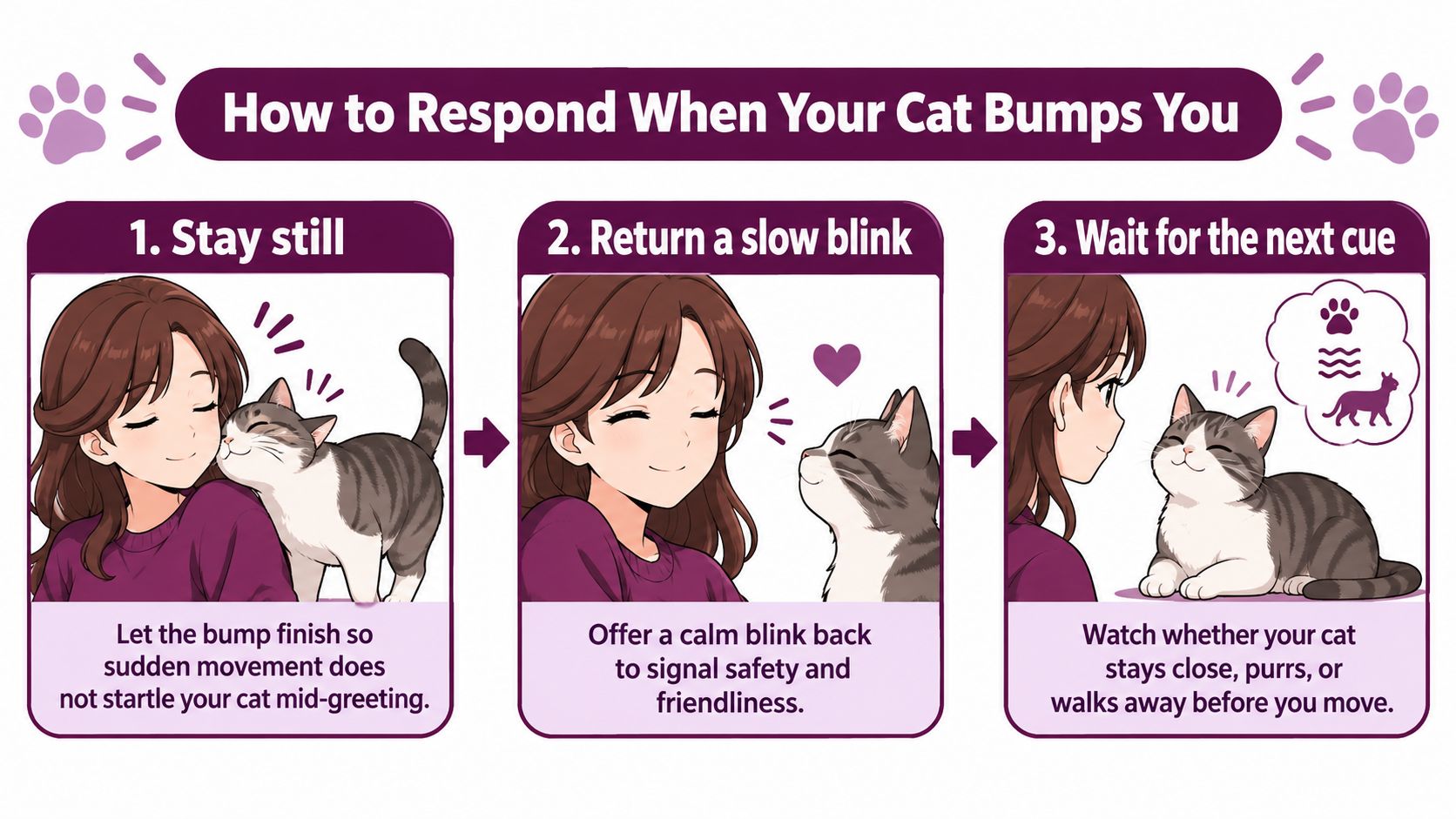
Let your cat start the contact, then keep your response easy to leave. A bump can invite interaction without inviting prolonged handling. Veterinary guidance on why cats rub their faces on people and objects recommends allowing cats to initiate and avoiding restraint or repeated head touching when they show avoidance.
Follow Your Cat's Lead
- Stay still and let the bump finish. Avoid suddenly leaning forward or reaching over your cat. A quiet response gives them room to complete the greeting without being startled.
- Return a slow blink. Keep your expression soft rather than staring directly into their eyes. Think calm acknowledgment, not an intense face-to-face inspection.
- Offer a little contact if they remain engaged. Try a gentle cheek or under-chin stroke rather than immediately picking them up. Keep your hand loose and your touch brief.
- Pause and lift your hand. Wait for your cat to approach again or lean toward you. This makes the next touch their choice, rather than the automatic continuation of your first stroke.
- Watch for a change in comfort. Flattened ears, tail lashing, skin twitching, or a head turning toward your hand can mean it's time to pause. Use this guide to reading cat body language to consider the whole posture rather than an isolated movement.
- Stop when your cat asks for room. Remove your hand and let them leave without following. Don't wait for a bite to make the boundary clear.
Research described in a paper on animal interaction and wellbeing reports a positive relationship between feline rubbing or bunting and wellbeing. That association isn't proof that more human-directed touching is always better; cat-initiated contact and prolonged petting aren't interchangeable.
If your cat keeps returning, repeated short interactions are fine. Holding the head, hugging tightly, or pinning the body removes the choice that made the greeting comfortable.
Teach children and visitors the same simple approach: let the cat bump first, pet briefly, then wait. Floofie's house rule is easy to remember: pawsitive greetings, no chasing. 🐾
The Scent Glands Behind the Bonk
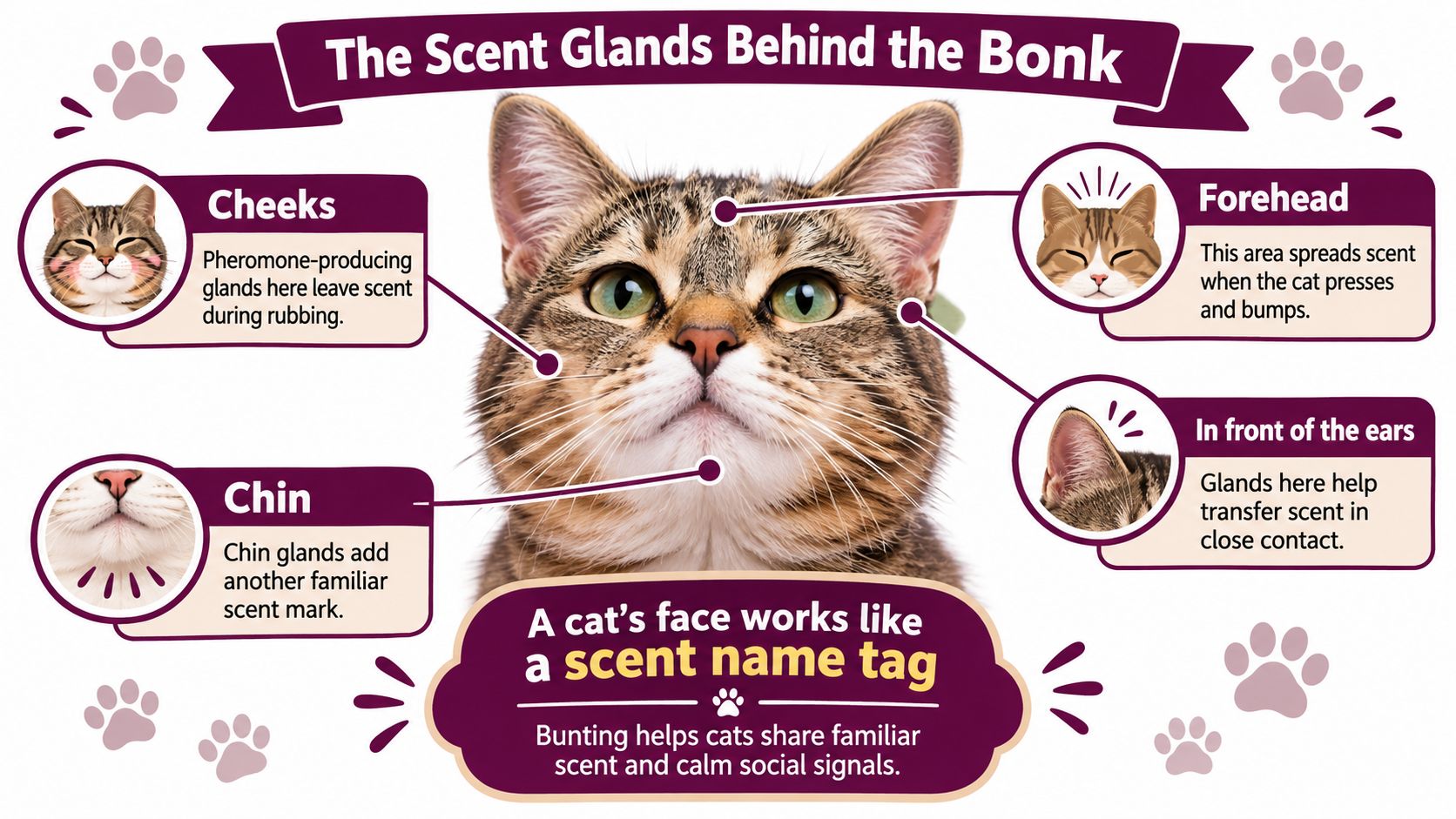
Your cat's face works a little like a scent name tag. When Floofie brushes a cheek against your hand, the greeting includes chemical information you can't usually smell.
Cats have pheromone-producing glands on the cheeks, forehead, chin, and just in front of the ears, according to VCA's explanation of feline headbutting. Pressing or rubbing these areas against a person, animal, or object deposits signals that other cats can detect.
A Familiar Route Through the House
Consider a cat walking past a chair, brushing its cheek along the edge, then approaching your outstretched hand. Those actions share a mechanism, even though one involves furniture and the other involves you.
The chair becomes a familiar scent-marked surface. Contact with your hand can combine scent identification with social affiliation, making affection and chemical communication parts of the same interaction.
Faces, hands, and furniture edges are common targets because they're accessible surfaces cats encounter during everyday movement. Your cat doesn't need a special occasion to refresh that familiar scent.
- On a person: Facial rubbing can communicate comfort, acceptance, and social connection.
- On an object: The same movement can help identify a surface as familiar.
- Across both situations: Context explains the interaction better than calling every rub a claim of ownership.
Scent Signals Aren't Whisker Signals
Whiskers sit close to these facial areas, but they aren't the source of the pheromones deposited during bunting. For a useful companion explanation of facial sensory anatomy, William Tucker Art offers a guide to whiskers for pet owners.
Facial rubbing also differs from urine marking, which has a stronger territorial association. If you're trying to distinguish the behaviors, this explanation of how a cat sprays addresses that separate form of communication.
The practical takeaway is reassuring: a brief, relaxed bonk has a biological purpose. You don't have to choose between calling it affectionate and calling it scent communication. It can be both. 😺
Build a Bump-Friendly Routine at Home
A welcoming routine gives your cat opportunities to approach without making contact an obligation. You're creating a comfortable meeting place, not training for the competitive forehead championships.
Start with places your cat already chooses. If they visit while you read or work, make that spot accessible and keep an unobstructed route away.
Make Greetings Easy to Choose
- Let your cat initiate every time. Never hold their head in position or lift them toward your face to manufacture a bump.
- Offer a convenient perch. A stable chair, window perch, or cat tree beside your desk lets your cat approach without balancing on your keyboard.
- Keep your arrival greeting predictable. Use a quiet hello and a relaxed expression rather than reaching down immediately.
- Choose calm moments. After a meal or nap may work for your cat, but watch their behavior rather than assuming the timing guarantees interest.
- Offer play separately from cuddles. A wand-toy session or an occasional small treat can be part of an enjoyable evening without becoming payment for a bonk.
- Provide safe rubbing surfaces. A sturdy scratching post or clean cardboard box gives your cat places to investigate and personalize.
- Finish while the interaction is comfortable. Let your cat leave without scooping them back for an encore.
Leave Room for Individual Preferences
A cat that chooses the chair beside you instead of your lap can still enjoy your company. Don't turn the absence of a head bump into a test of your relationship.
For a shy cat, success might mean approaching voluntarily and remaining nearby. For an enthusiastic greeter, success might mean enjoying the bonk without escalating into a wrestling cuddle.
Make the invitation available, then let your cat decide whether to accept.
Floofie's ideal routine includes plenty of choice and absolutely no attendance sheet. A bump is a lovely hello precisely because your cat chooses to offer it. 🐾
Track Bumps and Take the Next Step
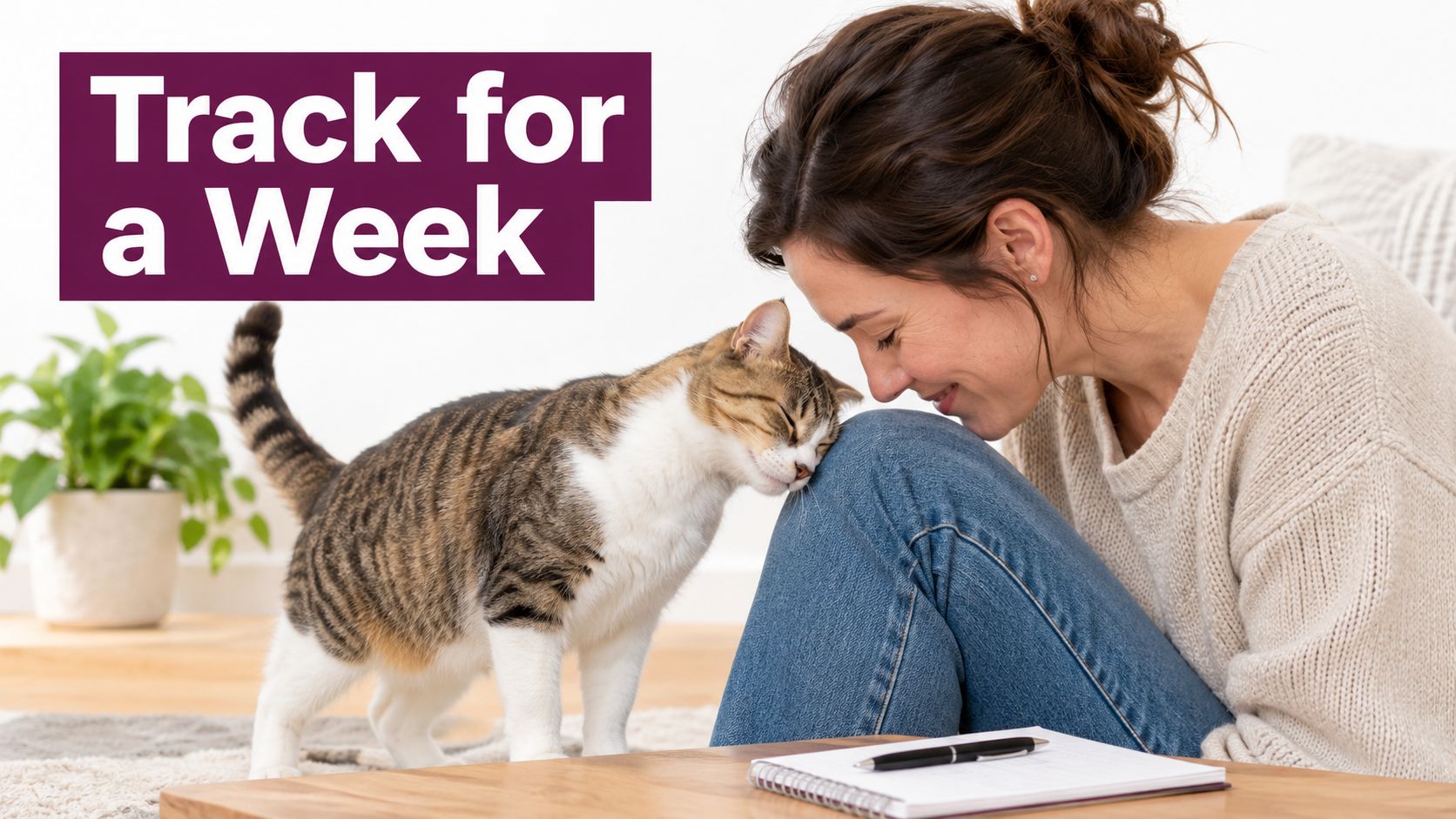
Try keeping a simple greeting log for a week, provided your cat isn't showing urgent warning signs. This is an observation exercise, not a reason to delay veterinary care.
Note the situation and your cat's response rather than counting bonks as a measure of affection.
| What to note | A useful observation |
|---|---|
| When and where | After you arrive home, beside the sofa |
| What happened | Brief forehead contact followed by a cheek rub |
| What happened afterward | Stayed close, purred, or walked away |
| What changed | Seemed uncomfortable or unusually restless |
If greetings remain brief, relaxed, and connected to ordinary routines, keep letting your cat lead. A sudden disappearance, frantic increase, or apparent discomfort deserves a veterinary conversation, particularly with lethargy or irritability.
For the human who gets a daily chin bonk, Floofie-approved cat-lover picks make a playful extra: a cat graphic tee, a morning mug, or wall art beside the favorite greeting chair. Choose a design that celebrates the best part of your day without expecting your cat to pose for the occasion. 😺
Enjoy the familiar little ritual. In everyday human terms, that relaxed bump can feel a lot like being told you're family. 🐾
Multi-Cat Homes and Bump Dynamics
Cats may also bunt familiar cats in the same household. A relaxed exchange can support social connection and familiar scent communication. Sharing an address does not guarantee that every pair wants close contact.
A 2024 Country Living report states that 83% of cats were likely to engage in head bunting with their owners after periods of separation. Reunion greetings like this are common, though individual cats vary.
That finding concerns cats greeting owners, not the rate at which cats greet each other. A reunion bump can suggest reconnection. Your cats' actual behavior matters more than applying that number to a different relationship.
Watch Both Participants
| Friendly exchange | Tense interaction |
|---|---|
| Loose bodies and voluntary approach | Stiff posture or prolonged staring |
| Brief contact with room to move | One cat blocking the other's route |
| Both cats remain comfortable nearby | Growling, avoidance, or one cat leaving |
The receiving cat's choice decides whether a bump is friendly. Watch for a cat that can stay, lean in, or walk away without being cornered. Enthusiasm from the approaching cat is not enough on its own. If the receiver stiffens, hides, or tries to escape, treat the exchange as tense.
A sudden stop in previously comfortable bunting can warrant attention, especially if you also notice avoidance or conflict. Give each cat separate access to food, water, litter trays, resting places, and escape routes rather than expecting them to negotiate everything at close quarters.
For escalating tension, use this practical guide to helping stop cats from fighting. Start by giving the pair space and independent resources. Do not force a shared greeting to prove they are friends again.
FloofChonk offers cat-themed apparel, accessories, and home décor for people whose favorite hello comes with whiskers. Visit FloofChonk to pick a Floofie-approved graphic tee, mug, or wall print that celebrates your household's daily bonk ritual. 🐾