
Cat Workwear Jacket Guide for Fit, Safety, and Style

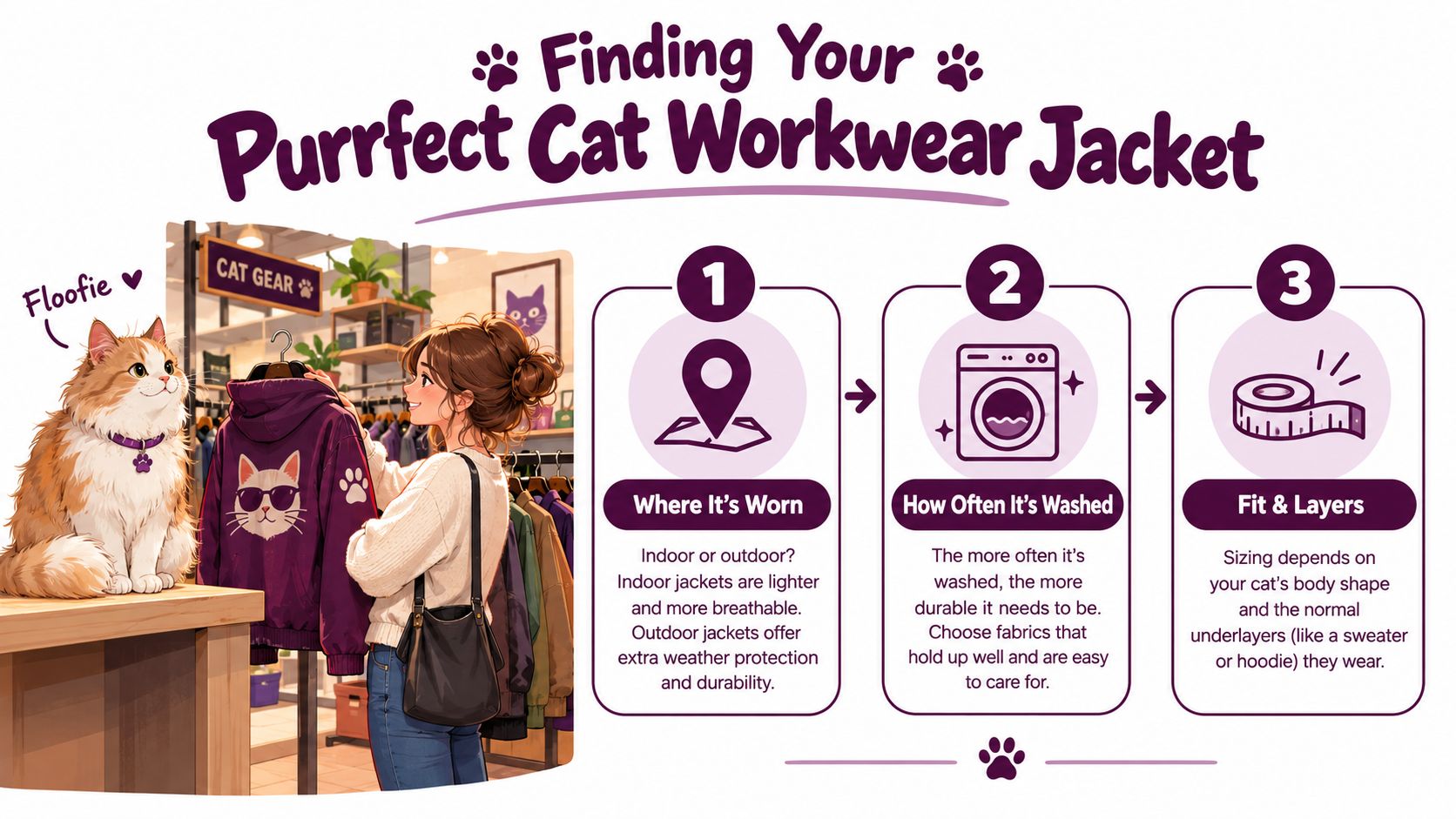
You're holding a jacket with a brilliant cat graphic, checking the pockets, and wondering whether it'll still feel like a good purchase halfway through a busy shift. Beside you, Floofie, our mascot, appears completely sold on the feline artwork. You still need answers about fit, washing, comfort, and what that rugged-looking fabric can handle. 🐾
Finding Your Purrfect Cat Workwear Jacket
On the shop floor, the playful jacket wins your attention. The practical-looking one gets a second look because its cuffs adjust and its pockets seem useful. My advice? Don't choose between personality and practicality until you've checked whether either jacket suits your actual day.
Start with where you'll wear it, how you'll clean it, and what you expect it to do. A classroom layer, a weekend overshirt, and a jacket worn on a hazardous worksite need different buying decisions. Floofie can judge the whiskers on the artwork. You need to judge the garment.
First Questions for a Cat Workwear Jacket
| Reader Need | What to Prioritize | Warning Sign |
|---|---|---|
| A comfortable indoor layer | Manageable lining, easy movement, useful pockets | Heavy insulation with no construction details |
| Frequent washing | Clear care instructions and decoration information | No readable care label |
| Outdoor errands | Weather specifications matched to your conditions | Rain protection implied by appearance |
| Workplace protection | Documented suitability for the identified hazard | Safety language without supporting markings |
Know Which Kind of Cat You're Shopping For
CAT-branded workwear and cat-themed clothing aren't interchangeable. Caterpillar describes how its employee apparel expanded into lifestyle merchandise, showing how industrial clothing crossed into everyday fashion through its history of CAT merchandise.
If you mean the industrial brand, browse the official CAT merchandise range. If you mean feline graphics, judge the jacket independently of that brand's reputation.
I'd buy a cat workwear jacket for its fit and usefulness first, then choose the design that makes me grin. A great graphic deserves a garment you'll reach for, not one that spends its life hanging beside the door.
Match the Jacket to Your Workday
Floofie's office-versus-workshop test is simple: would you choose the same jacket to answer emails and to lean across a workbench? Probably not. A structured silhouette can look right in both places without being equally useful in either.
Office and classroom wear should start with comfort while seated, easy removal, and pockets that don't become awkward against a desk. I'd choose a relatively uncomplicated layer over an insulated, equipment-heavy design. For outfit ideas, these casual Friday work outfits offer a useful starting point without requiring a full utility uniform.
Errands and events leave more room for statement graphics. Choose the jacket you'll enjoy wearing open or closed, carrying a bag over, and taking off when you move indoors. Don't buy outdoor styling when what you need is an easy everyday layer.
Different Jobs Deserve Different Priorities
- Retail teams: Try the jacket while reaching toward shelves and using the pockets you'd need during a shift. Check it against the employer's dress requirements before ordering matching garments.
- Veterinary staff: Ask the practice about permitted outerwear and laundering arrangements. Don't assume a cute feline design makes an everyday jacket appropriate for clinical tasks.
- Light workshop use: Prioritize controlled sleeves, secure closures, and practical storage. Keep the description “light workshop” tied to the actual task, not to how harmless the room looks.
- Hazardous work: Around vehicles, machinery, chemicals, or electrical hazards, stop shopping by style and establish the required protective clothing first.
Practical rule: Choose everyday clothing for everyday comfort. Choose protective clothing through the workplace's hazard assessment, not through a fashion photograph.
For a team purchase, let colleagues try samples rather than asking everyone to select a familiar letter size. Give them room to comment privately on comfort and preferred cuts.
My recommendation is to write a short use description before browsing: “indoor retail layer, worn over a shirt, employer-approved washing.” That's a much better shopping filter than “something tough with cats.”
Measure for a Workwear Fit That Moves
Buy the measurements, not the size label. Your usual size is a starting point, not proof that a particular jacket will fit over your normal clothes.
ISO 13688 addresses protective-clothing ergonomics, sizing, compatibility, marking, and positioning during foreseeable movements and postures. For shoppers, comparing body dimensions with finished-garment measurements makes fit easier to assess alongside those principles, as outlined in the ISO 13688 protective-clothing requirements.
Use Your Own Clothes as a Reference
Start with a flexible measuring tape and a jacket you already enjoy wearing. Choose a reference garment with a similar purpose, rather than comparing a fitted summer layer with a winter work jacket.
- Measure your body: Record chest, waist, and any other dimensions the seller's chart requests, in centimetres. Follow the seller's measurement locations rather than guessing.
- Measure the reference jacket: Lay it flat and record chest width, shoulder width, sleeve length, and back length. Note whether the listing uses flat widths or full circumferences.
- Account for underlayers: Try your reference jacket over the shirt, sweater, or uniform you wear. Don't add an arbitrary allowance when you can test the combination.
- Compare the whole cut: A generous chest won't rescue narrow shoulders, restrictive sleeves, or a hem that catches around your hips.
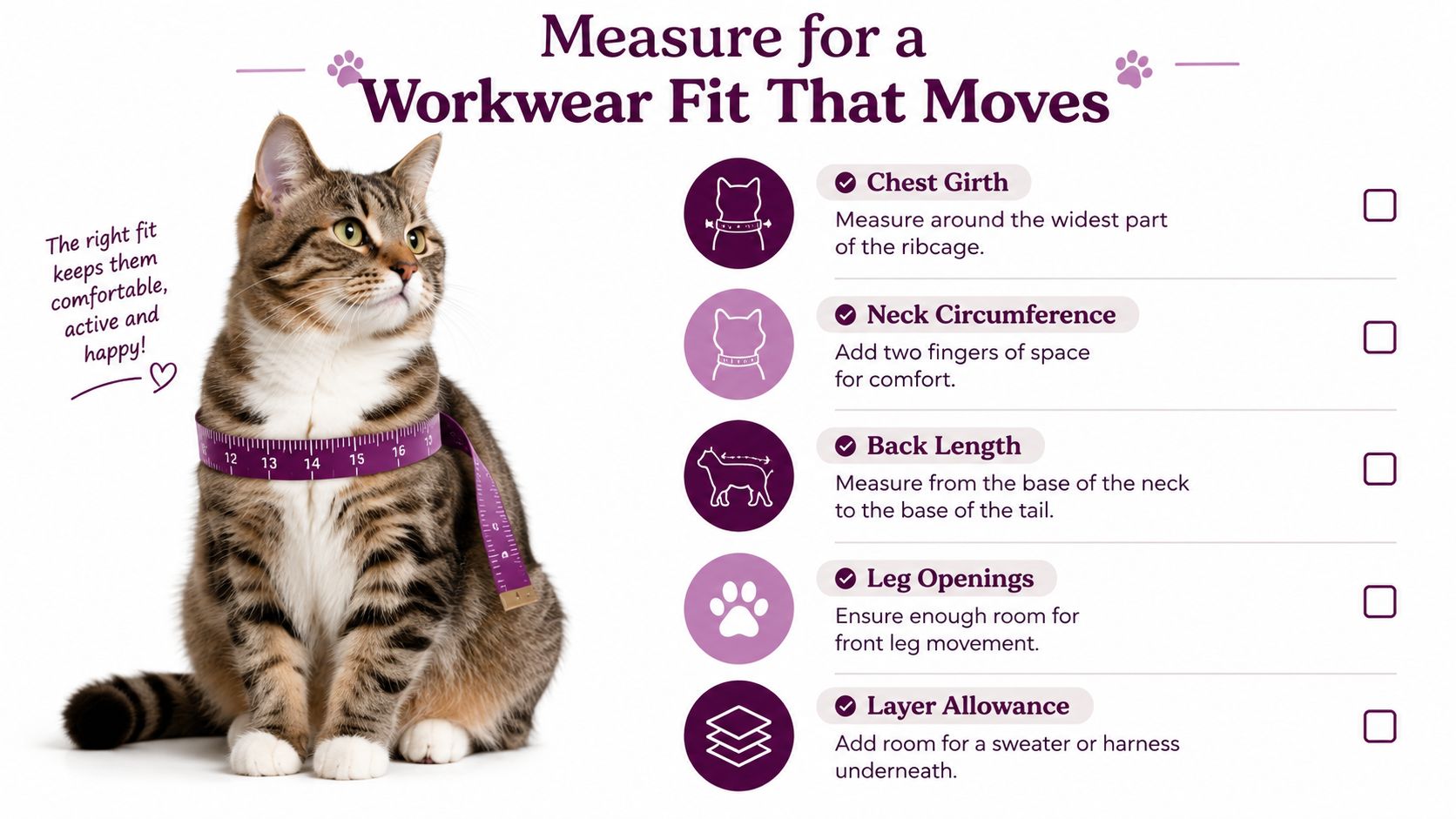
The feline measuring illustration below concerns pet garments. For an adult jacket, use human body and garment measurements, not the cat-specific measuring points shown.
Run a Real Movement Check
Fasten the jacket before judging it. Reach forward as though using a keyboard, lift your arms toward a shelf, sit down, bend, and crouch.
Watch for cuffs pulling away from your wrists, pressure at the collar, pulling across the upper back, and a hem that shifts out of place. Put your usual small essentials in the pockets and repeat the movements. Empty pockets can conceal an awkward position.
If you're choosing between sizes, don't automatically size up. Compare the actual dimensions and ask whether another cut would solve the problem without leaving excess fabric.
Floofie's fitting-room verdict is straightforward: you shouldn't have to negotiate with your jacket every time you move. If it only feels good while you're standing still, leave it on the hanger.
Choose Materials and Details That Work
A jacket can look substantial and still disappoint where you use it most: pocket corners, sleeve edges, closures, and the places your bag rubs. I'd rather see clear construction information than a product description stuffed with “rugged” and “heavy-duty.”
Choose the shell and lining together. A substantial outer fabric with a warm lining is a different proposition from an unlined overshirt, even when the photographs look similar. Ask what you'll be doing while wearing it, not just what the weather will be when you leave home.
Workwear Feature Check
| Feature | What to Check | Best-Fit Question |
|---|---|---|
| Shell and lining | Fabric composition, weight if provided, lining coverage | Will this combination suit my working temperature? |
| Pockets | Opening position, closure, reinforcement, loaded comfort | Can I access essentials without awkward reaching? |
| Front closure | Smooth operation and comfortable backing | Does it work while seated and layered? |
| Cuffs and hem | Adjustment range and secure fastening | Can I control the fit without bunching? |
| Decoration | Position, backing, thickness, and flexibility | Does the design interfere with movement or access? |
| High-wear areas | Reinforced construction and relevant test evidence | What supports the durability claim? |
Shell weight alone wouldn't persuade me. For active indoor work, I'd usually try the lighter, less insulated option first, then check whether it provides enough structure and coverage. For repeated contact with rough surfaces, I'd ask harder questions about abrasion evidence and reinforcement.
Stretch also deserves a fitting-room test. Don't assume stretchy fabric compensates for poorly positioned armholes or a restrictive lining.
Ask What Was Tested
Abrasion and pilling describe different things. Abrasion testing records rubbing cycles before breakdown, while pilling assesses surface appearance. The referenced workwear textile guidance associates workwear with a typical minimum of 100,000 Martindale rubs and distinguishes pilling on a 1-to-5 scale.
Treat that figure as a guide-specific benchmark, not proof that every suitable jacket must carry it. Ask the seller which test was used, what material was tested, and whether the result applies to the jacket you're buying.
Fabric strength needs similar scrutiny. ASTM D5034 grab-tensile testing evaluates breaking force and elongation, but a strong shell result doesn't establish that pocket seams, zipper attachments, or decorative zones will survive repeated pulling.
“Heavy-duty” is a description. A named test, a relevant result, and a clearly identified component are evidence.
Inspect seam finishing and pocket reinforcement in detailed photographs, then check them in person if possible. Ask separately about water resistance, seam construction, and garment-level wear testing rather than treating a fabric specification as a guarantee for the whole jacket.
Floofie approves of impressive embroidery. I approve of sellers who'll show you the inside as well as the outside. 😺
Know When Workwear Becomes Safety Gear
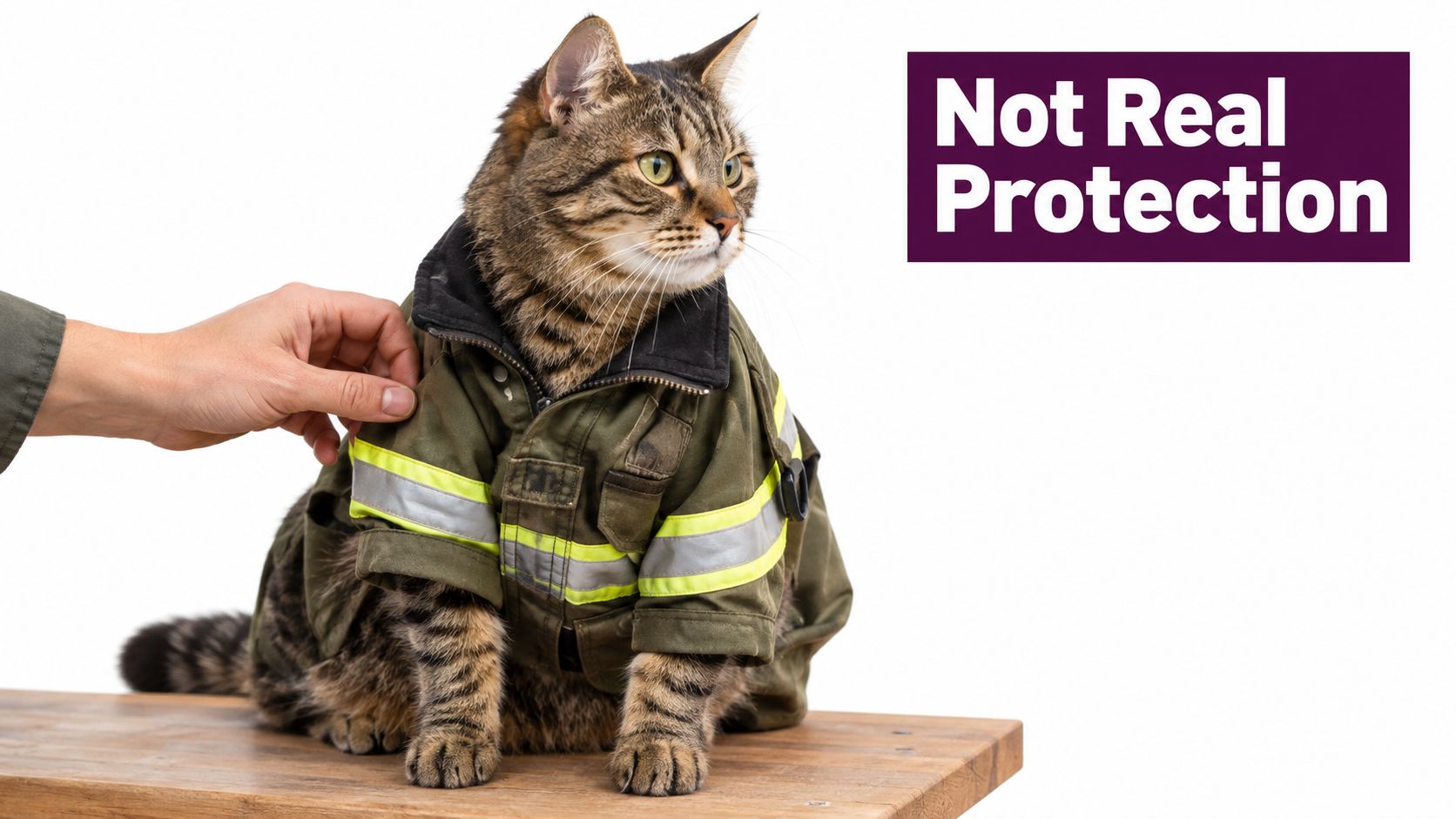
Yellow fabric isn't a safety certificate. Neither are reflective-looking strips, reinforced elbows, or a cat wearing a hard hat on the back.
A decorative cat workwear jacket belongs in the everyday-clothing category unless its protective claims are supported for the intended application. Don't let a worksite-inspired appearance make that decision for you.
This miniature firefighter outfit is a playful visual, not an example of protective equipment.
Read the Marking Rather Than the Colour
EN ISO 20471 defines high-visibility garment classes using minimum fluorescent and retroreflective material areas. Class 1 requires at least 0.14 m² of fluorescent material and 0.10 m² of retroreflective material, while Class 3 requires at least 0.80 m² and 0.20 m² respectively, according to Kübler's EN ISO 20471 protection-standard guidance.
Those requirements make “it has some bright panels” an inadequate buying test. The relevant marking and class need to match what your workplace requires.
- Ask for identification: Request the applicable standard, garment class where relevant, and documentation for the exact model.
- Name the hazard: Visibility, chemical exposure, and electrical hazards aren't interchangeable protection requirements.
- Check the complete arrangement: Ask whether the garment remains suitable with the other clothing and equipment you must wear.
- Get workplace approval: Have the responsible safety person confirm suitability rather than relying on a seller's reassuring phrase.
Don't Improvise Protection
A parking-area shift and a desk shift may share an employer, but they don't automatically share clothing requirements. Likewise, a jacket suitable for general warehouse duties shouldn't be assumed suitable for every task involving moving equipment.
If a listing claims flame resistance, anti-static performance, or chemical protection, ask for application-specific evidence. Don't infer any of those properties from fabric thickness or industrial branding.
My purchase-or-pass rule is firm: when you're relying on a jacket to reduce injury risk, unresolved documentation means pause. Keep shopping, ask your employer, or choose the approved garment. Floofie can wait for a safer place to make a fashion statement.
Style It for Cats Without Spoiling the Look
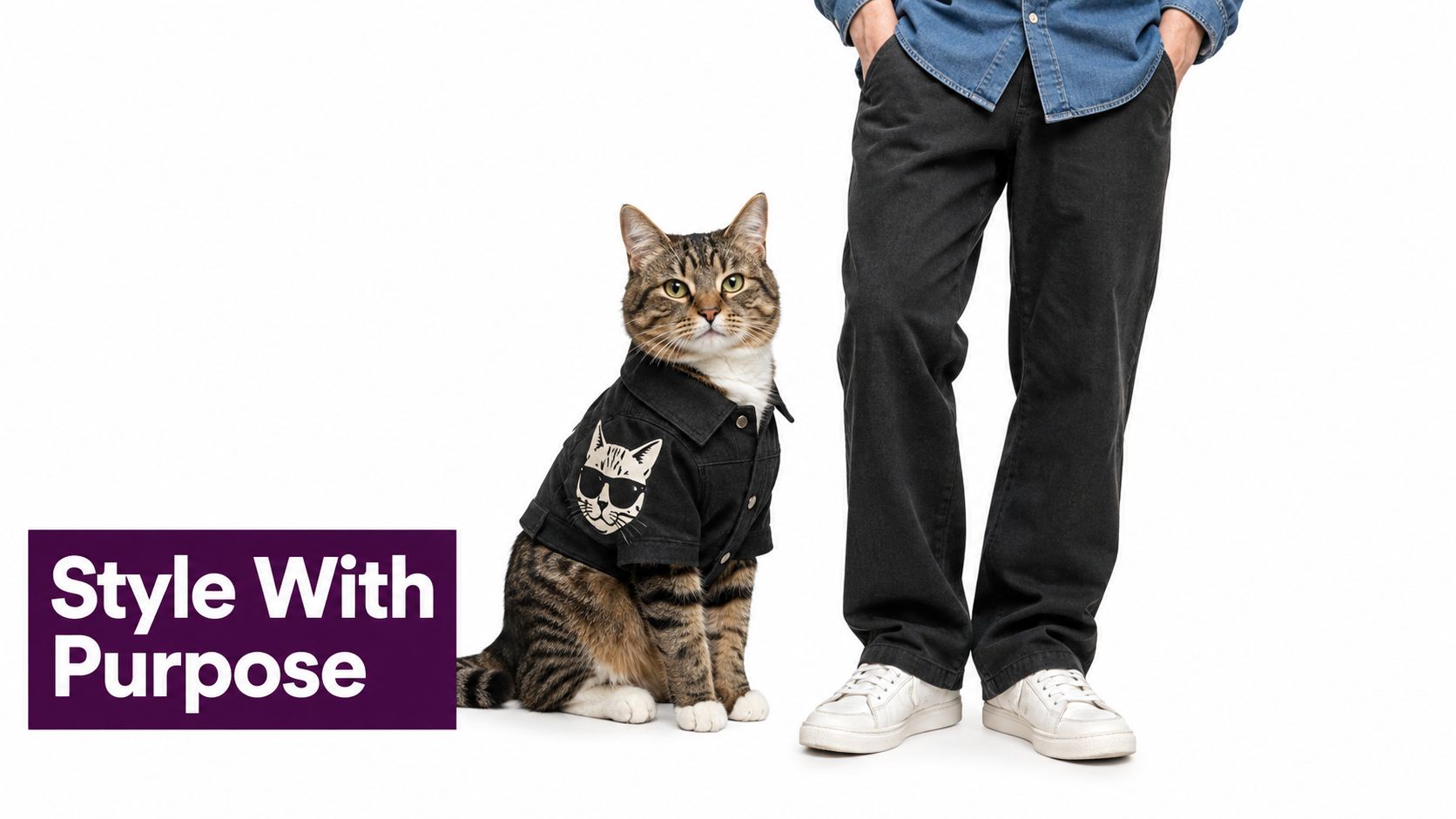
The easiest outfit is usually the one that gives the jacket room to be interesting. A cat graphic, dark trousers, a plain top, and practical shoes look intentional without making every garment compete.
For coordinated feline style, treat this image as outfit inspiration rather than a workplace recommendation.
Choose the Volume of the Outfit
For an educator, I'd pair a small chest motif with straight-leg trousers and an uncomplicated shirt. For a customer-facing retail colleague, restrained embroidery can make the outfit feel personal without overwhelming a team dress code.
A home-based creator or someone attending a cat-themed event has more freedom. A large back graphic with plain denim and boots can be the whole outfit's focal point. These ideas for cat clothing for humans can help you decide whether you prefer a discreet detail or a louder design.
Floofie's styling rule: choose a paw print or a full ensemble. You don't need both competing for attention.
For veterinary teams, choose only within the practice's approved clothing options. For warehouse roles, start with the approved workwear arrangement and add personality only where permitted.
Keep Decoration in Its Lane
Graphic placement deserves as much thought as graphic size. Look at the jacket closed, open, and under your usual bag strap before deciding whether the artwork lands where you want it.
On certified high-visibility garments, placement is a performance issue, not just a styling choice. Fluorescent fabric supports daytime visibility, while retroreflective components return headlight illumination toward drivers at night; their layout matters, as explained in CWS's high-visibility workwear guidance. Don't cover those areas with prints, pockets, or decorative additions.
Use the video below as a separate viewing break, not as evidence of a jacket's safety or construction.
My preference is one clear feline feature, supported by clothes you already wear. That's easier to repeat on a busy morning than an outfit that requires its own styling committee.
Personalize and Launder Without Losing the Design
Personalize only after you've confirmed the fit. A name, monogram, or embroidered patch won't make a restrictive jacket more wearable, and customization can change the seller's return terms. Ask about those terms before approving the artwork.
Try the undecorated garment with your normal underlayers and belongings first. Then mark the proposed design position with a removable paper template, following the fabric's handling instructions.
Plan the Placement Before Approving It
Check the template while seated, reaching, and wearing your usual bag. A name that looks centred on a flat product photo may sit awkwardly when the jacket is fastened or worn open.
- Keep access clear: Don't bridge a pocket opening, zipper, fastening, or adjustment tab with decoration.
- Check the inside: Ask about embroidery backing, patch edges, and whether anything will sit against your neck or wrists.
- Confirm the method: Request details about printing, embroidery, or patch attachment rather than approving a mock-up alone.
- Ask about care changes: Establish whether the added detail changes washing, drying, pressing, or repair instructions.
For initials, use a monogram planning guide to settle the arrangement before production. Check spelling and orientation carefully. Floofie accepts many things, but a permanently misspelled cat name shouldn't be among them.
If the jacket is certified protective clothing, use an approved customization route. Don't add a patch yourself and assume the original documentation still settles the question.
Wash the Whole Garment, Not Just the Shell
Read the care label before buying, especially if you need frequent laundering. If the required care doesn't fit your household or workplace routine, choose another garment.
The shell, lining, print, embroidery, closures, and reflective components need compatible treatment. Follow the garment's instructions rather than applying a generic rule for cotton, polyester, or denim.
Don't invent a washing temperature, drying setting, or pressing method because a similar jacket tolerated it. Ask the seller how the decorated version should be cleaned, including any limits on stain treatments or professional cleaning.
After laundering, inspect the fit and appearance. Look for shrinkage, fading, stiffness, distorted artwork, lifting patch edges, damaged stitching, and closures that no longer operate smoothly. Raise problems with the seller before attempting a repair that could affect the garment or its return eligibility.
For rainwear, ask about performance and maintenance together. A hydrostatic-head rating is more useful than fabric weight alone; the referenced construction work-jacket guide identifies 10,000 mm or higher as a useful target for sustained heavy rain. Treat that as a buying reference, not a substitute for checking the finished jacket's details and care requirements.
Make the Final Purchase-or-Pass Decision
Before paying, give each decision its own answer:
- Use: Can you describe where and how you'll wear it?
- Fit: Have you compared measurements and tested normal movements?
- Construction: Are the useful details supported beyond appearance?
- Safety: Are any protective claims documented and workplace-approved?
- Style: Do you like it with clothing you already own?
- Care: Can you follow the instructions, including personalization requirements?
Floofie's takeaway: “Pick the jacket you can move in, look after, and wear honestly. Cute is welcome. Mystery protection isn't.” 🐾
Choose a playful everyday jacket when comfort, expression, and practical durability are the priorities. Whenever you expect the garment to protect against a workplace hazard, pause and verify certification before you buy.
FloofChonk offers cat-themed apparel and accessories for adding feline personality to your everyday wardrobe. Visit FloofChonk to browse graphic tees, hats, and personalized pieces you can compare alongside your jacket choice, with fit, care, and your workplace's requirements firmly in mind.