
Meowing Cat Toy Guide: Enrichment That Purrs

A meowing cat toy mimics prey vocalizations to trigger hunting instincts, and cats can hear from about 63 Hz to near 79 kHz. For an indoor cat, that sound can turn a sleepy afternoon into a focused hunt, especially when it arrives with motion, touch, or a satisfying pounce.
Your cat is sprawled beside the sofa, one paw hanging dramatically over the edge, while the feather wand you bought has become furniture. Then a small plush mouse lets out a soft meow. The eyes open. The ears swivel. The tail gives one sharp flick, as if Floofie has just announced, “The adventure begins, tiny hunter!” 🐾
A meowing cat toy isn't magic, though it can look wonderfully mysterious. It uses sound, movement, and anticipation to create a play target that feels more alive than a motionless object. The clever part is choosing a toy that matches your cat's hearing, temperament, and safety needs rather than assuming every feline wants the loudest gadget in the basket.
Why Your Cat Craves a Meowing Cat Toy
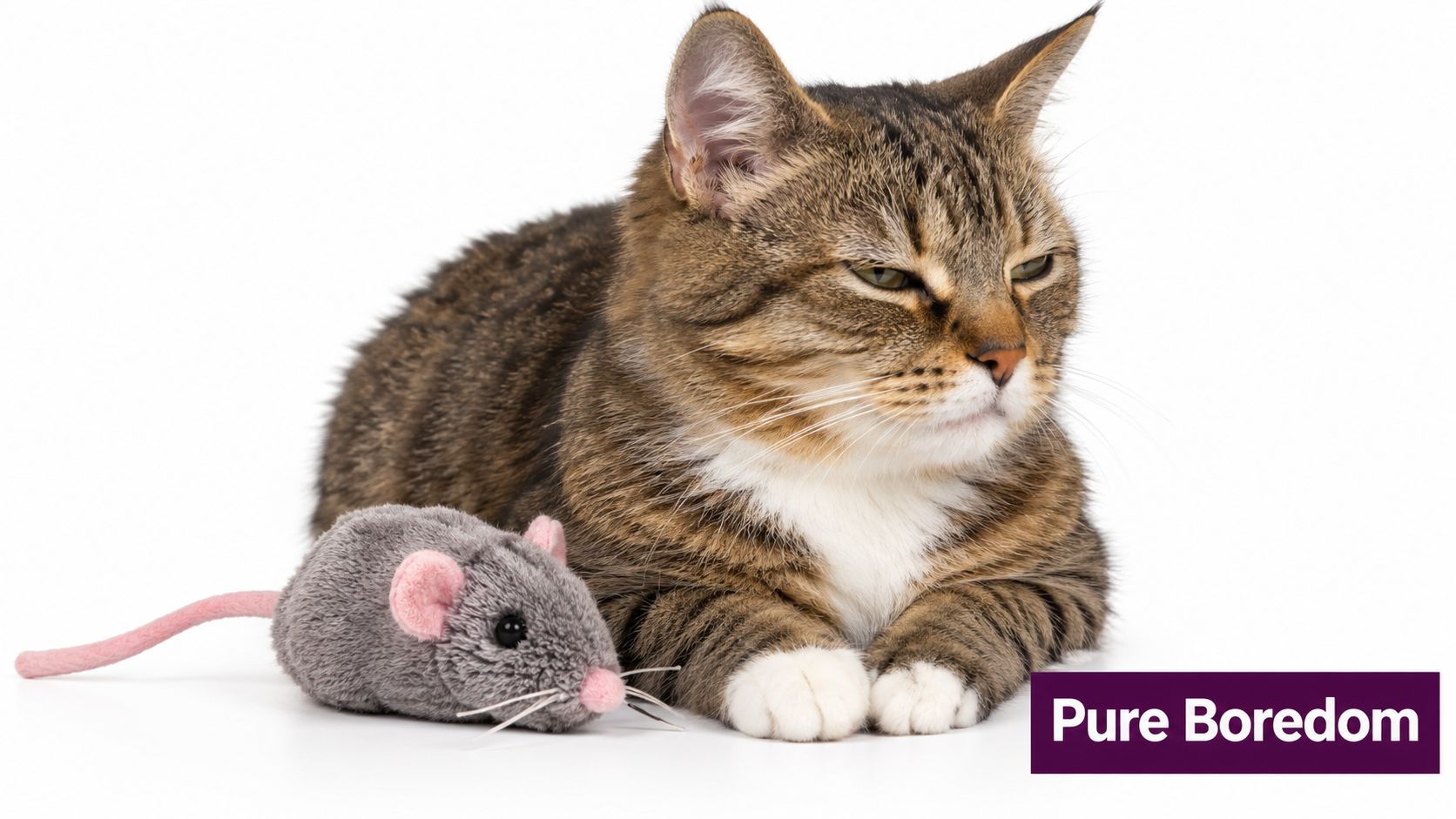
Miso, an indoor tabby with a serious talent for napping, had already dismissed a feather wand, a crinkle ball, and a plush mouse. Her human rolled the mouse across the rug one evening. It stayed quiet, and Miso watched it glide past with the polite disinterest of a queen inspecting a peasant.
Then the mouse meowed.
Miso's body changed before she moved. Her shoulders lowered, her pupils widened, and one paw crept forward. The sound gave the toy a story. It wasn't just fabric on a floor anymore. It suggested a creature hiding nearby, and Miso's old hunting sequence woke up: notice, stalk, pounce, grab.
The sound behind the pounce
Sound-based play works because cats don't experience a toy through one sense alone. They hear a possible target, watch it move, feel the impact beneath a paw, and decide whether to chase or wait. That combination gives an indoor cat a richer task than batting a silent object once before wandering away.
Meows can also carry social meaning. A controlled study comparing restricted access to food with restricted access to toys found that cats meowed significantly more in the feeding condition than in the play condition, showing that vocal responses change with motivation and context. For that reason, a meowing cat toy may work especially well when you build it into an owner-led routine, a pre-meal ritual, or a reward-based game rather than leaving it switched on all day. The study on feeding and play contexts offers useful context for why one sound won't affect every cat in the same way.
Floofie's field note: A toy should invite the hunt, not become the entire household soundtrack.
Another indoor cat, Juniper, reacted differently. She ignored the first sound but followed the toy after it disappeared behind a cushion. Her reward wasn't just the meow. It was the pause, the hiding place, and the chance to solve a tiny mystery.
If your cat regularly vocalizes for attention, play can also give that energy a safer direction. A useful companion read is why cats meow at their people, especially if your cat's vocal behavior has changed suddenly. A toy can enrich a routine, but it shouldn't replace a veterinary conversation when unusual meowing arrives with changes in appetite, mobility, litter-box habits, or mood.
How Meowing Cat Toys Trigger Hunting Instincts
The mechanism is easier to understand if you follow the sound from the toy to the paw.
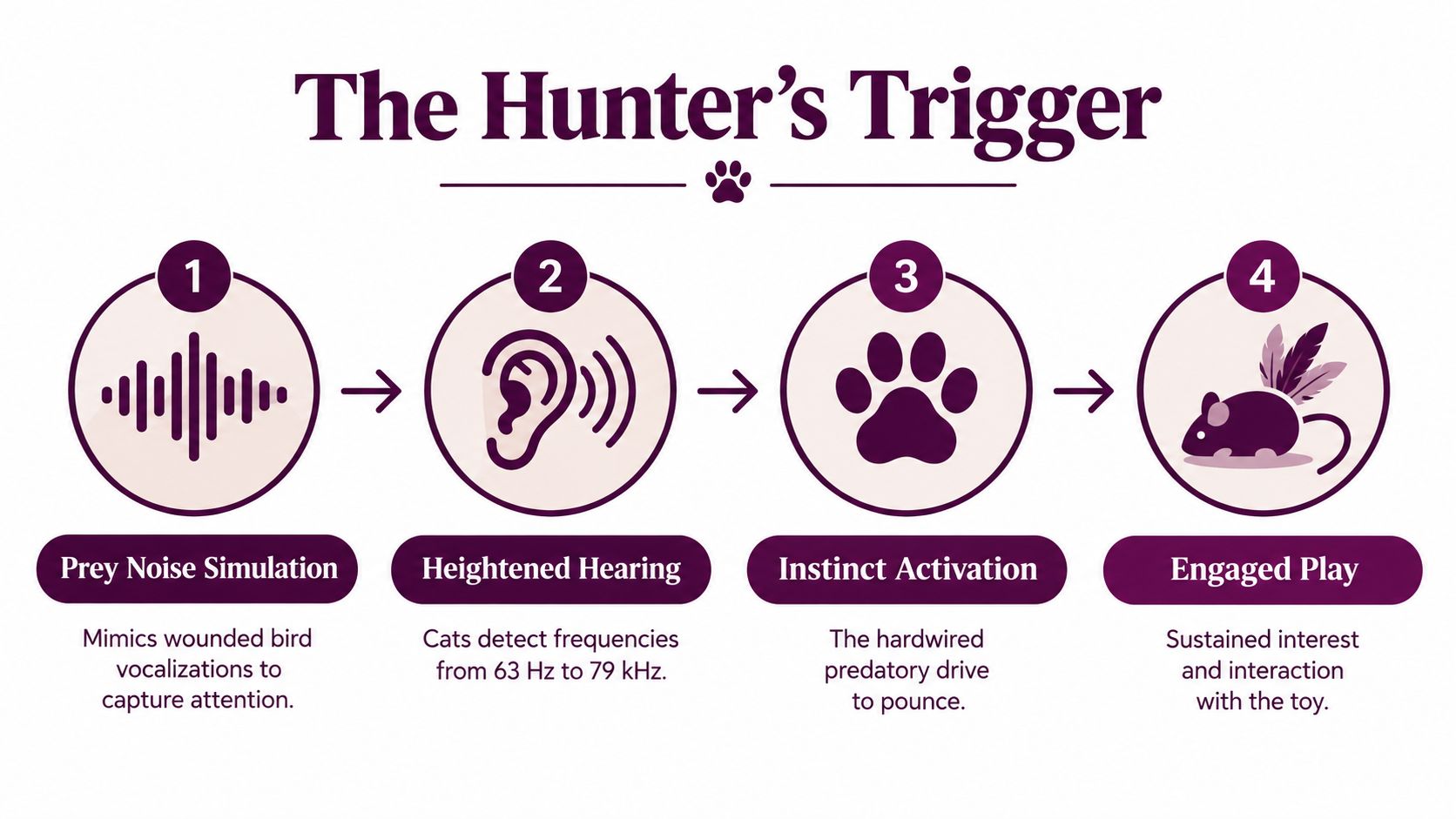
Cats hear across a remarkably broad range, from a lower limit around 63 Hz to an upper limit near 79 kHz, according to research on feline hearing. That means some ultrasonic sounds may be detectable to cats while remaining inaudible to people. A toy that relies only on very high-frequency audio may therefore seem silent to you while still attracting your cat, but sound alone can lose power in a busy home. Research on the cat auditory range supports pairing audio with motion or tactile feedback.
Four steps from noise to chase
- Attention arrives first. A meow, chirp, squeak, or prey-like call cuts through the stillness and gives your cat a reason to look.
- The ears locate the target. Your cat turns toward the sound, estimates where it came from, and watches for movement.
- The body prepares. The crouch, shoulder shift, tail movement, and paw lift are small signs that the predatory sequence is loading.
- The toy earns engagement. A pounce, bat, or bite produces movement or another sound, which rewards the interaction and keeps the exchange going.
A motion sensor makes that loop practical. When a cat bats the toy, the sensor detects vibration or movement and activates the sound. A flapping bird toy instruction manual gives a concrete example, describing a vibration sensor that triggers the sound mechanism when a cat bats, pounces, or otherwise interacts with the toy. This example of motion-triggered sound activation shows why touch-responsive toys can feel more interactive than products that make noise continuously.
Set the room like a small jungle
Start the toy near a hiding place, not in the middle of an empty floor. Let it disappear behind a chair leg, pause beside a box, and reappear from a different angle. Those pauses give a cautious cat time to observe and give a bold cat something to pursue.
Keep your movements irregular. A toy that travels in a perfectly predictable circle becomes easy to ignore, while short retreats and sudden stillness encourage watching. If your cat crouches but doesn't pounce, lower the intensity instead of pushing the toy into their face. Floofie recommends a gentle “peekaboo, meow-meow” approach. 😺
For another interactive format, explore this guide to a remote mouse cat toy. The principle is the same: sound works hardest when it joins movement, distance, and a moment of capture.
The Amazing Benefits of Interactive Meowing Toys
Miso crouches behind the sofa, ears forward. A meow chirps from beneath a blanket, stops, then sounds again from the other side. Her head tracks the change, paws gather beneath her chest, and she springs. The toy has turned a quiet room into a small hunting puzzle.
A meowing cat toy gives an indoor cat more than sound. A changing vocal cue can make the cat orient, locate a target, choose an approach, and finish with a pounce or bat. Those steps engage attention and body control, so play can feel satisfying even when the furniture stays put.
Interest in interactive cat enrichment has grown beyond a novelty category. One market-trends analysis reports that search interest rose by about 183% over six months and 332% over two years, with interest peaking in December. The interactive cat toy market analysis also reports that approximately 67% of North American cat owners regularly purchased specialized interactive enrichment products in 2024, compared with 41% in 2015, a 26-point increase over that period.
A workout with whiskers
Place the toy under a blanket and let the meow arrive before the movement. Your cat may freeze, turn toward the sound, stalk the edge, stretch low, pivot, bat, and carry the toy away. The sound supplies information at each stage, while movement gives the body a reason to respond.
A short sound-and-motion session can complete the hunt sequence: notice, stalk, pounce, and capture. That sequence uses mental energy a silent toy left beside the food bowl may never request. The reward is not constant noise. It is the moment the cat finds, catches, and controls the target.
Match the format to the individual cat. A patient problem-solver may prefer a puzzle toy, while a fast, watchful cat may choose a moving mouse. A cautious cat may approach a soft, quiet meow from cover; a bold chaser may enjoy a toy that changes direction. Rotate sound toys with scratching, climbing, hiding, and human-led play so one signal does not become background noise.
Sound can also push a sensitive cat past enjoyment. Keep sessions supervised, offer quiet pauses, and stop if your cat hides, pins the ears back, or becomes agitated. A toy that invites hunting should leave the cat curious, not overwhelmed.
Why routine matters
Bring out the meowing cat toy before a meal, after work, or during the evening alert period. Repeating the same general ritual helps your cat recognize when interaction is available, while changing the route keeps the hunt from becoming predictable.
For household ideas that fit enrichment into daily care, these tips for new cat owners this year offer a useful starting point. Floofie's rule is simple: let the meow start the mystery, let your cat solve it, and finish with a real moment of capture. 😺
Safety First, Choosing Secure Meowing Toys
The cutest toy in the basket can still be a poor choice if the battery compartment opens under a determined paw. Recent consumer safety action involving a battery-powered cat toy warned about children ingesting accessible coin batteries and cited a risk of serious injury or death. The CPSC warning about coin-battery pet toys makes the central point clear: a sealed battery compartment is not a decorative feature.
Inspect before the first meow
Check the housing, seams, eyes, ears, feathers, bells, strings, and sound opening before handing the toy to your cat. Pull gently at attached pieces. If a component shifts, the toy needs repair or retirement before play begins.
Pet toys also sit in a regulatory gray area. One compliance overview notes that many major markets don't have a single dedicated pet-toy standard equivalent to the EU Toy Safety Directive or the US CPSIA. The CPSC can act when a consumer product creates an unreasonable risk, but shoppers and manufacturers still need to pay attention to construction and foreseeable use. The pet-toy safety market overview explains why a product label alone shouldn't end your inspection.
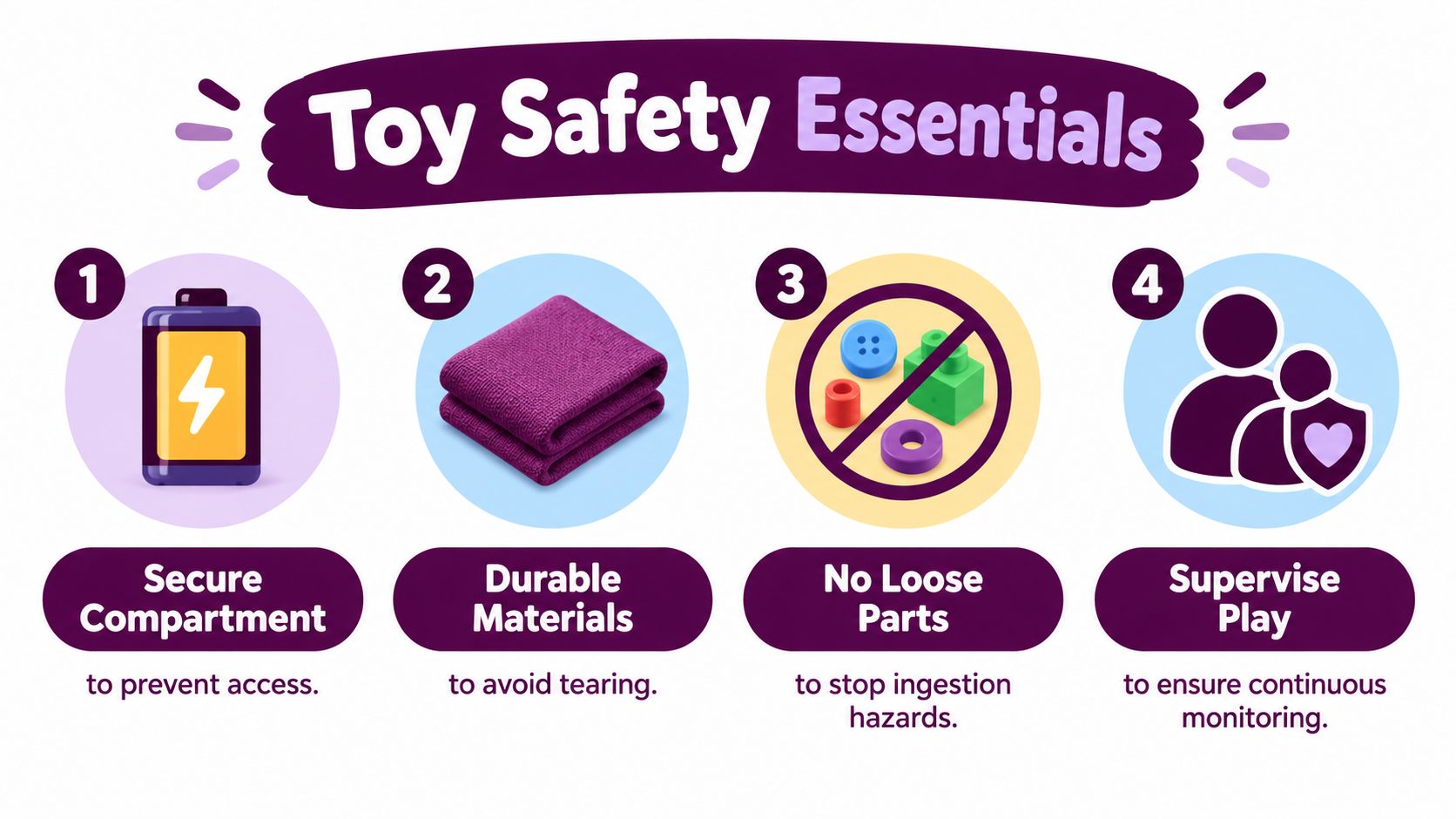
Use this quick Floofie-approved check:
- Battery security: Choose a compartment that closes firmly and requires a deliberate tool-assisted opening when appropriate. Keep loose batteries away from children and pets.
- Material strength: Look for fabric and components that won't splinter, crack, or tear into swallowable pieces.
- Attachment quality: Strings, feathers, and bells should be securely fixed. Independent guidance on choosing safe pet toys recommends avoiding loose fabric and embellishments that could be ingested.
- Play supervision: Watch sound-enabled toys during use, particularly if your cat chews, carries, or attacks with unusual force. Remove the toy as soon as damage appears.
Common hazards include chewing, choking, toxicity, strangulation, entrapment, suffocation, cuts, and punctures. A compliance guide lists frameworks such as ASTM F963-23, CPSIA, ISO 8124, and EN 71 that manufacturers may test against, but testing language still deserves careful reading. This pet-product testing guide gives the hazard categories and framework examples.
A laser pointer raises a different question because the cat can't physically capture the light. For a broader discussion of play choices, see whether laser pointers are bad for cats. With a meowing cat toy, finish the session by letting your cat catch, touch, or carry something tangible.
Matching Toys to Your Cat's Personality
A bold Bengal-like personality may charge at a vibrating toy the moment it chirps. A cautious senior may retreat from the same sound and watch from behind a doorway. Both responses are normal. The right meowing cat toy should fit the cat in front of you, not the imaginary average cat printed on the packaging.
The confident chaser
For a high-energy cat who launches at shoelaces and patrols every hallway, choose a sturdy toy with motion activation and a sound that starts after contact. Place it near corners, tunnels, or low furniture so the cat can stalk instead of just swatting in place. Short, varied sessions usually work better than leaving the toy active until the novelty evaporates.
If your cat bites hard or carries toys away, prioritize sealed electronics and sturdy seams. A louder sound isn't automatically more engaging. The cat needs a reachable target and a clear chance to win.
The careful observer
A shy cat may prefer a soft chirp or a quieter meow that comes from a stationary plush mouse. Begin with the toy several feet away and let the cat choose whether to approach. Move it slowly along the edge of a rug, then stop. The pause tells your cat that the object won't rush into its personal bubble.
You can also start without sound. Once the cat bats or sniffs the toy, activate the sound briefly. This teaches the cat that interaction controls the noise, which can feel less startling than an unpredictable toy.
The relaxed lap cat
A laid-back cat may enjoy a touch-activated toy during a short owner-led game, particularly when the toy moves across a blanket or beside a favorite bed. Don't interpret a quiet response as failure. Some cats prefer watching, reaching, and one decisive pounce rather than racing around the room.
Age and temperament matter more than a generic promise of endless engagement. A toy that excites one cat may overstimulate another, especially if the sound repeats without a break. Stop when the body language shifts from focused curiosity to irritation, frantic chasing, flattened ears, or avoidance.
| Your cat's style | Start with | Adjust if needed |
|---|---|---|
| Bold and physical | Motion-activated sound toy | Use stronger construction and shorter supervised sessions |
| Curious but cautious | Gentle sound with slow movement | Keep distance and let the cat approach |
| Quiet and observant | Soft plush toy with occasional activation | Add hiding places rather than louder audio |
| Easily overstimulated | Brief owner-led play | Reduce volume, repetition, and session intensity |
A cat who suddenly stops playing, vocalizes unusually, or seems uncomfortable deserves more than a new toy. Pause the experiment and consider a veterinary check, particularly if other behavior changes appear.
Play Ideas and Final Tips from Floofie
Floofie's favorite game begins with the meowing cat toy hidden behind a cushion. Let one small sound escape, wait, and move the toy only after your cat looks toward it. When the pounce arrives, allow a real capture. A successful hunt needs an ending, not an endless chase.
Try these variations:
- Treat trail: Place a food reward near the toy after play, so the sound leads to a calm, satisfying finish.
- Room safari: Move the toy between a box, a chair leg, and a tunnel. Change the route, not just the volume.
- Toy rotation: Put some toys away and bring them back later. Fresh access can restore curiosity without making the toy louder or more complicated.
Choose by personality, inspect by hand, and supervise the battery-powered gadgets. The best meowing cat toy creates a small adventure your cat can understand, control, and complete. “Pounce achieved,” Floofie says, fluffing the tail with pride. 🐱✨
FloofChonk offers cat toys and accessories, including interactive options such as the Smart UFO Cat Toy with bell and feather play, alongside cat-themed apparel, décor, and gifts. Visit FloofChonk to find a playful addition for your cat's enrichment routine and a little extra feline flair for your home.