
Pillows for Cats: Sizes, Safety and Cleaning Guide 2026

Your cat walks past the gorgeous velvet cushion printed with cats, sniffs the empty cardboard box beside the sofa, and climbs straight into it. Meanwhile, you're holding the receipt for a pillow that apparently belongs to you now. 😸
Choosing pillows for cats takes more than finding something soft. The usable sleeping space matters, but so do the location, room temperature, and your cat's age. Start with the cat's habits, then give the pillow a fair placement test before declaring it a very expensive ornament.
Cat Pillows and Cat-Themed Pillows Are Not the Same Thing
A pillow for a cat is a resting resource. A cat-themed pillow is décor for a person. They can look similar online, and a washable decorative cushion can sometimes serve both purposes, but a cat print doesn't tell you anything about suitability.
A functional cat pillow should be easy to clean, stable under moving paws, and shaped around the way your cat rests. Decorative cushions prioritize appearance, so trims, delicate weaves, and care restrictions deserve a closer look.
The distinction matters in a growing number of homes. The American Pet Products Association's Dog & Cat Report counted 49 million U.S. cat-owning households in 2024, up from 40 million in 2023, and reported a 36% increase in households with three or more cats since 2018. A coordinated sofa arrangement isn't a substitute for separate places where those cats can settle.
Pillows for cats vs cat-themed pillows for people
| Feature | Pillow for cats | Cat-themed pillow for people |
|---|---|---|
| Built for | Cats to rest, nap and sleep on | People to decorate a sofa or bed |
| Cover | Removable and machine-washable | Often sewn shut, spot or dry clean only |
| Fabric | Low-odor, non-looped, claw-resistant | Velvet, faux fur or woven prints that can snag |
| Shape | Bolster, round donut or flat pad | Square or rectangular cushion |
| Best place | Floor, quiet corner or elevated perch | Sofa, armchair or bed |
| Safety check | No loose cords or exposed foam | Don't assume cat-use testing; check trims and buttons |
Use those features when browsing FloofChonk's pillow and pet-product selection, rather than assuming every cushion featuring whiskers was built for sleeping whiskers. Floofie, our mascot, may approve the catitude, but your cat still gets the practical inspection. 🐾
The quick label test: a cover that zips off and says machine wash passes the first functional check. A sewn-shut, dry-clean-only cushion belongs in the décor category, even if your cat occasionally tolerates it. Washability alone doesn't establish safety, but it's a useful place to start.
Cat Pillow Sizes by Cat Weight and Sleep Style
Start with a tape measure while your cat is already resting. Follow the occupied space from nose to tail in a curled position, then measure again during a relaxed stretch without pulling the tail straight or disturbing the cat.
As a practical fitting allowance, add 5 to 10 cm to the sleeping length you want to accommodate. These are shopping guide values, not manufacturer standards or veterinary thresholds. Compare your measurement with the usable inner area, not just the pillow's outside dimensions.
Cat pillow size guide by cat type
| Cat type | Recommended size | Fit check |
|---|---|---|
| Kitten or small adult, under 4 kg (about 9 lb) | Round or bolster, measured length plus 5 to 10 cm | Cat tucks in nose to tail with no paws hanging over |
| Adult, 4 to 6 kg (about 9 to 13 lb) | Bolster or flat pad, measured length plus 5 to 10 cm | Side-lying stretch fits with room to spare |
| Large adult, 6 to 9 kg (about 13 to 20 lb), including some Maine Coons | Spacious flat pad or broad bolster, measured length plus 5 to 10 cm | Shoulders and hips stay supported during a full stretch |
| Senior cat, any weight | Body-length sleeping area with a suggested 4 to 6 cm low side | Easy step-in with no climbing |
| Two or more cats sharing a home | One pillow per cat plus one spare, sized to the largest cat when buying interchangeable pads | Each cat has its own spot |
Weight helps you shortlist, but it doesn't replace measuring. A long, lean cat can need more stretching space than a heavier cat who sleeps tightly curled. For kittens, avoid buying an oversized, deep nest just to allow for growth.
A 2024 noninvasive EEG study published in the Journal of Mammalogy reported approximately 16 hours of daily sleep and an average sleep cycle of 25.8 minutes. That makes fit important across repeated settling, turning, and stretching, not just a single overnight snooze.
Fit the sleeping style, not the breed label
Curlers often suit round pillows or bolsters that support a tucked posture. Sprawlers need a flatter rectangle with room for their shoulders, hips, and extended legs. Don't count a thick raised rim as sleeping space unless your cat actually rests on it.
For a senior cat, prioritize an entrance they can walk across without lifting their legs over a tall wall. A low side is useful only if the pillow also stays stable and doesn't collapse underfoot. If getting in or lying down looks painful, ask your veterinarian rather than trying to solve everything with extra padding.
Fit check: Measure the space your cat uses, then check how much of the advertised pillow size the bolster takes away.
Use the comfortable cat bed guide to refine your shortlist, then compare the listed dimensions in FloofChonk's pet bed selection. For interchangeable pillows in a multi-cat home, buy to accommodate the largest cat and add a spare rather than expecting everyone to share.
Materials, Covers and Durability Cats Will Actually Use
The fanciest-looking fabric isn't automatically the feline favorite. Controlled preference observations summarized in feline housing and welfare guidance found that cats preferred polyester fleece for lying on over cotton-looped towel, woven rush matting, and corrugated cardboard; the same guidance describes preferences for temperature-stable surfaces and an association between soft bedding and longer sleep periods.
That makes fleece a sensible starting point, not a guarantee. A cat who dislikes the texture or gets too warm still needs another option.
Cat pillow materials compared
| Material | Cat acceptance | Hygiene and wear | Verdict |
|---|---|---|---|
| Polyester fleece | Preferred over towel, matting and cardboard in controlled observations | Choose washable, low-odor fabric; brush out embedded hair | Best default |
| Cotton looped towel | Less preferred than fleece | Loops can catch claws and retain hair | Avoid for a purpose-made pillow |
| Woven rush matting | Less preferred than fleece | Woven gaps complicate cleaning | Skip as pillow material |
| Corrugated cardboard | Less preferred than fleece for lying on in those observations | Breaks down when damp; usually replaced rather than washed | Not a washable pillow |
| Non-looped microfiber or minky | No preference ranking established here; offer a texture trial | Check washability and inspect for pilling | Good if claw-checked |
| Fabric or wood surfaces | Temperature-stable substrates favored in observations | Wipe wood; launder fabric according to its label | Pair a suitable base with a washable cover |
Low odor and non-looped construction are useful buying criteria. Rub your hand across the fabric, inspect it for loose threads, and check whether a light fingernail pass catches easily. Avoid covers with dangling ties or decorative yarn.
Inspect the parts that take the strain
Look for a zipper that closes fully and sits beneath a protective flap, or a secure hook-and-loop closure without an exposed scratchy edge. Check corners for reinforced or double-stitched seams. Press firmly into the insert, release it, and see whether the filling redistributes rather than leaving a hollow.
Flip the pillow over. A non-slip underside matters when your cat kneads, turns, or jumps onto it. If the insert clumps after six months, for example, that's a reason to assess and replace the insert, not automatically discard a sound cover.
For the human side of a coordinated room, you can find cushion covers for your sofa at Casamé Home while choosing the cat's fabric separately. Matching colors needn't mean matching construction.
A removable cover is worth paying for when several cats use the room. Keep a replacement available so laundering doesn't remove a favorite resting resource, and preserve familiarity through the surrounding bedding rather than leaving a dirty cover unwashed.
Temperature and Safety Checks for Every Cat Age
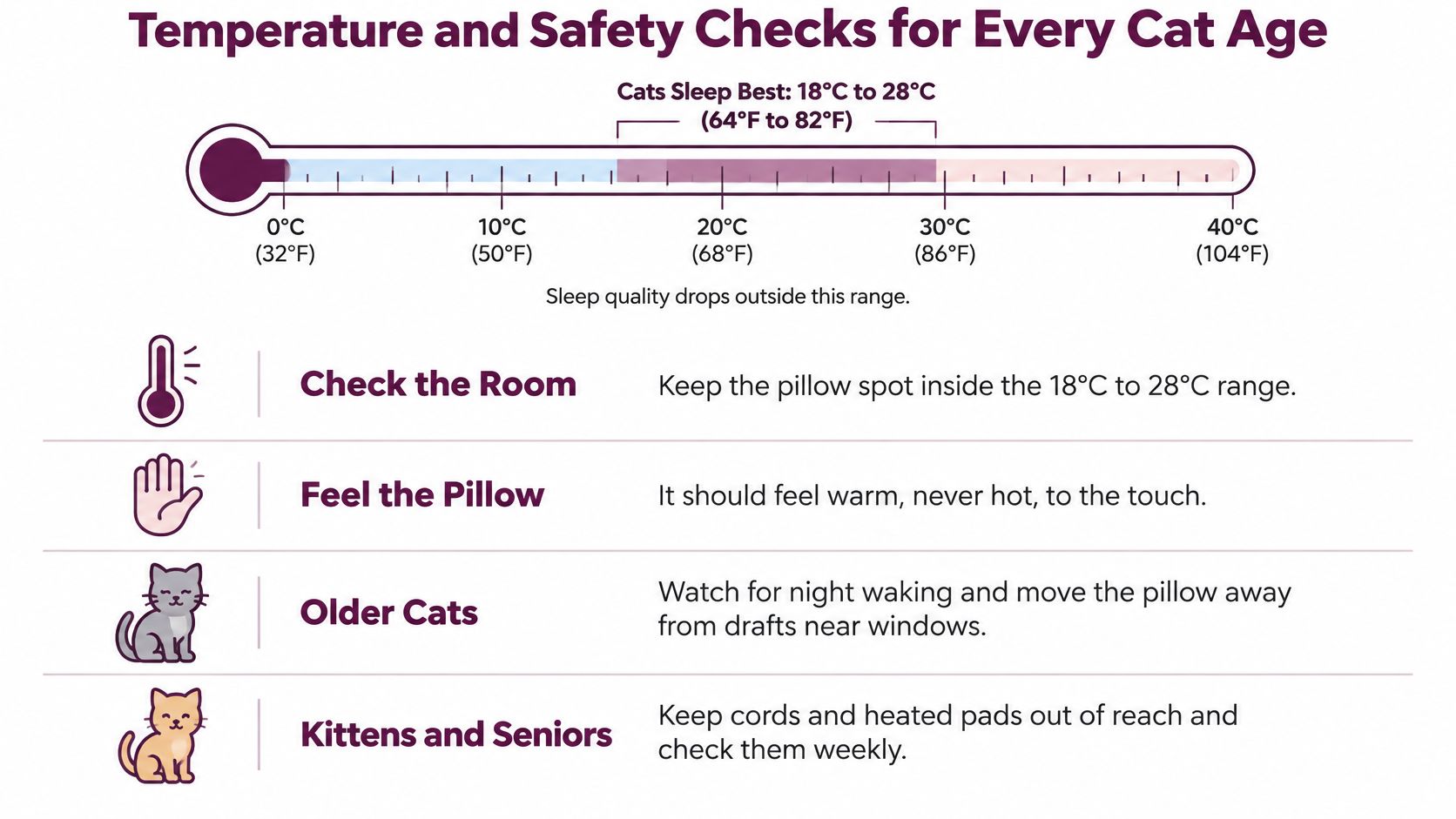
The plushest pillow isn't automatically the most comfortable. A review in Frontiers in Neurology describes feline sleep as generally best within roughly 18 to 28°C, with poorer sleep outside that range, and reports more temporary awakenings at temperature extremes in aged cats than in young adults.
Older cats therefore need more thought than just buying the thickest nest. In a warm home, heavy insulation can be unhelpful; in a cool room, a thin pad over a cold surface may offer too little insulation.
Temperature, fill and placement by situation
| Situation | Fill and fabric | Placement |
|---|---|---|
| Senior cat in a warm home | Low-loft breathable fill, cotton-blend or mesh-backed cover | Shaded spot away from heaters |
| Room below about 18°C | Thicker fill with a removable insulating layer | Off bare tile and out of drafts |
| Hot climate or summer | Thin, breathable fabric in a light color | Next to a cool floor surface |
| Mild room, 18–28°C, any age | Standard padded fill | Quiet, familiar spot |
| Near a radiator or sunny window | Avoid heat-trapping layers | Move away from direct heat |
Treat the temperature bands as orientation, not a prescription for every individual cat. Coat, health, activity, and the pillow's immediate surroundings matter too. Use a room thermometer near the resting area instead of relying entirely on a thermostat elsewhere.
Keep these checks handy when arranging the sleeping spot:
Offer a comfortable exit
Heat-loss responses can be suppressed during paradoxical sleep, so don't assume a sleeping cat will always compensate promptly for excessive warmth. Avoid trapping heat around the body and leave access to an adjacent cooler surface.
The guide to the best room temperature for cats can help you assess the wider room. A pillow shouldn't be the only comfortable option available.
- Remove dangling pieces: No loose cords, ribbons, or chewable trims.
- Contain the filling: No exposed foam or accessible stuffing.
- Check openings: Avoid deep gaps that could trap a head or claws.
- Secure raised setups: The pillow and supporting platform must resist slipping or tipping.
- Avoid concentrated heat: Keep beds away from radiators, direct sun, and poorly ventilated spaces.
Very young kittens and cats with medical problems may need individualized temperature advice. Don't add a human heating pad to compensate for a poorly chosen location.
Nap Spots, Travel and Decor Uses for Cat Pillows
Say your tabby ignores the sofa cushion but settles every afternoon on a flat pad beside the window. The useful feature may be the vantage point, not the padding. Keep the platform broad and stable, check that it can't tip, and provide an accessible route down.
A paper on sleeping positions in domestic cats discusses how raised resting places offer visibility and concealment, while additional hidden resting places in communal housing increased opportunities for rest. A partly enclosed refuge may suit a cat who wants cover rather than a panoramic view.
Give the home pillow a settled role
For a shy cat, try a washable pad inside an open-fronted hideaway away from household traffic. Leave the entrance unobstructed so the cat can enter, leave, and watch the room without squeezing around furniture.
If you're comparing plush alternatives, Pandemonium Millinery's discussion of cruelty-free cat beds for cozy naps offers another material option to consider. Still check the actual cover, access height, and cleaning instructions rather than choosing by the cozy photograph alone.
Pack a separate travel pad
Now say the same tabby has a vet appointment. A thin, familiar-smelling pillow can line the carrier, provided it doesn't crowd the interior, buckle under the cat, or block ventilation. Keep it inside the closed carrier rather than letting the cat ride loose on it.
Secure the carrier according to its manufacturer's instructions, using an approved seatbelt attachment or an appropriate vehicle-floor position. Bring a spare cover for accidents, and use the guide to traveling with cats to plan the rest of the journey.
Give each pillow a main job. A carrier liner shouldn't have to double as the household's only dependable nap spot.
Décor gets its own space. A cat-themed cushion for people, such as the Cute Cat Meow Pillow or Cat Trio Decorative Pillow, can coordinate with the cat zone without replacing it. Browse FloofChonk's decorative pillow range for the sofa, then let your cat keep the texture and location they prefer.
Floofie supports a coordinated room. Floofie does not support relocating a sleeping cat for the color scheme. 😺
How to Clean a Cat Pillow Without Losing Its Scent
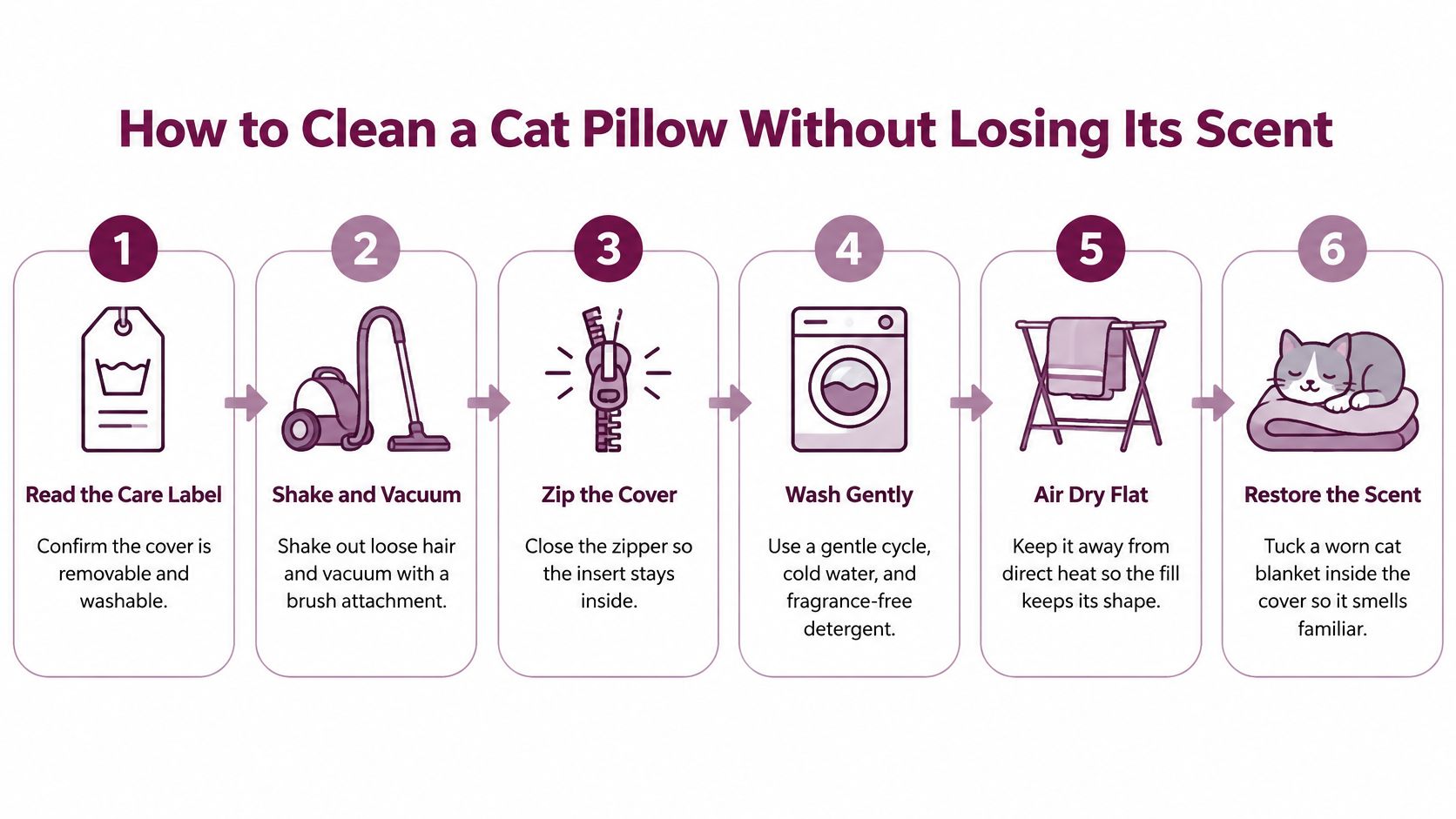
- Read the care label. Confirm that the cover is removable and washable, and check the insert separately. A washable cover doesn't mean the foam can go in the machine.
- Remove loose hair. Shake the pillow outside, then vacuum seams and surfaces with a brush attachment so fur doesn't become wet clumps.
- Remove the cover and close fasteners. Unzip it, take out the insert, then close the empty cover's zipper or other fasteners to reduce snagging.
- Spot-treat stains. Use a pet-safe enzyme cleaner suitable for the fabric and follow its contact and rinsing instructions. Skip bleach, strong fragrance, and essential oils.
- Wash gently. If the label permits, machine-wash the cover cold on a gentle cycle with mild, unscented detergent and no fabric softener.
- Dry completely. Air-dry with good airflow, including seams and corners; use low dryer heat only if permitted. Don't enclose a damp insert, because trapped moisture can encourage mildew.
- Reassemble and offer a sniff. Put the dry insert back inside, let your cat investigate, and return the pillow to its usual position.
Use this visual reminder alongside the component-specific care label:
Keep familiarity without keeping dirt
I'd start with washing the cover every one to two weeks, adjusting sooner for accidents, visible grime, or odor. That's a practical housekeeping schedule, not a veterinary rule. Keep a spare cover in rotation and leave a clean, familiar blanket nearby while the washed cover dries.
Don't preserve urine, vomit, or persistent odor in the name of scent. Familiarity should come from the cat's surroundings and clean bedding, not retained contamination. Nandog Pet Gear's guide to easy-clean cat bed materials is useful when comparing how much maintenance different constructions require.
For another care demonstration, watch the video before cleaning your pillow:
Replace the insert when lumps no longer recover, odor survives appropriate cleaning, or filling starts escaping. Torn corner seams need repair before reuse; if the surrounding fabric is weak, replacement is safer than repeatedly stitching the same failing area.
Where to Place a Cat Pillow and Test It for Two Weeks
In a cat-owner survey discussed in Frontiers in Veterinary Science, 93.7% said their cat had its own resting place, yet 38.7% reported the owner's bed as the preferred resting location. Having a designated pillow doesn't mean the cat considers it the best available bedroom.
Why does my cat ignore the pillow? Often, the product and the location don't suit the same cat. A comfortable pad in a busy walkway may lose to an ordinary chair with a better view and fewer interruptions.
Start with a warm but not hot, quiet location that offers a view of the room or some concealment. Don't place the pillow where the cat must pass another pet to reach it or where someone regularly steps over the sleeping area.
Match the shape without promising a cure
A cat who curls tightly or hides may appreciate a bolster or partly enclosed design. A sprawler needs a broad, open surface. Watch the posture your cat chooses voluntarily rather than interpreting every curled position as a request for a deep donut bed.
There's no published veterinary evidence establishing that a particular calming pillow shape reduces anxiety in the guidance discussed above. A suitable resting place can support comfort and choice, but a pillow isn't a treatment for persistent hiding, agitation, or other concerning behavioral changes.
Keep the goal practical: voluntary, relaxed use, not a photograph of your cat sitting where you put them.
Run a two-week acceptance test
This is a household trial, not a validated clinical test. Keep the pillow itself consistent so you can learn something useful about placement.
- Week one: Put the pillow in a location your cat already uses or regularly approaches. Leave it there without repeatedly repositioning it or placing the cat on it.
- Week two: If it remains unused, move it near a familiar scent, such as the cat's blanket or your favorite chair. Keep the new location stable for the rest of the trial.
- Daily tally: Record voluntary daytime use, including whether the cat only investigates, settles briefly, or sleeps. Note room conditions and interruptions so an unusually busy day doesn't decide the result.
Don't lure the cat onto the pillow and count that as acceptance. The useful result is whether they return independently. If they investigate but leave quickly, consider texture, support, or warmth before buying a different shape.
A pillow your cat chooses for an ordinary afternoon nap has passed a more useful test than one they sit on for a treat.
Arrange separate resources and make your shortlist
Feline environmental-enrichment guidance recommends at least one resting bed per cat, with open and partially enclosed options distributed across locations and heights. In a multi-cat home, separate the pillows rather than making one attractive corner the only resting destination, and keep adopted locations stable.
Before buying, check the practical details:
- Size: Accommodate the largest cat when buying shared-size pads, and add a spare.
- Cover: Choose low-odor, non-looped fabric with a removable, washable cover.
- Base: Confirm that it grips the intended surface.
- Fill: Match insulation and access to the cat's age and the room conditions.
- Placement: Offer a quiet protected spot and, when suitable, a secured raised perch.
Measure your cat, check the listed sleeping area, and browse FloofChonk's pet products with those requirements in hand. Let Floofie paw-approve your shortlist, then run the placement trial before judging the purchase. Your cat's verdict is the only review that counts. 🐾
FloofChonk offers cat-themed home décor and pet products for homes where the cat has strong opinions about both. Visit FloofChonk to compare options for your sofa and your cat's resting space, then choose by usable size, care instructions, and where your feline actually likes to nap.