
Wind Up Cat Toys: A Complete Guide for Happy Kitties

Your cat is halfway across the room when a tiny mechanical mouse rattles into view. Floofie freezes, pupils wide, tail twitching, then drops into that wonderfully serious hunter crouch. You wind the toy again, it scuttles beneath a chair, and suddenly the living room has become a miniature safari. 🐾
That reaction is exactly why wind-up cat toys remain so appealing. They move without batteries, make cats think, and create a quick burst of stalking, chasing, and pouncing. But the right toy depends on your cat's personality, and a moving toy needs a closer safety check than many buying guides suggest.
Floofie's rule is simple: choose motion that matches your cat, inspect every part, and stop play while it's still fun. Let's find out what makes these toys tick, wiggle, and earn a place in the toy basket.
Why Your Cat Goes Bonkers for Wind-Up Cat Toys
Miso had ignored a plush mouse for days. It sat beside the scratching post, perfectly innocent and completely uninteresting. Then I wound a small mechanical mouse and set it on the floor. Miso stopped mid-step, lowered her shoulders, and watched the toy zigzag toward her. Floofie would call that a successful activation of the tiny predator software. 😸
Static toys ask your cat to create the action. A wind-up toy supplies just enough movement to start the sequence. Its stop-start pace can feel less predictable than a ball sitting still, while a darting mouse or crawling bug resembles something that might escape. That uncertainty gives a cat a reason to track the toy rather than just glance at it.
The winding click can help, too. Cats notice small sounds, especially when those sounds happen near the floor. The noise may become an auditory clue that something interesting is about to move, although sensitive cats might need a quieter introduction.
Floofie's observation: The toy doesn't need to perform a complicated routine. It only needs to create a believable reason for your cat to watch, follow, and pounce.
A short wind-up session can support several parts of the hunting pattern in one compact burst. Your cat spots the object, stalks it, chases it, and makes a final leap. Short play sessions also fit the natural rhythm of feline hunting bursts, which commonly last one to two minutes, according to the behavioral framing used in the catnip and feline play guide.
The appeal isn't marketing magic. It's the combination of movement, sound, and uncertainty. For a cat who likes to investigate first, a slowly crawling toy may be perfect. For a bold hunter, a quick zigzag can turn a quiet afternoon into a full Floofie-approved ambush. 🐱
How Wind-Up Cat Toys Work
A wind-up toy stores energy in a spring, much like a tightly twisted rubber band. Turning the key winds the spring. Releasing it lets that stored energy travel through the mechanism, powering the wheels, feet, or moving body.
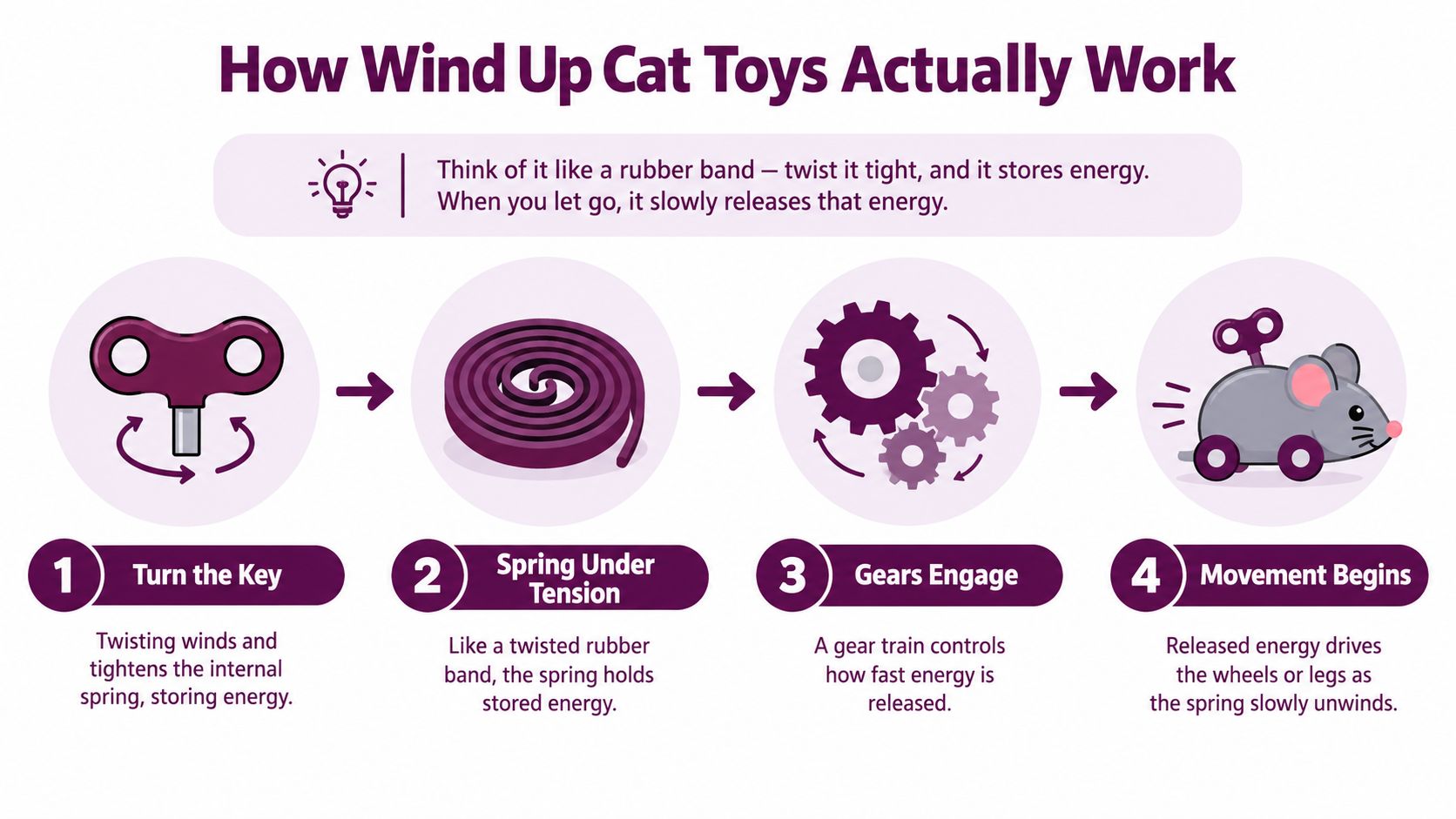
Each part has a specific job:
- The mainspring stores energy. The key tightens the spring. Extra turns can store more power, but forcing the key may damage the mechanism.
- The gear train transfers energy. Small gears control how quickly the spring's release reaches the wheels or moving limbs.
- The speed control regulates release. This part prevents the spring from releasing everything at once, helping the toy crawl, roll, or scurry instead of lurching forward.
- The output parts produce movement. Wheels can create a straight path, offset axles can make the body wobble, and shaped legs can imitate crawling.
The battery-free design means there is nothing to charge or replace before playtime. It also avoids the specific risk of a cat chewing into a battery compartment, a concern covered in our guide to electronic cat toys. Small detachable pieces can still create a hazard, so supervision remains important.
For a visual explanation, this mechanical wind-up toy demonstration shows the principle in action. The movement changes as the spring unwinds. Force gradually decreases, and the toy slows before stopping.
A well-made toy should move smoothly, without immediate grinding, binding, or wobbling. This guide to wind-up mechanisms describes a useful practical check: a fully wound toy should complete a smooth cycle without binding and produce at least 10 seconds of motion without excessive turns. Floofie's rule is simple: if the toy squeaks like an unhappy cupboard, inspect it before granting playtime approval. 🛠️🐾
What Makes One Wind-Up Toy Better Than Another
Two toys can look equally charming on a product page and behave very differently on the floor. The useful comparison isn't the printed face or the number of decorations. It's the relationship between materials, motion, construction, and repairability.
A sturdy ABS plastic body usually handles impacts better than thin vinyl, especially if your cat sends the toy into table legs. Synthetic flocking can be easier to clean and more consistent than delicate real fur, while a protected metal spring generally offers more dependable service than a mechanism that relies heavily on flexible plastic. Those choices don't guarantee safety or longevity, but they give you clues about how the toy may cope with ordinary play.
Motion matters just as much. A straight-line toy can work well in a hallway, while a figure-eight or irregular path gives a curious cat more to follow. The best match depends on your floor plan and your cat's habits, not on a claim that one trajectory suits every feline.
A practical comparison
| Feature | Budget Toy | Quality Toy |
|---|---|---|
| Body | Thin plastic or vinyl with flexible seams | Rigid body with secure, well-finished seams |
| Mechanism | Rough winding, noticeable wobble, limited protection | Smooth winding with enclosed gears and stable axles |
| Motion | Mostly straight or repetitive | Varied crawling, rolling, zigzagging, or wobbling |
| Key | Small, awkward, or loosely fitted | Easy to grip and firmly attached |
| Impact resistance | May deform after collisions | Better chance of surviving ordinary bumps |
| Repairability | Usually replaced when damaged | May offer accessible parts or a serviceable design |
Run time deserves a little skepticism. A toy may move for thirty seconds to two minutes, but a longer run isn't automatically more enriching for a short-burst hunter. Cats often benefit from a pause that lets them reset and choose whether to pursue again.
Look at the gear housing for cracks, the winding knob for sharp edges, and the axle for excessive side-to-side movement. If the toy becomes unusable after one collision, its low price may not represent good value. A replaceable key, accessible wheel, or repairable outer shell can matter more than extra decoration.
Before adding another item, compare it with guidance in FloofChonk's cat toy guide, then choose based on how your own cat plays. Floofie has never been impressed by a glittery feature list when a plain mouse is the toy that gets chased. 😼
Matching Toys to Your Cat's Personality
Cats don't all hunt the same way. One may charge at anything that moves, another may wait behind a doorway, and a third may need several calm introductions before deciding that a mechanical creature isn't suspicious.
| Cat Personality | Best Wind-Up Motion | Toy Examples |
|---|---|---|
| Bold hunter | Fast, irregular movement | Darting wind-up mouse, skittering mechanical spider |
| Long-distance chaser | Smooth travel across open space | Gliding mouse, rolling creature |
| Cautious explorer | Slow, low-to-the-ground movement | Crawling insect, waddling bug |
| Senior or easily tired cat | Gentle, predictable bursts | Slow roller, softly wobbling creature |
| Ambush specialist | Short runs that disappear behind objects | Compact mouse, low-profile crawler |
Born hunters often enjoy erratic movement. Bengals, Abyssinians, and energetic domestic shorthairs may prefer a mouse that changes direction or a spider that skitters in a way they can track from a crouch. Give these cats room to stalk, but remove obstacles that could turn a hard pounce into a collision.
Chasers want distance. Younger cats and high-energy breeds may engage more readily with a toy that travels across an open floor instead of stopping immediately beside their paws. A hallway can become a useful play lane, provided the toy doesn't roll toward stairs or inaccessible gaps.
For a shy or senior cat, start close and slow. A crawling insect or waddling creature gives the cat time to observe without being overwhelmed by sudden speed. Confidence grows when your cat controls the distance, so don't send the toy directly at their face.
The matching process is more useful than a universal “top toy” list. Watch what Floofie watches: Does your cat lock onto motion, follow sound, or wait for an object to pass? Choose the movement that supports that preference, and you'll create enrichment instead of another forgotten object beneath the sofa.
The Case for Simple Over Fancy
A toy with flashing lights, electronic sounds, and multiple moving sections can look exciting to a human shopper. Cats often care about something simpler: does the object move in a way worth chasing?
A plain mechanical mouse can create that answer without asking you to charge a battery or replace a sound module. A crawling bug can be quieter than a gadget that chirps at every turn. For cats who startle easily, fewer sensory inputs may make play feel inviting rather than chaotic.
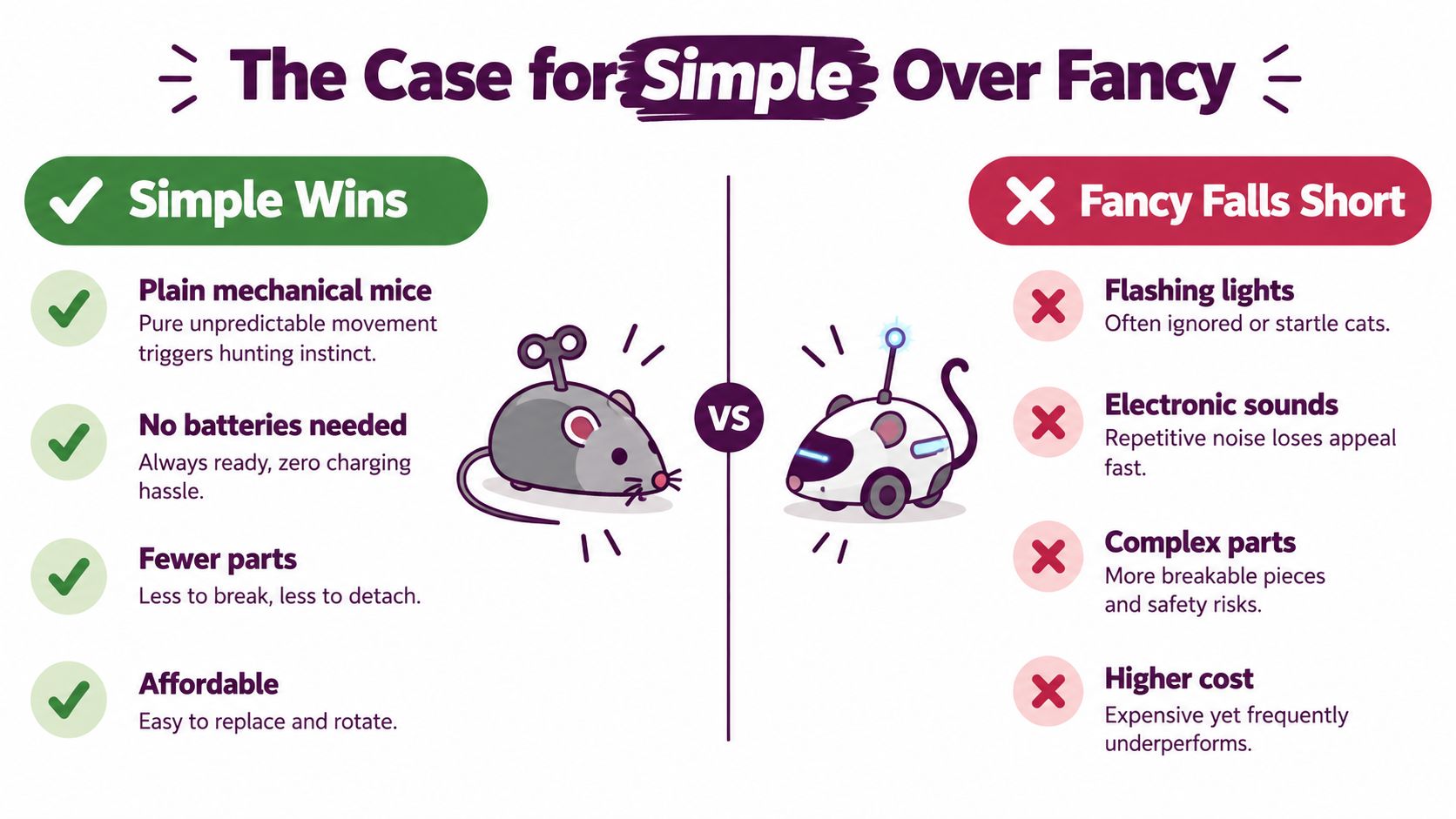
Complexity also adds potential failure points. Every loose decoration, exposed battery cover, glued-on feature, or detachable attachment creates another component for an enthusiastic chewer to investigate. That doesn't make every fancy toy unsafe, but it does mean you should inspect more carefully.
A thoughtful mechanical design can provide more useful play than a crowded feature list.
Simple options can be easier to rotate, replace, and store. If one toy becomes boring, you can put it away and bring it back later without maintaining a charging routine. The lower purchase price of many basic toys also makes it easier to keep several motion types available, such as a mouse for stalking and a roller for chasing.
The safety concern is practical, not philosophical. Independent feline toy guidance warns that small bells, pom-poms, glued-on parts, feathers, and similar pieces can break away during play. A cat that mouths every toy may be better served by a simpler object with a secure body and fewer parts to detach.
Floofie's verdict? Fancy isn't forbidden. It just has to earn its complexity. If the lights startle your cat, the sound gets ignored, and the decorative parts loosen, the plain wind-up mouse wins by a whisker. 🐭
Safety Checks Every Cat Parent Should Do
A moving toy deserves a moving inspection. Before Floofie allows a new wind-up toy onto the playroom floor, I use a quick check that looks at both the outer body and the mechanism.
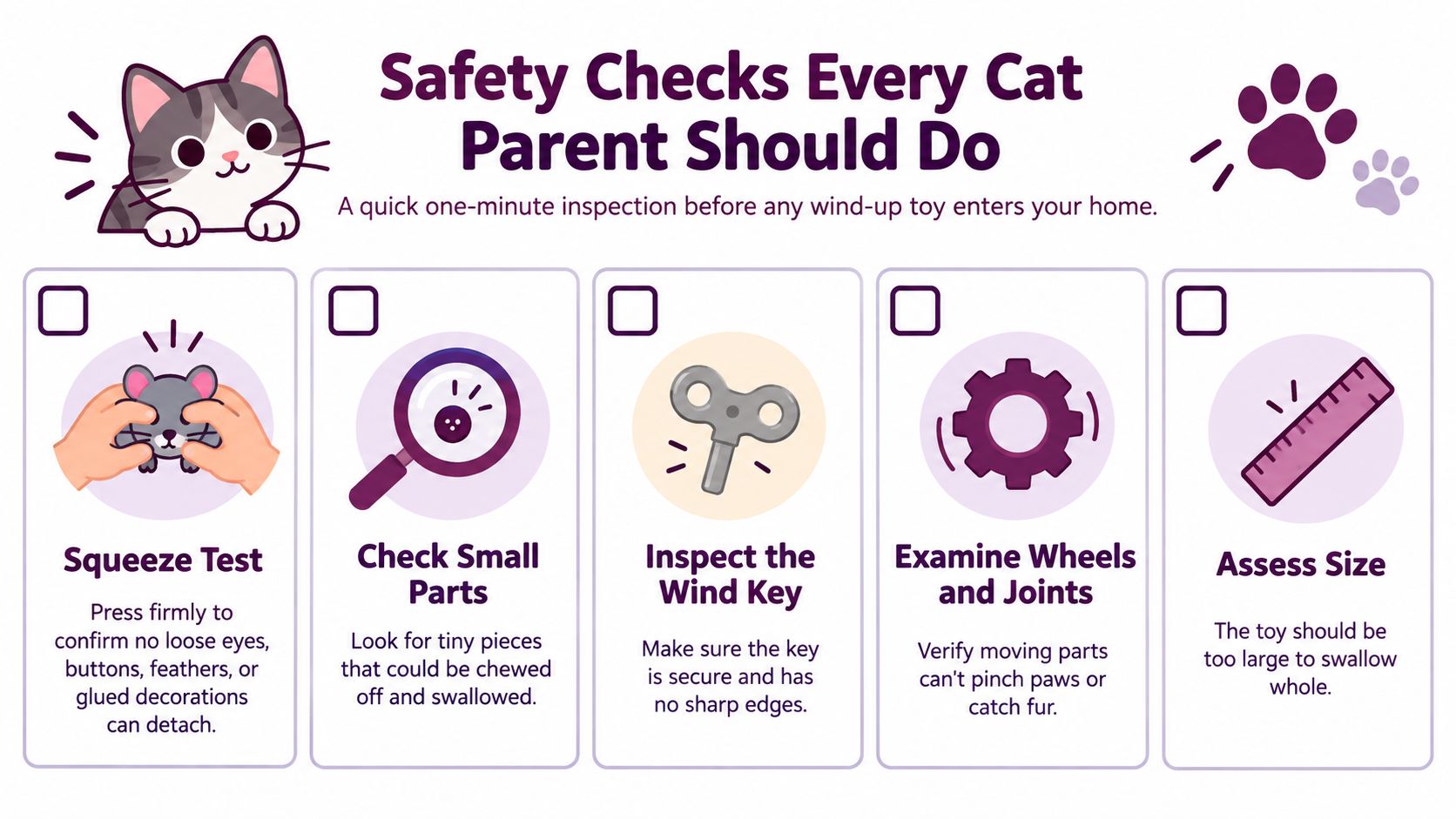
Start with the body
- Squeeze the toy firmly. Press around the eyes, buttons, feathers, fabric, and glued decorations. If anything shifts, cracks, or peels, don't offer it.
- Search for detachable pieces. Look along seams and beneath decorations for anything a cat could bite free. A part that seems harmless in your hand can become dangerous once a determined jaw gets involved.
- Check the size. The toy should be too large for your cat to swallow whole and large enough that you can retrieve it easily if your cat grabs it.
A U.S. consumer-safety definition describes a small part as an object that fits entirely into a small-parts cylinder without compression, in any orientation. That rule applies to children's products, not as a direct feline-toy testing standard, but it illustrates why tiny components deserve serious attention. The CPSC small-parts guidance explains the choking, aspiration, and ingestion concern clearly.
Then inspect the moving parts
Turn the key gently several times. Grinding, stiffness, sharp edges, or a wobbling axle can signal a poor fit or damaged mechanism. Check wheels, joints, and gaps for places where claws or fur could catch.
If the product lists material information, look for a non-toxic finish and labels such as BPA-free, pet-safe, or child-safe. Those labels don't replace supervision, especially for cats that chew aggressively.
Stay nearby during the first session. Put the toy away at the first sign of fraying fabric, an exposed spring, a cracked housing, or chewing that weakens the structure. A quick pause can prevent a small defect from becoming a swallowed piece or a veterinary emergency.
Tips for Introducing a Wind-Up Toy
Some cats chase a new toy immediately. Others treat it like a suspicious parcel delivered by the International House of Cats. A gentle introduction gives cautious players control and helps them learn that the clicking sound predicts something safe.
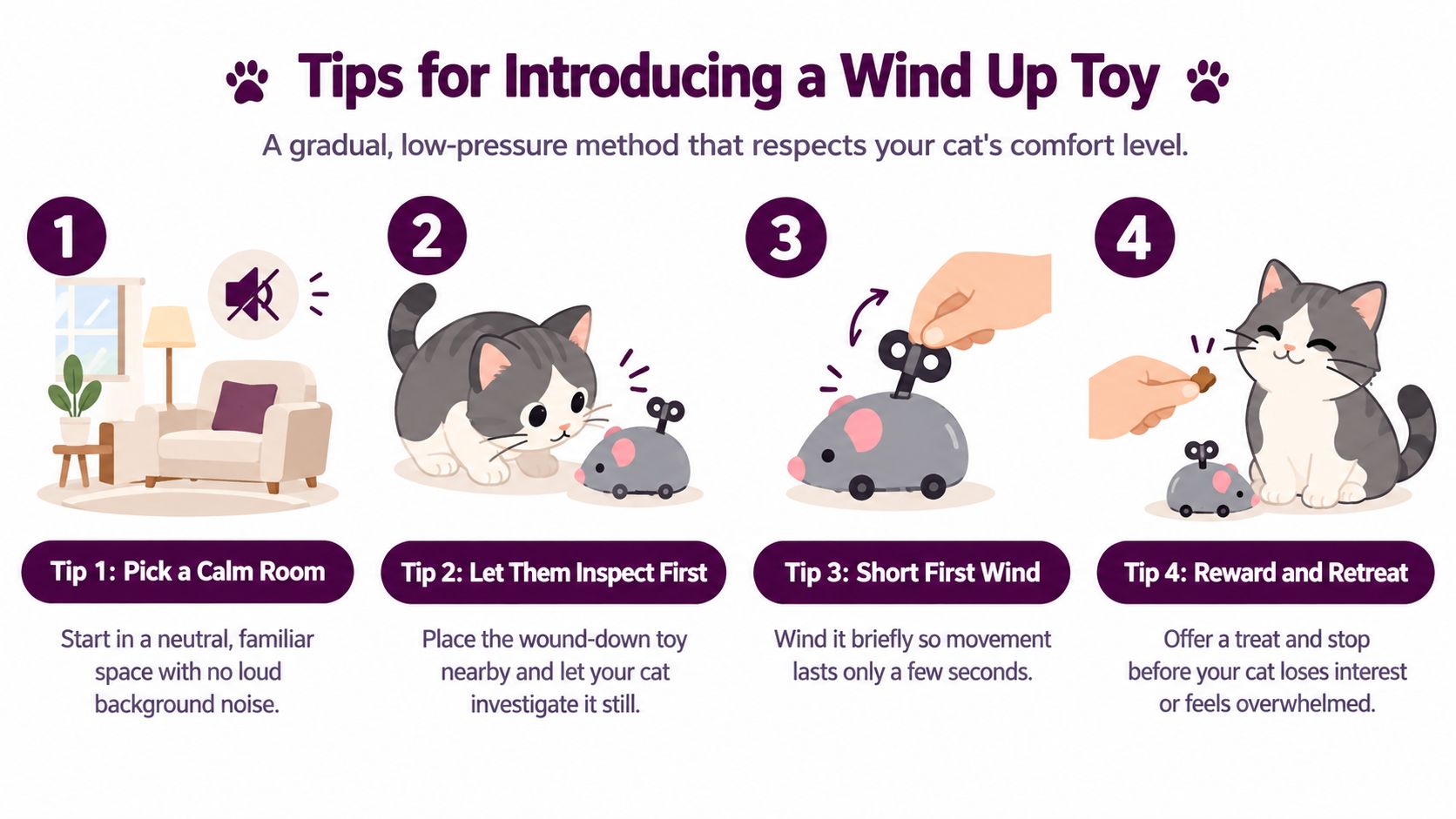
- Choose a calm room. Pick a familiar space without loud music, busy foot traffic, or other pets rushing through. Your cat should have an easy retreat.
- Let the toy sit still. Place the wound-down toy near a cat tree or another comfortable spot. Give your cat time to sniff it without movement.
- Make the first wind brief. Demonstrate the winding sound from a short distance, then release only a few seconds of motion. Sit nearby and avoid pushing the toy toward your cat.
- Reward and retreat. Offer a treat, gentle praise, or a familiar wand toy when your cat investigates. Stop before your cat becomes overwhelmed or loses interest.
For a particularly cautious cat, place the inactive toy near a food dish or the base of a cat tree, but keep it far enough away that it doesn't interfere with eating or resting. Familiar scent can make the object feel less strange.
The winding sound should become part of a predictable routine. Wind the toy where your cat can see you, let it move briefly, then allow quiet time. If your cat backs away, don't chase them with it. Floofie believes consent is the secret ingredient in every successful play session. 🐾
Rotate the toy with two or three others so novelty doesn't vanish overnight. Store wind-up toys in a sealed bag between sessions if you want to preserve their fresh scent, and keep each session short enough that your cat finishes curious rather than frustrated.
Floofie's Final Paw of Approval
The right wind-up toy isn't the one with the loudest feature list. It's the one that fits your cat's preferred hunting style, moves reliably, and survives close inspection. A bold hunter may need a darting mouse, while a cautious senior may prefer a slow crawler that stays within easy reach.
Floofie's routine combines three habits: match, inspect, introduce. First, observe whether your cat stalks, chases, ambushes, or watches from a safe distance. Next, check the body, key, seams, wheels, joints, size, and finish before play. Finally, introduce the toy slowly, beginning with a still object and a short wind.
The Floofie-approved checklist
Screenshot this before shopping:
- Durable body: The shell and seams stay intact when pressed.
- Secure winding key: The key is easy to grip, firmly attached, and free of sharp edges.
- Smooth motion: The toy rolls, crawls, or scurries without grinding or binding.
- Appropriate size: Your cat can't swallow the toy whole.
- Non-toxic finish: Materials and coatings are clearly identified where possible.
- No small parts: Eyes, bells, feathers, pom-poms, and decorations can't detach easily.
- Matched play style: The speed and path suit your cat's personality.
Start with one versatile, simple wind-up rather than filling a basket with gadgets. Watch what your cat does, then add a different movement only if their reactions show you what's missing. Marketing claims can't tell you whether Floofie prefers a hallway chase, a doorway ambush, or a slow investigative sniff.
If you want to browse cat-focused products alongside your toy search, FloofChonk offers items such as the Smart UFO Cat Toy: Bell & Feather Fun, plus cat-themed accessories and gifts. Treat every product as an option to evaluate, not a universal must-have. The discerning feline gets the final vote.
A good wind-up toy doesn't need to entertain your cat forever. It only needs to create that bright-eyed pause, the twitching tail, and one satisfying pounce before the toy rests and your cat struts away like a champion. That little burst of joy is worth protecting, and it costs far less than a moment of genuine feline delight. 😺
Bring FloofChonk's playful cat collection into your next enrichment rotation, including cat-themed pet products and gifts for devoted feline households. Visit FloofChonk to find a fun companion for your cat's play corner and let Floofie help you shop with maximum whisker wisdom.