
How to Stop Dog from Chasing Cat: A Pawsome Guide 🐾

So, how do you stop your dog from turning your cat into a furry rocket? 🚀 It's a mix of smart management to prevent the chase from ever happening and positive reinforcement training to totally change how your dog feels about their feline roomie.
The goal is to teach your dog that being calm around the cat brings amazing rewards (like super tasty treats!), essentially rewriting that instinct to chase. This is never about punishment, fur-iends; it’s about making the cat’s presence a sign that something wonderful is about to happen for the dog.
Understanding Why Your Dog Chases Your Cat
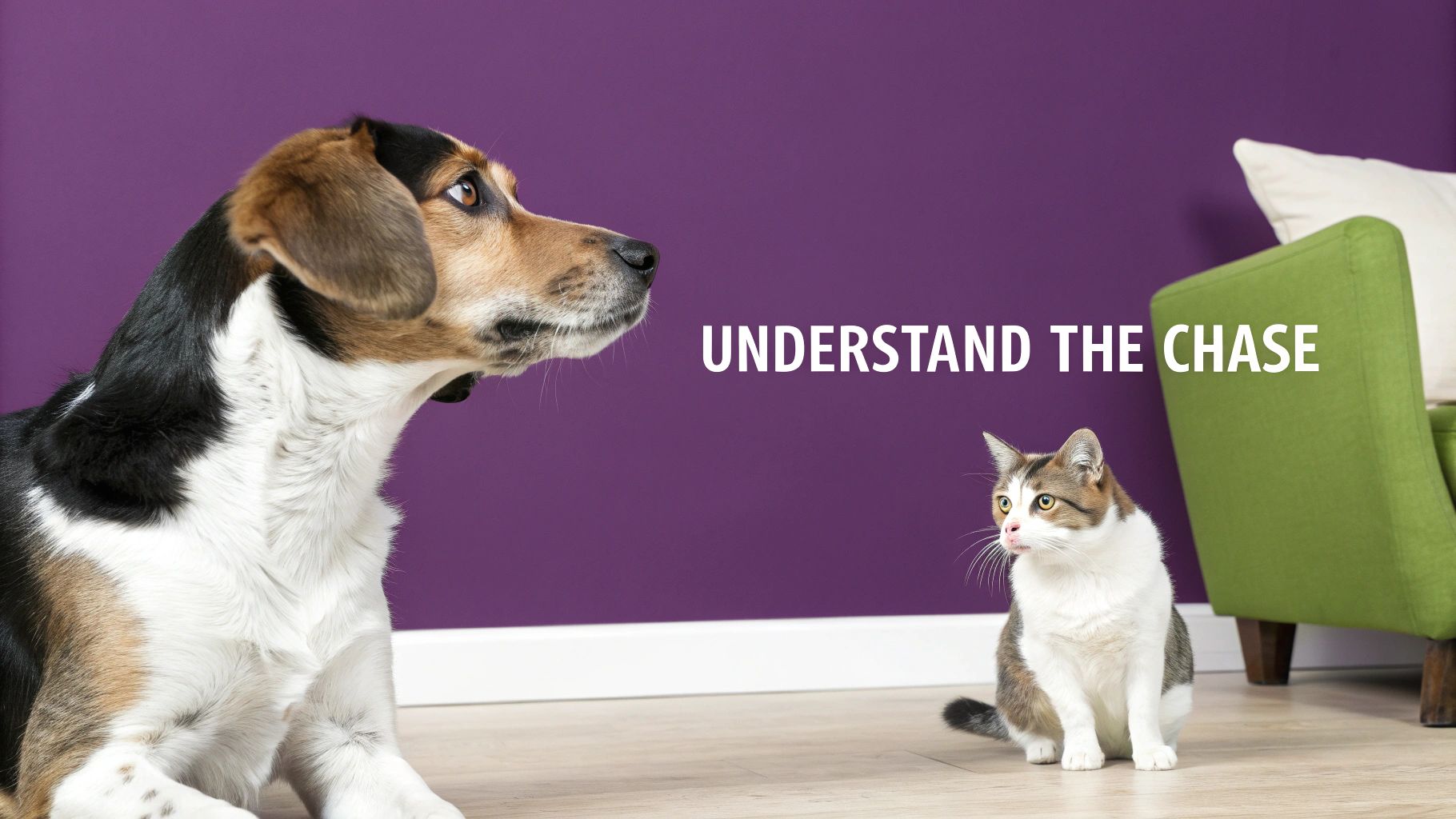
Welcome to the ultimate furry showdown! 🐾 If your living room sometimes feels more like a high-speed action movie, you've come to the right place. The first step in stopping your dog from chasing your cat is figuring out one simple thing: why are they doing it?
It's easy to think your dog is just being a jerk, but the reason is usually way more instinctual. For most dogs, this behavior isn't mean-spirited at all—it's a powerful, deep-seated drive that’s hard to ignore. Our mascot, Floofie, wants you to know that a little empathy for your pup's point of view is the purr-fect starting point for a peaceful home.
The Power of Prey Drive
At its heart, the chase often comes down to a single powerful instinct: prey drive. For thousands of years, dogs were bred to hunt. A small, fast-moving creature—like your elegant kitty zipping across the floor—can flip that ancient switch in their brain that screams, "CHASE!"
This impulse is way stronger in certain breeds. Just think about their history:
- Terriers: These feisty pups were literally created to hunt and take care of small vermin.
- Hounds: Breeds like Greyhounds and Beagles were designed to pursue game for miles.
- Herding Dogs: A Border Collie or Australian Shepherd might see your cat as a fluffy little sheep that needs to be "managed" and herded.
Knowing your dog's breed history gives you a huge clue about the intensity of their chase instinct. It doesn't mean they can't learn better, but it helps you appreciate the challenge you're both up against.
Is It a Game or a Hunt?
Sometimes, the line between innocent play and predatory behavior feels a little blurry. A playful dog will often do a "play bow" (front end down, butt in the air) and take breaks. Their body language is loose, bouncy, and fun.
Predatory chasing, on the other hand, looks completely different. The dog’s body will be stiff, their stare fixed and intense, and their movements quiet and focused. This isn't a game; it's a dangerous situation that needs to be stopped immediately.
Your cat's reaction is also a dead giveaway. A cat who is hissing, hiding, or has flattened ears is terrified, not playing. That level of stress can cause major health problems, so creating a calm environment is a must. You might find our guide on how to reduce cat anxiety helpful for getting your kitty to feel more secure.
Floofie's Insight: Remember, even "playful" chasing is only fun if both pets are into it. If your cat is running for their life, it’s not play—and it’s reinforcing a very dangerous habit for your dog.
Recent studies back this up, showing that a dog's chase instinct is often accidentally reinforced from puppyhood with games like fetch. To fix this, experts suggest a technique called counter-conditioning. You can start by giving your dog high-value treats like our tasty Floofie-approved Calming Chews whenever they see the cat from a safe distance, like 10 to 15 feet away. Research shows this approach successfully rewires a dog's emotional response in 70-80% of cases within four to six weeks of consistent training. You can read more about the science behind pet interactions to see how it works.
Creating Safe Zones and Managing Your Home
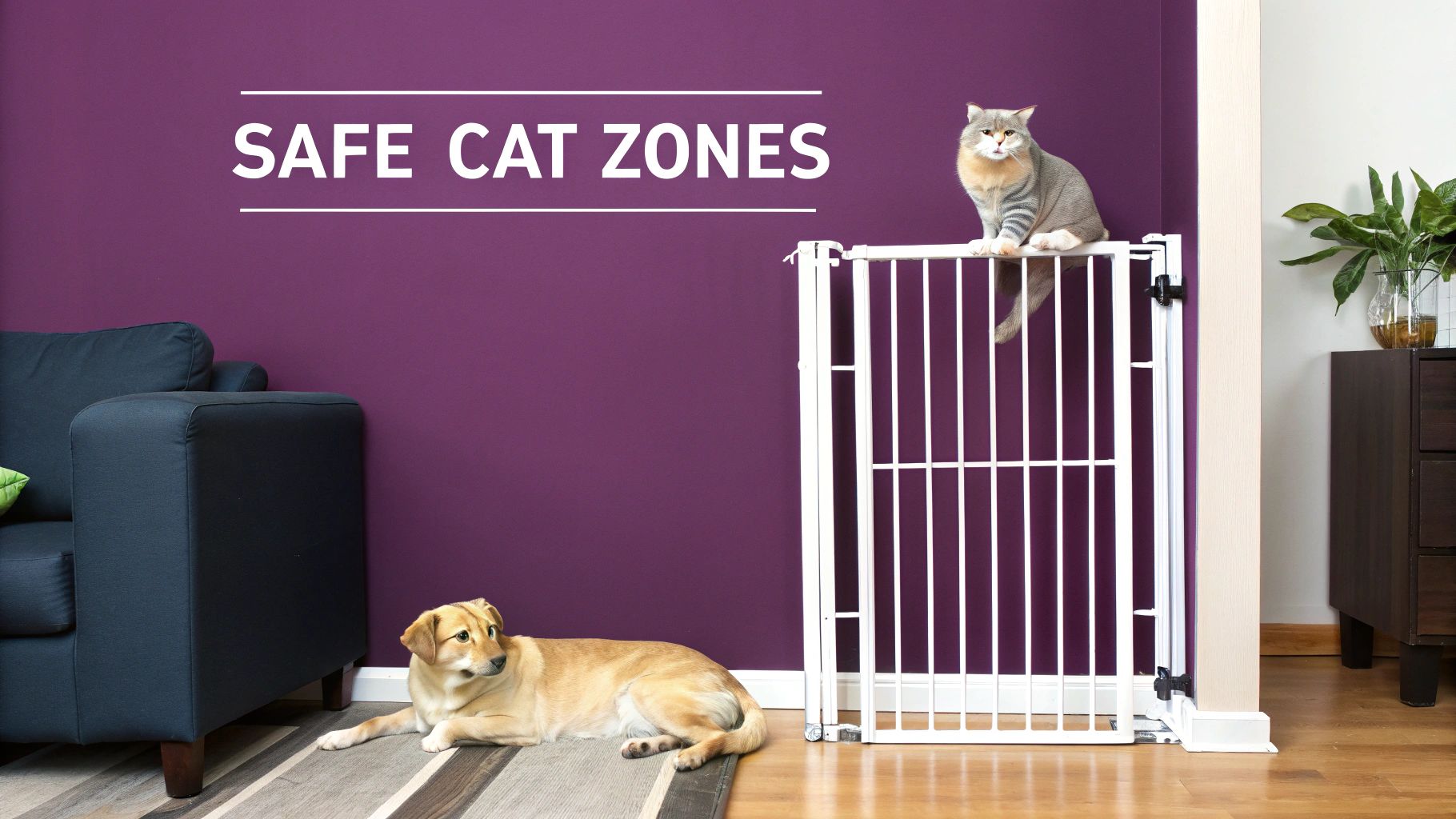
Before you even think about training, your absolute number one priority is making sure everyone in the house is safe. Our mascot, Floofie, insists on it! This first phase is all about management—smart, simple strategies you can implement right now to stop chases before they even start.
Think of it as setting the stage for a successful peace treaty. ☮️ This isn't just about preventing stress; it's about protecting your cat from real harm. A chase can go from playful to dangerous in a split second, and management is your best tool to prevent that.
The Power of Separation and Sanctuaries
The golden rule is pretty straightforward: never leave your dog and cat together unsupervised until you are 100% confident they’ve built a positive, reliable relationship. This process can take weeks, sometimes even months, and that is perfectly fine. The goal here is lasting safety, not a quick fix.
A brilliant way to start is by creating dedicated dog-free zones. This gives your cat a personal sanctuary, a place where they can totally relax without having one eye on the dog. It's their own little VIP lounge, and the pup isn't on the guest list.
A few tools make this super easy:
- Tall Pet Gates: These are an absolute lifesaver. Pop them in doorways to rooms your cat loves, like a bedroom or office. Many have a small built-in door so your kitty can slip through while the dog has to stay behind.
- Microchip Cat Doors: If you're looking for a more high-tech solution, these doors only unlock for your cat's specific microchip. It's the ultimate in exclusive access to their safe space.
Floofie's Top Tip: "A safe kitty is a happy kitty! Make their sanctuary extra special. It gives them a plush spot to de-stress and feel totally secure." 💖
Go Vertical: Give Your Cat an Escape Route
Cats are climbers by nature. They feel most secure when they can survey their kingdom from up high. Giving them plenty of vertical space is like building a network of feline superhighways throughout your home, keeping them safely out of your dog's reach.
Look around your house and see where you can create these elevated escape routes:
- Cat Trees and Condos: A tall, stable cat tree is non-negotiable. Put it in a common area so your cat can still feel like part of the family, just from a safe vantage point.
- Wall-Mounted Shelves: You can create a literal path along your walls with shelves, letting your cat travel between rooms without ever touching the floor.
- Clear Off High Surfaces: Make sure the tops of bookcases, cabinets, and mantels are clear. Your cat will see them as perfect, safe landing pads.
Embracing this vertical strategy is a huge part of learning how to cat-proof your home and creating an environment where both pets can thrive.
Your Home Safety Checklist
Setting up your space for success is the first, most crucial step. Use this quick checklist to make sure you've covered all the bases for creating a safe, harmonious home during this training period.
| Safety Measure | Why It's Important | Floofie's Top Product Pick |
|---|---|---|
| Install Pet Gates | Creates immediate, secure dog-free zones. Prevents unsupervised interactions and gives your cat a guaranteed safe space. | Our favorite gate has a small cat-door so your kitty can pass through easily while the dog stays put. |
| Add Vertical Space | Taps into a cat's natural instinct to climb. Provides high-up escape routes and observation posts, reducing stress. | A multi-level cat tree placed in a corner of the main living area works wonders. |
| Provide Hideaways | Gives your cat places to retreat and decompress if they feel overwhelmed, preventing a "fight or flight" chase response. | A cozy, enclosed cat bed in their safe room offers the perfect spot to feel secure. |
| Separate Resources | Placing food, water, and litter boxes in the cat's safe zone eliminates resource competition and potential conflict. | Keep dog bowls in the kitchen and cat resources in an upstairs room behind a gate. |
| Secure Outdoor Areas | Ensures your dog has a safe place to burn off energy, reducing pent-up prey drive that could be directed at the cat. | Consider building a dedicated dog run if you have the space. |
Taking these management steps seriously lays the foundation for all the training to come. It's not just about barriers; it's about creating a home where your cat feels genuinely secure.
How to Rewire Your Dog's Brain About the Cat
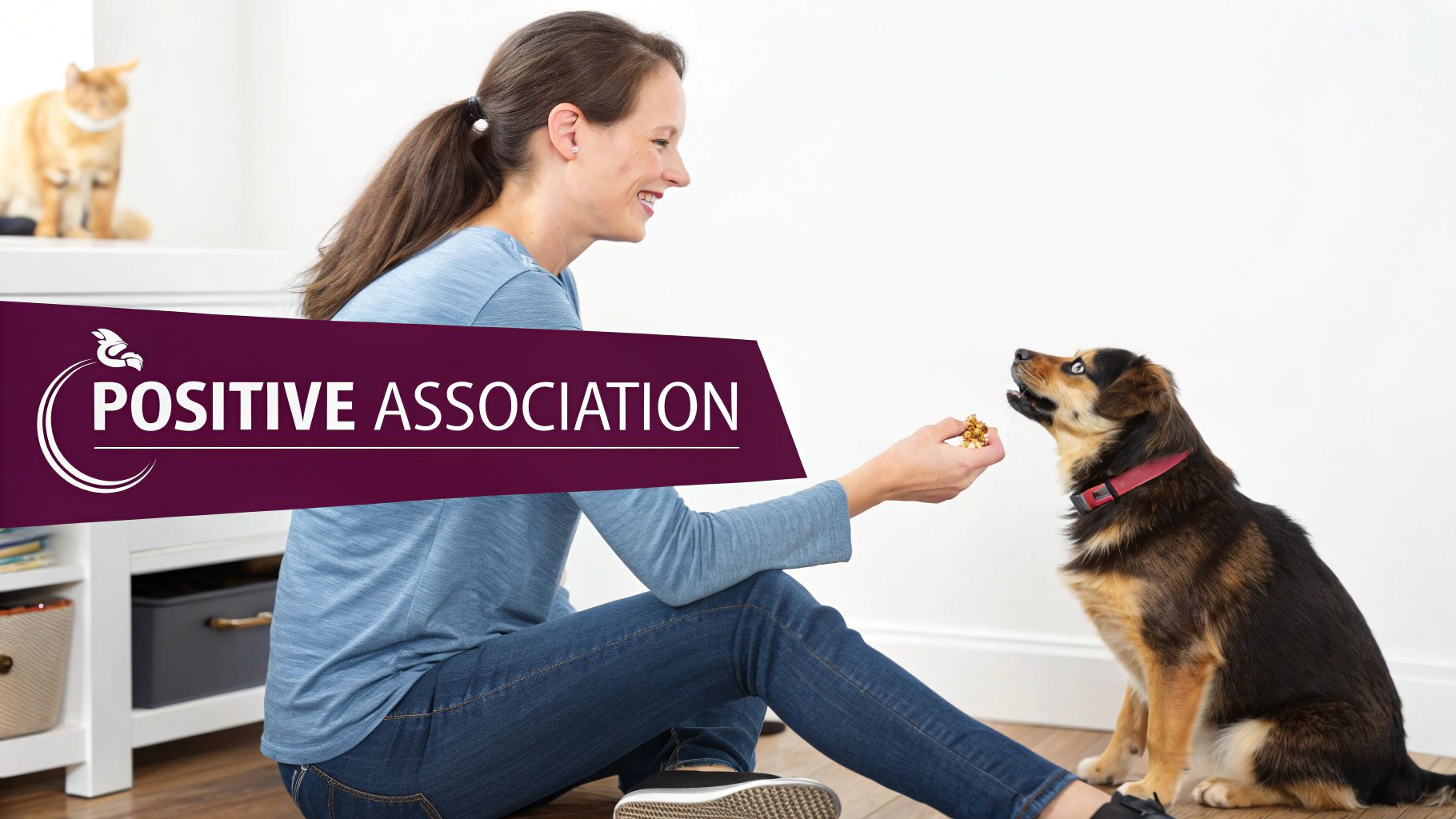
Ready for a little brain magic? ✨ Now that you’ve got your safe zones set up, we can dive into the really cool part: changing how your dog feels about the cat. We're not just trying to manage the chase; we want to stop the thought from ever taking off in your pup's head.
This is where two powerful, science-backed techniques come into play: desensitization and counter-conditioning (DSCC). It sounds complicated, but our mascot Floofie promises it’s easier than it looks!
The goal is to transform your dog's reaction from "OMG, a fluffy rocket I must chase!" to "Oh hey, the cat's here… that means something awesome is about to happen for me!" 🤩
Patience is your absolute superpower here. Rewiring instinct takes time, but every short, positive session is a massive win.
Understanding the Threshold
The single most important concept in this entire process is your dog's threshold. Think of it as an invisible line. On one side, your dog can see the cat but remains completely calm—no staring, whining, or lunging. They're aware, but they're still "under threshold" and able to think and listen to you.
Your first mission is to find this magic distance. It might be across the room, down the hallway, or even with the cat visible through a glass door. This starting point is critical. If your dog is already reacting, they're too stressed to learn a single thing.
The Power of High-Value Rewards
To change a big emotion, you need an equally big reward. Your dog's everyday kibble isn't going to cut it. We need the good stuff, the treats that make your dog’s eyes go wide with pure joy! 🍖
Think of treats that are:
- Smelly and Delicious: Tiny bits of plain boiled chicken, cheese, hot dogs, or amazing goodies like our Floofie-approved Calming Chews.
- Small and Fast to Eat: You'll be giving out a lot of rewards, so keep them pea-sized to avoid an upset stomach.
- Special: Reserve these treats only for your cat-training sessions. This makes them extra exciting and valuable.
You're using these amazing rewards to build a brand new, positive association. The cat's appearance now predicts that the most delicious snacks on the planet are on their way.
Floofie's Pro Tip: "Make it a party every time your dog chooses calm over chaos! Lavish praise, a happy tone, and those super-special treats will show them that ignoring the kitty is the most rewarding choice they can make." 🎉
Chasing is a self-rewarding behavior for dogs. In fact, research shows that when a scared cat runs, it reinforces the dog's chasing 92% of the time. We have to offer something even better than the thrill of the chase. Using counter-conditioning—like treating a dog for calmly seeing a cat from 20 feet away—has been shown to cut chasing incidents in half in just three weeks. Discover more insights about how science can help dogs and cats get along on phys.org.
Playing the 'Look at That' Game
This simple exercise, often called the "Look at That" (LAT) game, is the heart of your training. It’s incredibly effective because it helps your dog learn to make the right choice all on their own.
Here’s how it works:
- Get Set Up: Have your dog on a leash and position yourself at their threshold distance from the cat (who should be comfortable and relaxed, maybe in one of their safe zones). Get your high-value treats ready.
- Wait for the Look: The moment your dog looks at the cat, say "Yes!" in a happy, upbeat tone.
- Reward the Turn: Immediately after you say "Yes!", bring a treat right up to your dog's mouth. They will have to turn their head away from the cat to get it.
- Repeat, Repeat, Repeat: Keep sessions short and sweet—just a few minutes at a time, several times a day.
You are rewarding your dog for simply noticing the cat and then immediately looking back to you for a snack. Over time, something amazing will happen: your dog will automatically look at the cat and then whip their head back to you, expecting their treat. This is a huge milestone! It means they are choosing to engage with you instead of fixating on the cat.
If you're starting from square one, our guide on how to introduce a cat to a dog can give you more foundational tips.
As your dog gets better and stays calm, you can slowly, gradually decrease the distance—maybe by a foot or two each week. If your dog starts to react, you’ve moved too fast. No big deal! Just increase the distance again to where they were last successful and keep practicing.
Building Essential Obedience and Impulse Control
A well-trained dog makes for a happy cat. 🎓 While changing your dog's feelings about the cat is a huge part of the puzzle, it's most effective when you also have some solid, foundational training in your back pocket. This is all about building the skills that give you immediate control to stop a chase before it even starts.
Think of these commands as your communication tools. It's not about forcing your dog to "obey" — it's about giving them clear instructions when their instincts are screaming "CHASE!" Our pal Floofie likes to think of it as teaching your dog a new language: the language of peaceful coexistence! 😻
Mastering the 'Leave It' Command
The 'Leave It' command is probably the single most important skill in your toolbox for stopping a dog from chasing a cat. It's your emergency brake. You're teaching your dog to disengage from something they really want, which in this case, is your fluffy feline. The secret is making ignoring the cat way more rewarding than the chase could ever be.
Start in a quiet room, completely away from your cat.
- Put a boring, low-value treat (like a piece of their kibble) inside your closed fist and let your dog sniff it.
- The instant they turn their head away, even for a split second, say "Yes!" in an excited voice and give them a super high-value treat (like our Floofie-approved Calming Chews) from your other hand.
- Repeat this until your dog is pretty much ignoring your fist right away. They're quickly learning that moving away from the first thing gets them something way better.
Once they've got that down, you can up the challenge. Place the boring treat on the floor, cover it with your hand, and eventually leave it uncovered while giving the "Leave It" cue. Patience is everything here!
The Power of a Reliable Recall
A lightning-fast recall, or 'Come' command, is non-negotiable in a home with multiple pets. It needs to be so automatic that your dog will stop dead in their tracks and turn on a dime to come to you, even if the cat is doing a full-on zoomie across the living room.
The golden rule is this: coming to you must always feel like the best party in the world. 🎉 Never, ever call your dog over for something they hate, like a nail trim or a scolding. That just poisons the cue and teaches them that coming to you is sometimes a trap.
Practice this command all the time. Start inside, then move to a fenced yard, always rewarding them with over-the-top enthusiasm, praise, and their absolute favorite treats or toys. The goal is for your dog to believe that returning to you is the best choice they could possibly make.
Building a Rock-Solid 'Stay'
A good 'Stay' command is a masterclass in impulse control and calm behavior. It’s perfect for those moments when you need your dog to remain still while the cat simply walks through the room. This gives them a specific job to do—staying put—which is much easier for a dog's brain to handle than trying to figure out the "right" thing to do on their own.
Start with super short durations, just a few seconds at first, in a place with zero distractions.
- Ask your dog to sit or lie down.
- Say "Stay" with a clear, open-palm hand signal.
- Take just one small step back.
- Before they have a chance to move, step right back to them and give them a treat.
- Slowly, gradually, increase the time and the distance.
Keep these sessions short, positive, and fun. If your dog breaks the stay, don't get frustrated. Just calmly guide them back into position and try again with an easier, shorter duration.
Floofie's Fun Fact: Did you know that impulse control is like a muscle? The more you work it with games and training, the stronger it gets. A dog with good impulse control is a dog who can think before they act—a total game-changer for cat safety!
Fun Games to Build Impulse Control
Obedience commands are critical, but you can also build general impulse control through fun and games! These exercises teach your dog that waiting patiently and controlling their urges leads to amazing things. That skill directly translates to resisting the temptation to chase the cat.
Try working these into your daily routine:
- Tug of War with Rules: This classic game is fantastic for teaching control. Get a good game of tug going, but every so often, say "Drop it." When your dog lets go, immediately praise them or give them a treat, then start the game again.
- Wait for Your Food: Before you put their food bowl down, ask your dog to sit and wait. Lower the bowl slowly. If they lunge for it, lift it back up. They only get to eat when they stay sitting calmly until you give a release word like "Okay!"
- The 'It's Your Choice' Game: Hold a treat in your closed hand. Let your dog sniff, paw, and lick at your fist. The moment they back off, say "Yes!" and open your hand to give them the treat. This teaches them that being polite, not pushy, gets them what they want.
These skills are the foundation for creating a safe and happy home. For a deeper dive into canine behavior, there are many excellent general dog training articles online that cover these topics. Remember, every minute you spend on this training is an investment in a peaceful future for your whole furry family. 💖
Your Daily Training Plan and Troubleshooting Guide
Let's pull all this great information together into a simple, actionable plan you can actually use. 💖 Consistency is the secret sauce for creating a lasting friendship between your pets, and this guide will help you weave management and training into your daily life without it feeling like a massive chore.
Of course, the path to purr-fect harmony isn't always a straight line. Hitting a few bumps in the road is totally normal! Floofie wants you to know that this is your go-to guide for navigating those inevitable setbacks. You've got this.
A Simple Daily Routine
Building new habits is way easier when the plan is simple. You don't need to block out hours every day for this. In fact, short, frequent, and positive sessions are far more effective. A few five-minute bursts of training can work wonders.
Here’s what a typical day might look like:
- Morning: Before pouring your dog's breakfast, play a quick two-minute round of the "Wait for Your Food" game. It's a fantastic way to build that crucial impulse control right from the start of the day.
- Mid-Day: Use a coffee break or a moment between meetings for a fun "Look at That" session. With your dog on a leash, let the cat wander by at a safe distance and reward every single calm glance your dog gives. Keep it short and always end on a high note!
- Evening: While you’re unwinding, have your dog practice a 'Stay' on their bed while you give your kitty some love across the room. Reward your dog’s calm behavior with a special chew. For your cat, a few tasty treats like our Floofie-approved Calming Chews can make these shared moments feel even more positive.
Floofie’s Reminder: "Every single calm moment is a huge victory! Remember to celebrate the small wins. Each time your dog chooses to look at you instead of the cat, you’re one step closer to a chase-free home." 🥳
Troubleshooting Common Setbacks
Even with the best plan, you might hit a snag. Don't panic! It’s all part of the process. The key is knowing how to respond calmly and effectively when things don’t go as planned. This isn't failure; it's just your dog giving you data on what to adjust.
My Dog Barks and Lunges at the Cat
If your dog suddenly starts barking or lunging, it’s a clear sign they are over their threshold. They're too stressed out to learn, and their brain has snapped back into reactive mode. That chase instinct is powerful, and this reaction is telling you the situation is just too intense for them right now.
Your immediate action plan is to create more distance. Calmly lead your dog away from the cat to a spot where they can settle down. Don't scold them; just increase the space between them until your dog can relax again. For your next session, make sure to start from a much greater distance—a distance where you know your dog can succeed.
My Cat is Too Scared to Participate
What if your cat wants absolutely nothing to do with these training sessions? A fearful cat who spends all their time hiding can make progress feel impossible. If your kitty is too stressed, you must prioritize their sense of safety above everything else.
Make sure their "dog-free" sanctuary is a true paradise. Fill it with cozy beds, favorite toys, and a Feliway Diffuser to promote a sense of security. You can also work on building your cat's confidence separately with interactive play using a fun wand toy. Never, ever force an interaction; let your cat choose when they feel ready to venture out.
Here’s a simple flow to visualize the core impulse control skills that will become your best friends in these moments.
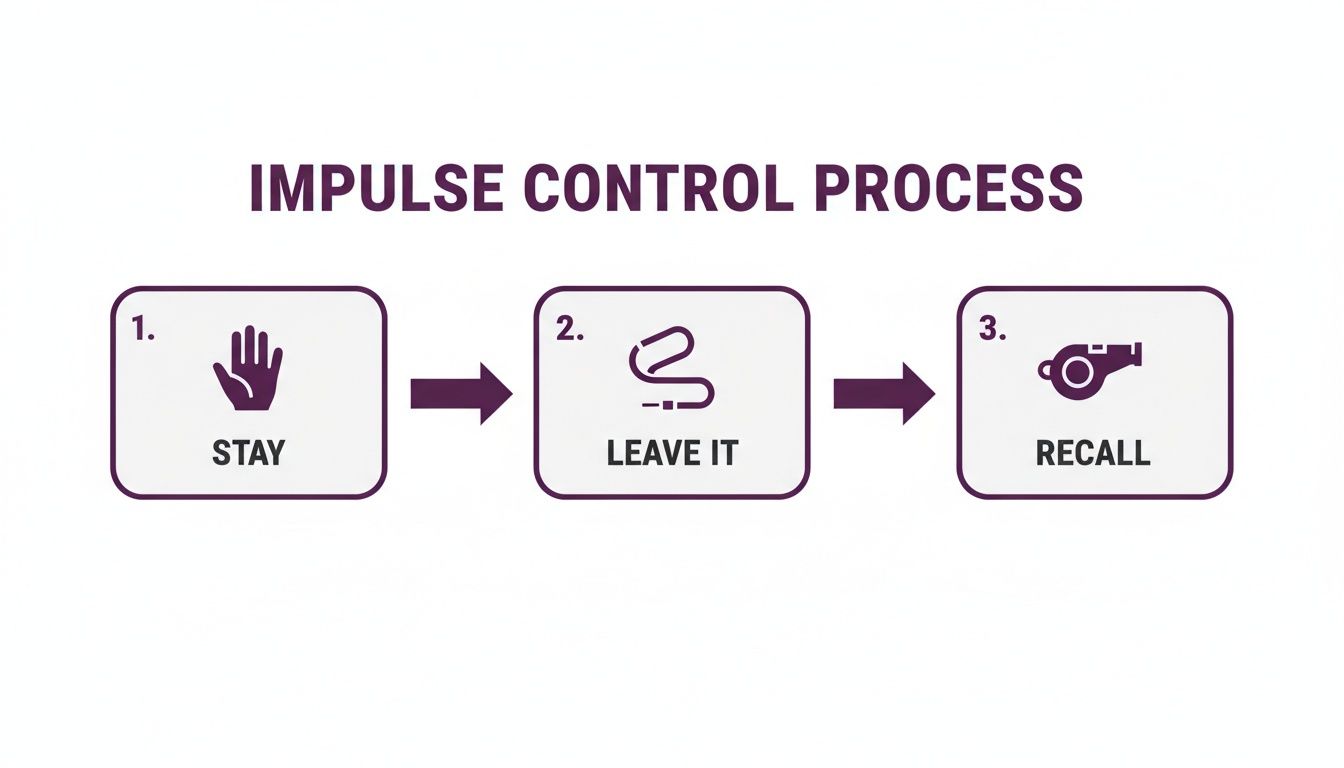
This visual breaks down the essential commands that give you direct control, turning a potential chase into a moment of calm obedience. They're the foundation for a more peaceful home.
Your Top Questions, Answered
Bringing a dog into a home with a cat is a journey, and it's totally normal to have questions. Here are some of the most common ones we hear from our community, with a little help from Floofie himself! 😺
How Long Will This Actually Take?
Every pet household is its own little universe, so there's no magic number here. For some, things click into place within a few weeks. For others, it's a slow burn that can take several months.
Your timeline really depends on a few key things: your dog's breed and background, your cat's confidence level, and—most importantly—how consistent you are with the training. Just be patient and remember to celebrate the small stuff. Every peaceful moment they share is a huge win!
Is This Play, or Is It Something More Serious?
This is a really important distinction to make. True play is usually bouncy and loose, with lots of breaks. You might even see a classic "play bow" from your dog (you know, the butt-in-the-air pose!). Predatory chasing, on the other hand, is stiff, silent, and intensely focused.
Keep an eye out for these red flags:
- Your Dog's Body Language: A rigid body, a low stalking posture, or a fixed, unblinking stare is not playful.
- Your Cat's Reaction: If your cat is hissing, spitting, flattening their ears, or frantically trying to escape and hide, they are terrified.
If your cat is showing any signs of fear, it is not play. The chasing needs to stop immediately. A stressed-out kitty is a serious issue, and creating a sense of safety is your top priority. A calming tool like our Feliway Diffuser can be a great way to lower the tension and help your cat feel more secure.
Can Some Dogs Just Never Be Trusted with Cats?
Honestly? In some rare cases, yes. A dog with an incredibly high, deeply ingrained prey drive might never be 100% safe to leave alone with a cat, no matter how much training you do. And that’s okay.
The goal isn't necessarily a perfect, cuddly friendship. It's peaceful coexistence where everyone feels safe. For some families, that peace of mind comes from keeping their pets comfortably separated when no one is home to supervise.
If this ends up being your reality, it's not a failure. It's responsible pet ownership. A well-managed home is a loving home, and that’s what matters most.
At FloofChonk, we believe every cat and dog deserves to feel safe, loved, and celebrated at home. If you're looking for more ways to spoil the feline in your life, check out our collection of paw-approved pet products and fun apparel. Visit us at https://www.floofchonk.com to find something special