
Keeping Cats Out of Plants: A Pawsitively Purrfect Guide 🐾

If you've ever come home to find your beautiful fern looking like a chew toy, you are definitely not alone. It seems our feline overlords, including our own mascot Floofie, have a built-in radar for houseplants. But this isn't just random mischief; it's a behavior rooted deep in their natural instincts.
Decoding Your Cat's Plant Obsession
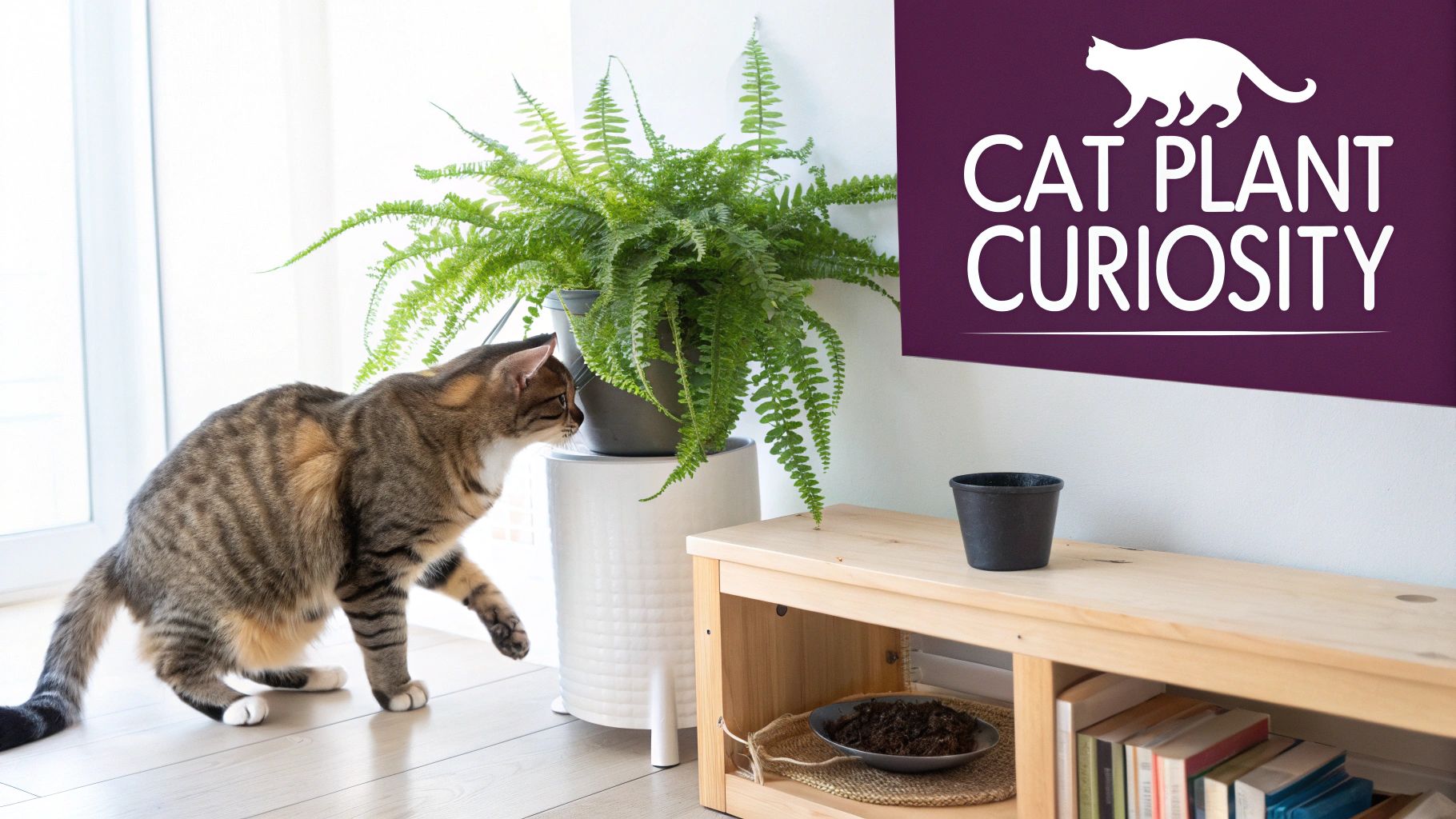
That fascination with your greenery can be traced back to a few key motivators. For many cats, it’s simply about curiosity and play. Those dangly leaves and rustling fronds are just too tempting for a creature born to hunt and pounce. In their world, swatting at a spider plant is just as fun as chasing a laser pointer! Meow-za!
Natural Instincts at Play
Sometimes, the urge to chew is purely instinctual. Wild cats often munch on grass to aid digestion or get certain nutrients. Your indoor kitty is just following that ancient programming, even if your ficus isn't exactly a dietary supplement. Thinking about it this way helps us see them less as tiny plant vandals and more as clever creatures acting on instinct, just like Floofie!
Other big reasons your cat might be obsessed with your plants include:
- Boredom: A cat without enough stimulation will make their own fun, and digging in soft soil is an incredibly entertaining way to pass the time. 😼
- Texture and Sensation: The feeling of leaves brushing against their face or the satisfying crunch of a stem can be very appealing.
- A Prime Perch: Let's be honest, sometimes a large, sturdy planter is just the best vantage point in the room for supervising their human subjects.
Floofie's Big Takeaway: Your cat's plant-destroying habit isn't personal—it's instinctual. It's a mix of their natural drive to play, explore, and even self-soothe. Once we understand the 'why,' we can start tackling the 'how' of keeping cats and plants living in purrfect harmony.
The Hidden Dangers in Your Decor
While a chewed-up leaf is frustrating, the real worry is the potential for poisoning. A surprising number of common houseplants are toxic to cats. This is where keeping them away from your greenery becomes a critical safety issue, not just a matter of home decor.
Lilies, for example, are famously beautiful but are one of the most deadly plants for felines. Veterinary experts warn that even a tiny nibble of two leaves or a bit of pollen can cause acute kidney failure, which is often fatal within 72 hours if left untreated. In 2023 alone, the ASPCA's Animal Poison Control Center handled over 10,000 cases of plant toxicity in cats, with lilies being a major culprit. You can discover more insights about these plant-related dangers and see why being vigilant is so important.
Here’s a quick guide to help you distinguish the good greens from the bad.
Toxic Vs Safe Plants A Quick Reference
| Common Toxic Plants for Cats | Common Safe Plants for Cats |
|---|---|
| Lilies (all types) | Spider Plant |
| Sago Palm | Areca Palm |
| Tulips & Daffodils | Boston Fern |
| Azaleas & Rhododendrons | Money Tree |
| Oleander | Ponytail Palm |
| Philodendron | Calathea (Prayer Plant) |
| Pothos (Devil's Ivy) | Christmas Cactus |
| English Ivy | African Violet |
Of course, this is just a starting point. Always double-check any new plant before bringing it into a home with cats.
Some plants, like catnip, are perfectly safe and can even be a fantastic enrichment tool. If you want to dive deeper into that particular plant, check out our guide on why cats go crazy for catnip. But assuming all plants are harmless is a dangerous gamble you don't want to take.
Creating Physical Barriers And Deterrents
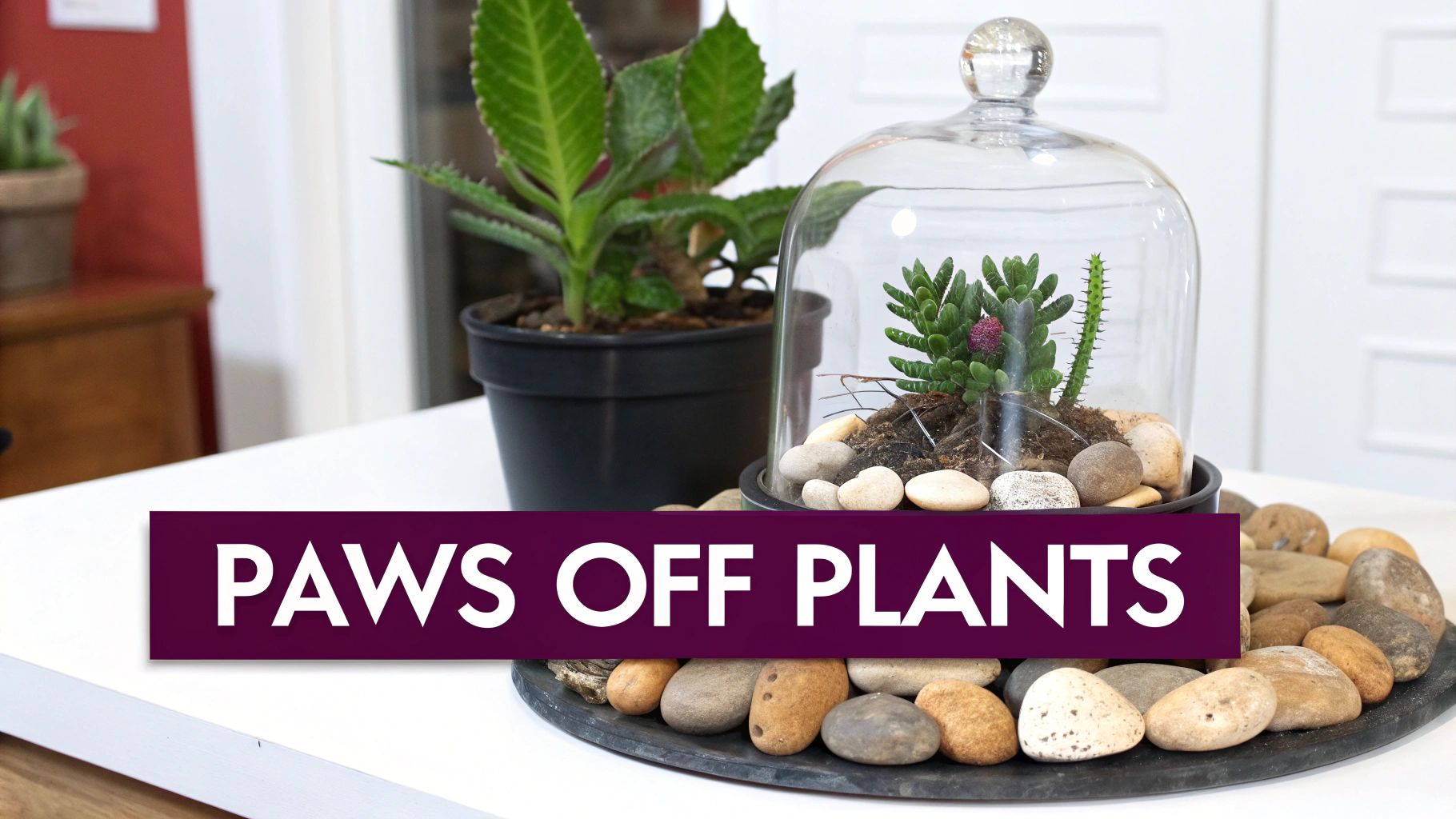
If your cat treats your planters like a personal playground, it's time to build a beautiful, impenetrable fortress for your flora. Creating physical barriers is your first and most effective line of defense. This isn’t about punishment; it’s about making the plant zone a less-than-purrfect spot for feline shenanigans, as our mascot Floofie would say.
The goal is pretty simple: make the plants harder and less fun to get to than, say, a cozy sunbeam. By strategically placing a few obstacles, you can gently guide your furball toward more appropriate activities—like attacking their favorite toys instead of your fiddle-leaf fig.
Make The Soil Uninviting
Cats adore the soft, diggable texture of potting soil. To them, it’s basically a miniature, custom-built litter box. The first order of business, then, is to make that soil feel less like a five-star bathroom and more like something they’d rather avoid.
You can easily do this by covering the topsoil with materials that feel weird on their delicate toe beans. 🐾
- Decorative River Rocks or Pebbles: A layer of smooth, chunky river stones not only looks chic but makes digging pretty much impossible. Plus, if your cat does manage to unearth some dirt, the rocks keep the mess contained.
- Pinecones: They’re prickly, uneven, and just not pleasant to walk or sit on. Arranging a few pinecones over the soil is a natural and surprisingly effective deterrent.
- Lattice or Mesh: For a more custom solution, you can cut a piece of plastic or wire mesh to fit right around the base of your plant. This lets water and air through but keeps paws out.
Use Sticky And Crinkly Textures
Cats are creatures of comfort, and certain textures are a major turn-off. We can use this to our advantage by making the edges of pots and surrounding surfaces feel unpleasant. This is a classic Floofie-approved tactic for keeping cats off counters and out of plants because it works without causing any harm.
A simple change in texture can be more effective than a thousand scolds. A cat who steps on something sticky once is unlikely to try it again. It's a gentle, memorable lesson in "this spot is not for you."
For instance, applying a specially designed pet-safe double-sided sticky tape along the rim of your planters can be a game-changer. Your cat will touch it, dislike the sticky sensation, and quickly decide that countertop is no longer prime real estate.
Similarly, the sound and feel of aluminum foil can be a major deterrent. While it might not win any interior design awards, loosely wrapping the base of a pot or laying a sheet of foil around it can startle a curious kitty enough to make them think twice.
Enclose Your Most Precious Plants
For those extra-special or delicate plants, sometimes the best defense is a beautiful enclosure. Think of it as giving your plant its own little VIP room where paws aren't invited.
A stylish glass terrarium or a decorative cloche can completely protect smaller plants like succulents and air plants while adding a touch of elegance to your decor. If you have a whole collection, a glass cabinet or a dedicated plant shelf with a protective barrier works wonders. It’s the ultimate win-win: your plants are safe, and your home looks amazing. ✨
Using Scents As A Safe Repellent
Let's tap into one of your cat's most powerful assets: their super-snoot! 👃 A cat's sense of smell is roughly 14 times stronger than a human's, which is something we can absolutely use to our advantage in the great battle for plant protection. By introducing scents that cats naturally find offensive, you can create a powerful, invisible shield around your greenery.
This is a fantastic, gentle way of keeping cats out of plants without resorting to harsh chemicals or scary tactics. Our mascot, Floofie, might be a professional mischief-maker, but even he will turn his nose up at the right aroma! The goal is simple: make your plants smell unappealing enough that your kitty decides to find a better spot to hang out.
Citrus: The Classic Cat Deterrent
There's a reason citrus is the go-to for cat repellents—it just works! Most cats absolutely despise the sharp, overwhelming smell of oranges, lemons, and grapefruits. It's just too much for their sensitive noses, making it an easy, natural, and safe first line of defense.
You can simply place fresh orange or lemon peels directly on the topsoil of your plants. Just remember to replace them every few days as they dry out to keep the scent potent. It's a zero-waste hack that immediately makes your planter a no-go zone for your furry friend. Meow-za!
The idea isn't to make your entire home smell like a citrus grove, but to create a localized scent barrier right where it matters most—the pot itself. A subtle scent to you is a powerful "turn back now" signal to your cat.
DIY Sprays And What To Avoid
If peels aren't your style, a simple DIY spray can be just as effective. These are great for spritzing around the outside of the pot or on nearby surfaces. Just be careful and never spray them directly on your plants, as acids from things like citrus or vinegar can damage delicate leaves.
Safety has to be the top priority here. While the internet is full of suggestions, some common "repellents" are actually dangerous for cats. Never use essential oils like tea tree, eucalyptus, or peppermint. They are highly toxic to felines if ingested or absorbed through their skin, so just don't risk it. Stick to simple, proven, and non-toxic ingredients.
For a safer alternative, our Floofie-approved Cat-Safe Repellent Spray Base is a perfect starting point. You can just add your own citrus infusion for a custom scent that tells your kitty "paws off!"
If you'd rather whip something up from scratch, here are a few super easy, cat-safe recipes.
DIY Cat Repellent Spray Recipes
Making your own repellent is way easier than you think. You probably already have everything you need in your kitchen! These simple recipes use scents that cats dislike but are perfectly safe to use around your home.
| Repellent Type | Ingredients | Instructions |
|---|---|---|
| Citrus Infusion Spray | 1 cup water, peels from 1 lemon or orange | Simmer the peels in water for 20 minutes. Let it cool completely, strain the liquid, and pour it into a spray bottle. |
| Vinegar Solution | 1 part white vinegar, 3 parts water | Mix the vinegar and water together in a spray bottle. Shake it well before each use, as the scent is potent! |
| Rosemary Rinse | 1 cup fresh rosemary, 2 cups boiling water | Steep the rosemary in boiling water just like you'd make tea, for about 30 minutes. Strain, cool, and transfer to a spray bottle. |
No matter which concoction you choose, remember to reapply your chosen scent every few days or after watering to keep it effective. With a little bit of olfactory magic, you can gently guide your cat away from your plants and toward more appropriate adventures. ✨
Redirecting Play And Positive Reinforcement
A cat staring down your monstera isn't always plotting botanical destruction. Sometimes, they're just really, really bored. 😼
When your feline friend turns your ficus into a jungle gym, it's often a cry for help—a sign of untapped energy and primal hunting instincts looking for an outlet. The secret to saving your plants is often less about saying "no" and more about offering a much more exciting "yes!"
Redirecting this behavior is all about enriching their world. Instead of letting the plant be the most interesting thing in the room, we want them to see their toys as the main event. A bored cat will make its own fun, and unfortunately for plant parents, digging in soil and batting at leaves is a top-tier feline pastime.
Unleash Their Inner Hunter
To successfully redirect your cat, you have to think like one. What do they love? Chasing, pouncing, and "capturing" their prey. This is where interactive playtime becomes your superpower. Just scheduling a couple of 15-minute play sessions each day can work wonders.
Wand toys with feathers or ribbons are fantastic because they mimic the erratic flight of birds and bugs. Puzzle feeders are another brilliant option, challenging their clever minds and rewarding them with a tasty snack. It’s a productive way to channel their focus away from your precious plants and onto a more rewarding job.
Remember, a tired cat is a well-behaved cat. A good play session that taps into their hunting instincts provides both mental and physical stimulation, leaving them more interested in a post-play nap than a leafy snack.
For a truly mesmerizing distraction, Floofie’s absolute favorite is the FloofChonk UFO Cat Toy. This interactive toy zips around unpredictably, keeping cats engaged for ages and making your plant pots seem totally dull in comparison. Exploring different types of engaging pet toys for cats can help you find the perfect match for your kitty's personality.
The Power of Paw-sitive Reinforcement
Now, let's talk about rewarding good choices. Positive reinforcement is the secret sauce to effective cat training. It's not about scolding them when they get into trouble; it's about celebrating when they make the right decision. This builds a wonderful, positive association with the behavior you actually want to see.
Here’s how it works in a real-world scenario:
- Catch them being good: You see your cat walk past the plant without a second glance. Immediately praise them with a happy, high-pitched "Good kitty!" and offer a delicious treat.
- Redirect and reward: Your cat starts sniffing the planter. Don't shout! Instead, calmly toss their favorite toy a few feet away. When they chase the toy instead of digging in the dirt, shower them with praise and another treat.
This simple process teaches them that ignoring plants leads to yummy rewards and fun playtime—a much better deal than getting a mouthful of soil. And it's not just a hunch; it's a proven strategy. Studies show that indoor cats provided with enrichment toys and training chew on plants 75% less often. You can learn more about these fascinating findings on feline enrichment and see just how effective prevention can be. 😻
Strategic Plant Placement And Cat-Friendly Greenery
Sometimes, the simplest fix is just a clever bit of rearranging. Think of it like a strategic game of chess—you're just trying to place your leafy kings and queens well out of your furry opponent’s reach. It’s all about working smarter, not harder, to create a home where your cat and your flora can finally call a truce. 🌿
Positioning your most tempting plants up high on inaccessible shelves or bookcases is a fantastic first move. Cats are incredible jumpers, sure, but even the most athletic floof has its limits. A high shelf, far from any launch points like sofas or chairs, can be the perfect safe zone.
Stylish hanging planters are another purr-fectly brilliant option. They keep trailing plants like pothos (which are toxic!) or spider plants (which are safe but still super tempting) completely off the ground. Your cat gets a beautiful, dangling spectacle to watch from below, and your plant gets to live another day. It's an aesthetic win-win!
Designate A Plant Sanctuary
If you’re dealing with a particularly persistent plant-nibbler, you might need to create a dedicated plant sanctuary. This could be a spare room, a sunroom, or even just a corner of your office that officially becomes a cat-free zone. This gives you a special place to enjoy your most delicate or toxic plants without a single worry.
This visual guide breaks down a simple decision tree for what to do when your cat gets a little too close to your greenery.
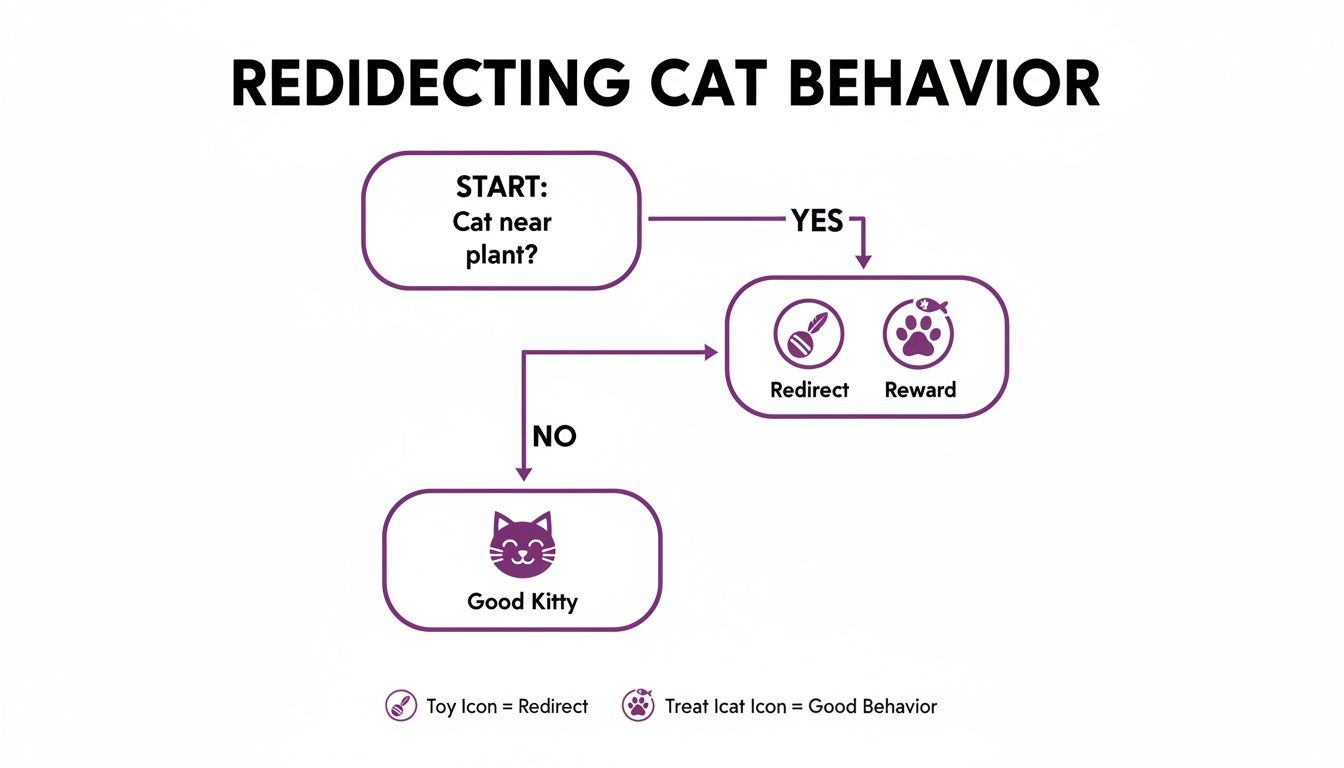
As you can see, the key is to gently redirect their attention toward an appropriate toy and then reward that good choice. It's all about reinforcing positive behavior.
Create A Cat-Friendly Garden
Now for the fun part: giving your cat a plant they can destroy! Why fight their instincts when you can embrace them? Setting up a small, dedicated "cat garden" is a total game-changer. You're giving them their own safe, munchable greenery, which makes your other plants seem far less interesting by comparison.
Here are a few cat-approved plants to get you started:
- Cat Grass: This is usually a mix of grasses like wheat, oat, or barley. It's incredibly easy to grow and provides fiber that can help your cat's digestion.
- Spider Plants: While you might want to keep your big one safe, these are non-toxic, and cats absolutely love swatting at the little "spiderettes."
- Valerian: Think of it as a calmer cousin to catnip. Many cats find the scent of its flowers incredibly relaxing.
Floofie's Top Tip: By giving your cat a designated "yes" plant, you make it so much easier to teach them which plants are a "no." It satisfies their natural craving to chew on greenery in a safe and controlled way.
For those looking to create a beautiful yet cat-safe outdoor space, understanding the basics of designing an effective garden layout can be a huge help. By strategically placing these sacrificial plants in an accessible spot, you create a powerful diversion that keeps your prized houseplants out of the line of fire. 😻
Protecting Outdoor Gardens And Local Wildlife
The grand mission to keep cats out of plants doesn't just stop at the backdoor! When your feline friend has access to your garden, patio, or yard, the challenge becomes a little wilder. It's no longer just about protecting your prized petunias—it's also about keeping your cat, and the local wildlife, safe and sound. 🦉
Letting our cats roam freely outdoors feels natural, but it comes with some serious risks. Beyond your garden beds, a free-roaming kitty can run into traffic, other animals, and dangers we can't always predict. On top of that, their impressive hunting skills can have a huge impact on the local ecosystem.
The Ecological Paw-Print
It’s a tough truth for us cat lovers to hear, but our sweet fluffballs are formidable predators. Their instinct to hunt is incredibly powerful, and it doesn't just switch off because they have a full food bowl waiting inside. And this instinct has a massive effect on local critters.
One landmark study revealed a staggering statistic: in the United States alone, domestic cats are responsible for the deaths of up to 2.4 billion birds and a jaw-dropping 20.7 billion small mammals every single year. These numbers make them the top human-related threat to birds. It’s a powerful reason to think about how our cats interact with the world around them.
Catios: The Purr-fect Compromise
So, how do we let our cats enjoy the fresh air without turning them into tiny neighborhood terrors? Enter the 'catio'! A catio, or cat patio, is a secure outdoor enclosure that gives your kitty all the benefits of the outdoors—sunshine, breezes, and chirping birds—without any of the dangers. Think of it as their own personal, predator-proof balcony.
Catios are the ultimate win-win. Your cat gets to safely experience the great outdoors, your garden remains untrampled, and the local chipmunk population can breathe a collective sigh of relief.
They can be as simple as a window box or as elaborate as a fully furnished screened-in porch. Creating one is a fantastic way to enrich your cat’s life responsibly. If you're looking for inspiration, you can learn how to build a catio for a sliding glass door with our handy guide.
Garden-Safe Solutions
For the garden itself, a few strategic moves can make it much less appealing as a litter box or snack bar. Planting natural deterrents around your garden beds can create a fragrant barrier that cats just don't like.
Most cats dislike the strong smells of plants like lavender, rosemary, and Coleus canina (aptly nicknamed the "scaredy-cat plant"). To prevent digging, you can also place chicken wire just under your mulch or use cat-proof fencing.
And if you're looking to create an outdoor space that's safe for everyone, consider adopting some pet-safe lawn care strategies. Ultimately, providing safe outdoor time and protecting your garden ensures everyone—your cat, your flowers, and the local wildlife—can thrive in harmony. 💖
Got Questions? We’ve Got Answers.
Still scratching your head over a few things? Don't worry, that's what we're here for. We get tons of questions from fellow cat parents trying to find that perfect balance between a happy cat and thriving houseplants. Here are a few of the most common ones.
Is Bitter Apple Spray Safe for My Cat and Plants?
Yes, for the most part. Commercial bitter apple sprays are a solid tool in your plant-protection arsenal. They're designed to be non-toxic but taste absolutely disgusting to cats, which is exactly what you want.
That said, always give the label a once-over to confirm it's safe for your specific plant varieties. And it goes without saying, but never, ever spray it near your cat's face! 🍎
My Cat Ignores Every Single Deterrent. What Now?
So you've got a four-legged supervillain who laughs in the face of citrus peels and scoffs at your sticky tape. If your cat is unusually persistent, it might be more than just a little mischief. It could be a sign of deep-seated boredom or even a health issue like pica—a compulsion to eat non-food items.
If your cat’s plant obsession feels unbreakable despite trying everything, it’s probably time for a quick chat with your vet. They can help rule out any underlying medical reasons and make sure your furry overlord is feeling their best.
In the meantime, try shaking up their routine. Rotate their toys daily to keep things feeling new, and carve out a little more one-on-one playtime. A tired-out cat is a well-behaved cat (usually).
Can You Really Train a Cat to Leave Plants Alone?
Absolutely! It’s totally possible to teach your feline friend what’s off-limits. The secret is all about positive reinforcement. Rewarding them for being good is always going to work better than scolding them for being bad.
Here’s a simple game plan:
- Catch them in the act... of being good. The moment you see your cat chilling near a plant but not messing with it, shower them with praise and a tasty treat.
- Interrupt and redirect. If they go in for a nibble, make a sharp, surprising noise—like a quick clap—to snap them out of it. Immediately toss them an approved toy, like one of their favorite FloofChonk danglers, to show them what they can play with.
- Consistency is key. Just like with any other training, you have to stick with it. Soon enough, your cat will connect the dots: ignoring plants = good things happen.
At FloofChonk, we're all about making sure your home is a happy place for everyone, paws and all. For more fun distractions and enrichment ideas to keep your kitty busy (and your plants safe), check out our full collection of toys and accessories at https://www.floofchonk.com.