
Robotic Mouse Cat Toy: A Cat-Lover's Buying Guide

Your cat has just launched off the sofa after a crumpled receipt, while the fancy toy you bought sits untouched under the coffee table. You'd love to join the chase, but the cat has energy for another round and you've got other things to do. That's where a robotic mouse cat toy can help, provided it gives your cat more than a motorized object to chase.
The best choice supports a little hunt: notice, stalk, chase, pounce, and catch. It should also stand up to claws, teeth, and household scrutiny. Floofie's rule is simple: buy for the whole play sequence, not just the zoomies. 🐾
Why Cats Go Wild for Robotic Mouse Cat Toys
Pixel hears a soft whirr, spots a little mouse-shaped toy scooting across the rug, and drops into a crouch. A second later, she's chasing, batting, and trying to pin it down. Her person gets to enjoy the show without having to drag a wand toy around the room all evening.
That reaction has a behavioral basis. Research on adult domestic cats found that small size, prey-like texture, and movement were strong external triggers for object play. The most intensive play was elicited by moving toys roughly 7 × 5 × 1 centimeters and covered with real deer fur, feathers, or imitation fur, as described in the University of Southampton research on feline object play. A robotic mouse combines a compact shape with motion, two features that can make a toy feel more like something worth stalking than a crinkle ball sitting still.
Movement alone isn't magic, though. In a toy-preference study, cats interacted with moving toys for average reported durations of 59.04 seconds when scented and 58.24 seconds when unscented, compared with 12.27 seconds for an unscented stationary toy. The study also found that 75.2% of cats showed a significant preference for moving toys over stationary ones (the study in Scientific Reports).
The chase isn't the whole hunt
Here's what those seconds of interaction don't show: a predictable loop lets your cat chase but never stage the pounce, and habituation sets in faster than owners expect. The mouse rounds the same chair leg, turns at the same wall, and escapes the same way every time. Your cat's brain solves the pattern, and the game dies.
The fix isn't more speed. It's interruption. A toy that stalls against a wall, pauses mid-route, or slows after a bat creates the window where a crouching cat can commit to the capture. That pause is the pounce, and the pounce is the payoff. Toys with varied routes and occasional stops feed the finish; toys that zip endlessly feed only the first minute.
While you're watching for that capture window, run a quick household check too: a mouse that wedges itself under the radiator or spins near dangling cords creates hazards beyond a bored cat. What's worth buying is a toy that pauses enough to let your cat finish the sequence, and that behaves safely in your actual floor plan. Those are the questions I'd ask before letting a tiny motor loose around a curious set of paws.
What a Robotic Mouse Cat Toy Is Actually Doing Under the Hood
Most robotic mice combine three systems: a trigger, a drive mechanism, and a power source. Understand those parts and product-page jargon gets much easier to evaluate.
First, find the trigger
Some toys start with a button. Others respond to motion or proximity, then wake up when your cat approaches or bats them. A product may call this a sensor or a PIR sensor, but the practical question is the same: what action starts the toy, and does it respond consistently?
A sensor can make play feel more interactive, but it can also draw power while the toy waits. If it wakes whenever someone walks past, the battery may drain without your cat ever getting a turn. Look for clear information about how the toy enters and leaves standby, rather than assuming “automatic” means efficient.
Next, check how it moves
The drive mechanism might roll the body on wheels, vibrate it across the floor, or wiggle a tail. “Dual-motor drive” means the toy uses two motors to produce movement; it doesn't prove that the route will be varied or that the mouse can turn when it meets a chair leg.
That distinction matters because your cat responds to the movement, not the feature name. A small, textured body with motion fits several documented feline play triggers, as the University of Southampton study on cat object play reports. But the toy still needs motion patterns that encourage a pounce rather than a bored stare.
Finally, understand the power
A rechargeable pack needs charging, while a replaceable cell needs secure access and a safe way to store spares. “Sleep mode” usually means some functions pause when the toy isn't in active use. Ask whether the sensor stays on during that pause, and how the company describes runtime under intermittent play.
Don't judge a robotic mouse by its motor alone. A good buyer checks whether the trigger is sensible, the movement supports a hunt, and the battery design fits the household.
Comparing Movement Patterns That Keep Cats Engaged
A robotic mouse can dart in a straight line, wander unpredictably, or move in stop-start bursts. The most convincing prey-like motion isn't necessarily the fastest. It gives a cat time to notice, stalk, chase, and make a catch.
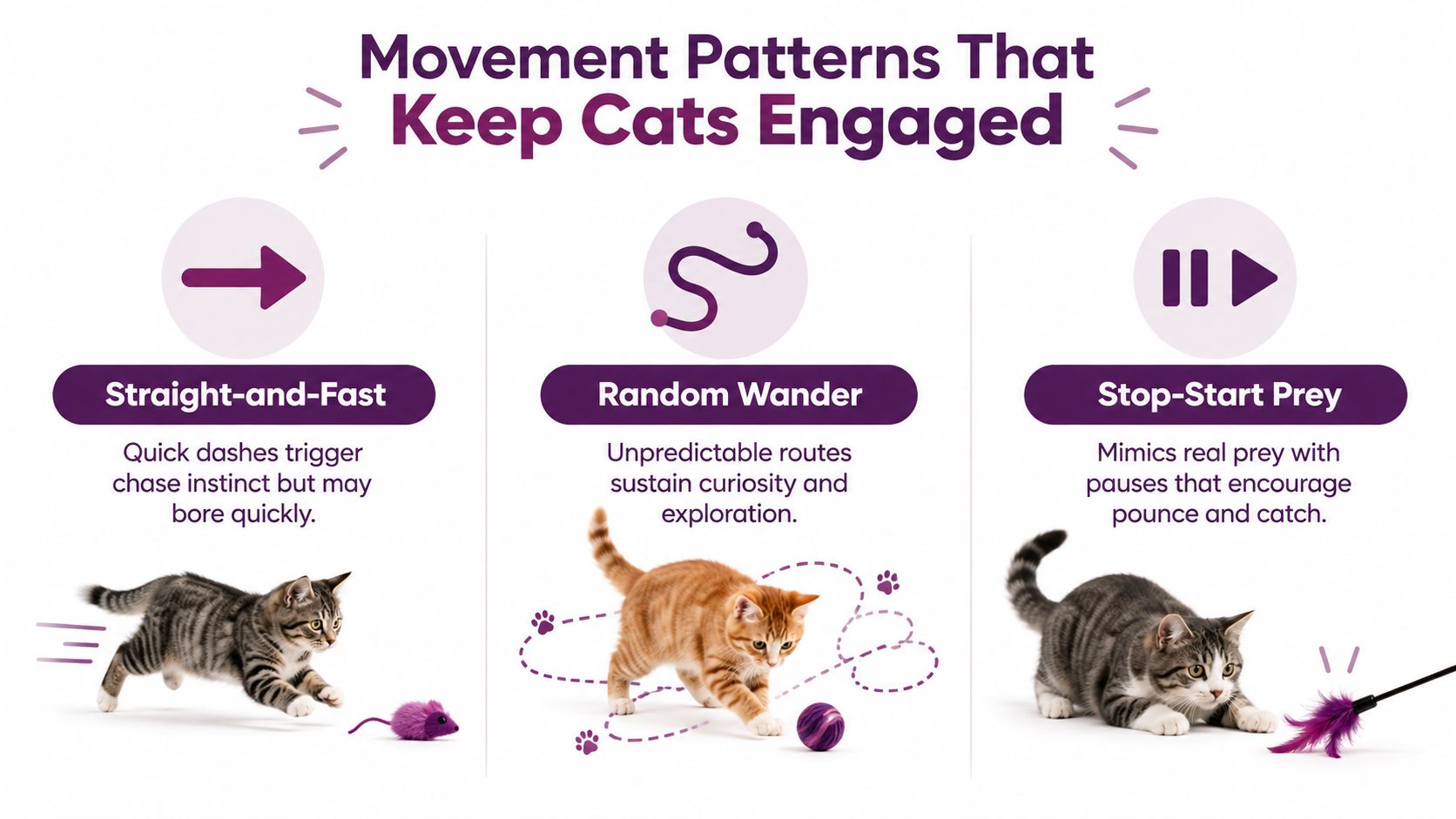
Straight-and-fast motion is an instant invitation to chase. It can suit a cat who likes a quick sprint, but a toy that takes the same route each time may soon feel like a bumper car with whiskers. Repetition can make the chase less interesting, especially if the cat can't catch the target.
Random wandering adds surprise. The mouse changes direction or explores different patches of floor, giving a curious cat more reason to follow. It may encourage stalking and investigation, but “random” alone doesn't guarantee a good finish. If it darts away every time your cat gets close, the chase may never turn into a pounce and capture.
Stop-start prey motion is my favorite to shop for. A pause gives the cat an opening to crouch, spring, and bat the toy. That makes the pattern feel less like a motor racing around and more like a small target reacting to the hunt. Look for pauses and turns that create reachable moments, not just a brief interruption before another escape.
| Movement Pattern Comparison | Engagement Strength | Habituation Risk | Best For |
|---|---|---|---|
| Straight-and-fast | Strong chase prompt, limited stalking | Higher when the route repeats | Cats who love brief sprints |
| Random wander | Encourages curiosity and following | Lower if routes stay varied | Explorers who tire of predictable loops |
| Stop-start prey | Creates opportunities to stalk, pounce, and catch | Lower when pauses and direction changes vary | Cats who want a more complete mini-hunt |
Floofie's pick: Choose varied movement with reachable pauses over a toy that simply keeps scooting away. The cat should get to play hunter, not treadmill passenger.
Battery, Charging, and What the Specs Don't Tell You
“Days of play per charge” sounds handy, but it's hard to compare unless the maker explains how long the toy runs, how often it activates, and what settings were used. I'd rather see a clear description of continuous runtime and intermittent-session endurance than a confident-sounding claim with no conditions.
Rechargeable designs avoid loose replacement cells during ordinary use, but the toy still needs a reliable charging routine. Check whether the charging port is easy for a cat to reach, whether the cable must be removed before play, and whether the battery compartment remains secure if the toy takes a tumble. Store the cable away from cats who chew.
Coin-cell designs may be compact and easy to swap, but tiny batteries bring a serious household hazard. A U.S. Consumer Product Safety Commission warning issued in May 2025 involved pet toys with coin batteries and said swallowing one can cause serious internal chemical burns or death (the CPSC warning about coin-battery pet toys). That warning concerns specific products, not every robotic mouse, but it makes battery access a must-check feature, especially in a home with children.
| Rechargeable vs Coin-Cell Power | Rechargeable | Coin-Cell |
|---|---|---|
| Charging or replacement | Recharged through a port or charging cable | Replaced when depleted |
| Household routine | Remove the cable before play and store it safely | Secure spare cells and keep the battery door closed |
| Buyer check | Inspect port location and battery-door security | Check that the compartment is tool-secured and stays locked |
| Main concern | Chewing or access to the charging cable | Ingestion hazard if a cell becomes accessible |
Ask sellers for the details that affect your real use: charging time, sensor standby behavior, and how they define each runtime claim. If they don't say, don't treat “long-lasting” as a battery test.
Safety Checks Every Buyer Should Run Before Clicking Buy
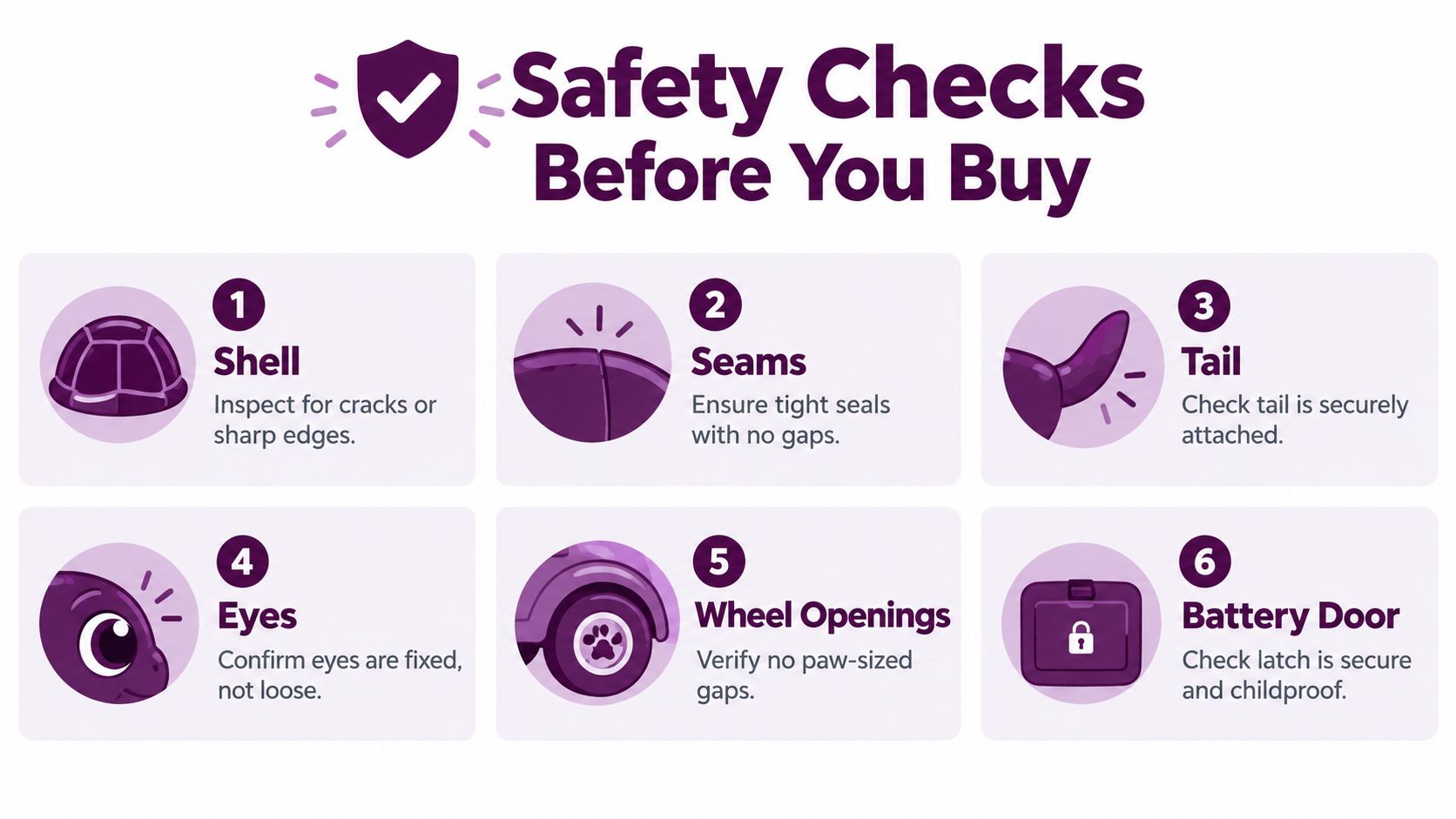
“Pet-safe” isn't a useful promise unless you can see what makes the toy safer. Before buying, zoom in on the shell, seams, tail, eyes, drive openings, and battery door. You're looking for parts that stay attached and gaps that won't trap a paw.
Veterinary guidance from Cornell's Feline Health Center on choosing safe toys advises avoiding toys that shed small pieces or linear strands, keeping chewable electrical cords inaccessible, and checking a toy's battery compartment, seams, and casing for damage before each play session.
Before the first play session
Inspect the product images and description for a firmly secured battery door, sealed electronics, a durable shell, and no loose ribbon or wire. Check whether the wheels or drive openings leave a space where a claw could catch. A tail that looks delightfully mousey in the listing is not a bonus if it dangles loosely or can unravel.
Once the toy arrives, run your fingers along its seams and edges. Reject or return a toy with a cracked casing, sharp edge, loose decoration, or accessible battery. Don't rely on a floor demonstration to tell you how it will hold up to biting.
Before and after every play
Start with a quick inspection: Is the shell intact? Are the eyes, tail, and other parts still firmly attached? Does the battery cover remain closed? Remove charging cables from the play area, and don't leave loose strings or accessories where your cat can chew them.
Supervise the first sessions and watch how your cat approaches the moving parts. Afterward, inspect again for fresh cracks, lifted fabric, loose pieces, or anything that could come off next time. If the toy is damaged, stop using it and retire it. Don't keep a weakened mouse in rotation because it still technically moves.
A cat-friendly design also needs a suitable play area. Clear away objects that might fall during vigorous chasing, and choose a flat zone where you can watch how the toy behaves. The cat's safety depends on the toy's condition and the room it's running through.
The Automation Trap and Why Human Play Still Wins Sometimes
More automation doesn't automatically mean better enrichment. A robotic mouse can start a chase while you're busy, but if it never pauses long enough to be caught, it may leave out the satisfying end of the hunt. Some cats also prefer a toy that responds to a person's movements, so a wand session can offer control and connection that an autonomous gadget can't.
Humane Society of Missouri guidance recommends games that let cats catch and “kill” their prey-like toy, as well as short 10–15-minute play sessions and regular toy rotation (their guidance on cat play and toys). A review discussed in that guidance found that only 22% of surveyed cat guardians reported rotating the toys available to their cats. That's a lot of cats staring at the same old mouse on the same old route.
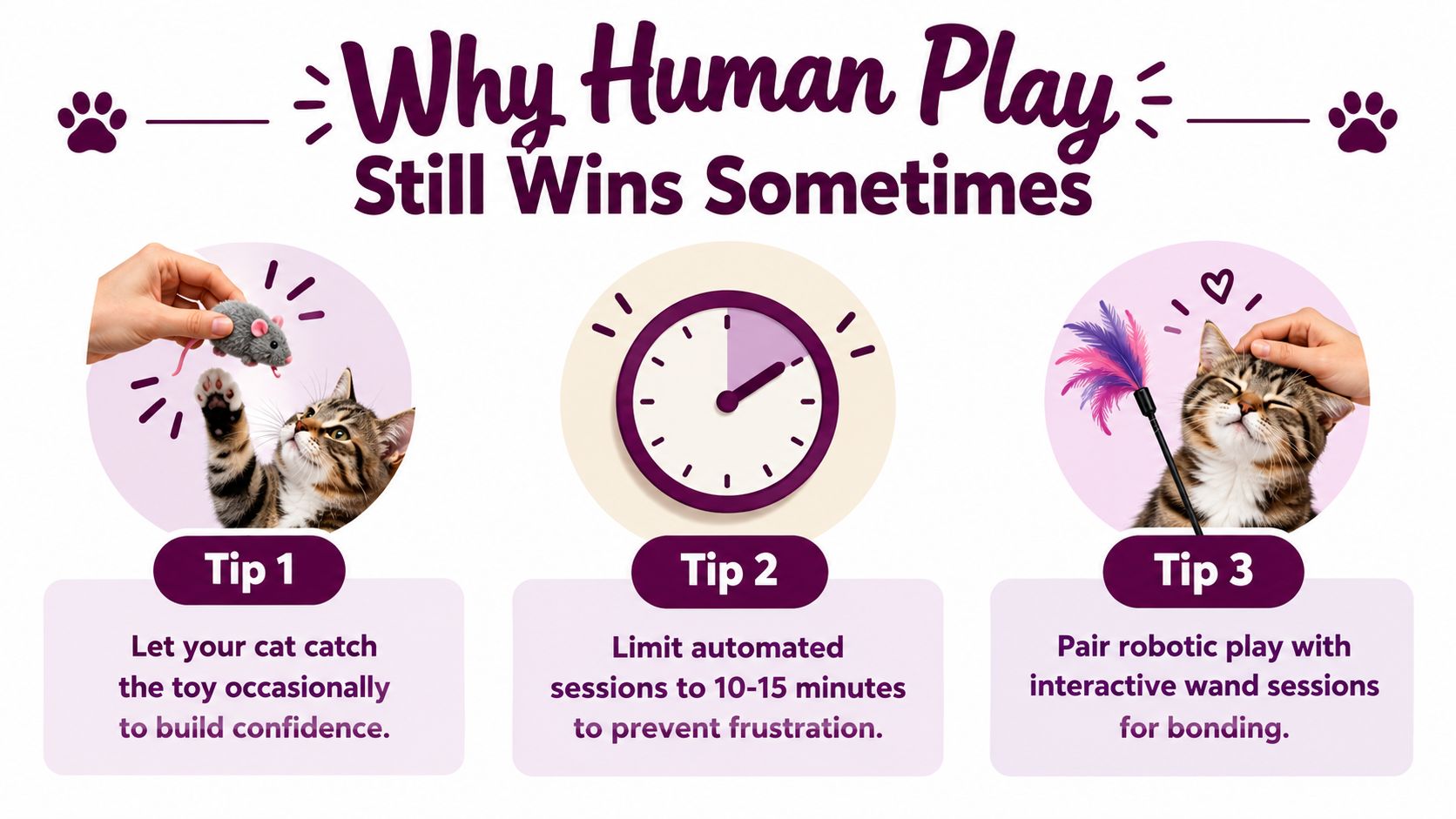
Let your cat catch a wand toy sometimes, change its direction, and give it pauses that invite a pounce. You can use a robotic mouse as one part of that routine, then finish with a toy your cat can grab. The point isn't to make every session elaborate. It's to give your cat a chance to control the hunt instead of chasing an object that always wins.
Floofie approves of automation as a helper, not a substitute for your attention. Rotate toys to bring back novelty, and choose a stopping point before your cat gets wound up or frustrated. 😺
Matching the Right Toy to Your Cat's Personality
Two cats in the same living room will read the same robotic mouse completely differently. One sees prey worth stalking. The other sees a noisy intruder. Match the toy to how your cat hunts, then judge it on whether the movement lets that cat finish the full sequence: notice, stalk, chase, pounce, capture.
The timid apartment cat. Start with a quiet toy that moves gently and pauses often. Put it in an open area, away from the bed and food bowl, and let your cat watch from a comfortable distance before inviting a chase. Those pauses matter. They give a nervous cat room to notice and stalk without a loud, sudden restart breaking the spell.
The high-drive hunter. This cat needs varied routes, sharp turns, and stop-start motion. A straight-line sprint gets the chase going but skips the stalking and pouncing that make a hunt satisfying. Worse is a mouse that never lets itself get caught. Endless fleeing turns fun into frustration, so look for a catchable moment built into the pattern.
The senior slow-poke. Prioritize low noise, manageable speeds, and a shell that is easy to bat and hold. Shorter sessions suit older cats, so a toy your cat can pin down beats one built for speed. Keep the floor clear and let your cat set the pace.
The multi-cat household. Choose a sturdy shell with a secure battery door and no dangling parts that could become a tug-of-war prize. Watch the first sessions closely. If the mouse sparks a scuffle instead of a hunt, switch to individual play.
A mouse shape isn't required. FloofChonk also lists an automatic rolling cat interactive ball toy, described as a rechargeable electric toy that imitates a mouse. For cats that ignore rodent forms but chase anything that rolls, it's a reasonable alternative.
My honest take: the right pick is the one your cat can safely catch, not the one with the longest feature list. 😺
Floofie's Final Verdict and a Paw-Smart Buying Checklist
My recommendation is a robotic mouse that varies its movement, includes catchable pauses, and has a securely closed battery compartment. Skip a toy that promises endless motion but says little about its shell, battery access, or how it behaves when it meets a wall. Floofie likes a good zoom, but a safe, satisfying hunt wins the day. 🐾
Floofie's quick buying checklist
- Movement: Does it pause, turn, or vary its route, and can your cat catch it?
- Safety: Are the shell, seams, tail, and battery door secure, with no exposed wires or loose pieces?
- Battery: Can you tell how it charges, how standby works, and how to keep the battery inaccessible?
- Rotation: Can you put it away and bring it back later, rather than letting the same pattern become background noise?
Are robotic mice worth it for kittens? They can be, if the movement suits the kitten and you supervise play. Choose an intact, secure toy and let the kitten catch it rather than running it endlessly out of reach.
Are they useful for people who work away from home? They can offer a way to start independent play, but don't treat automation as a babysitter. Follow the manufacturer's use guidance, supervise early sessions, and put the toy away if it shows wear or your cat can access its parts.
Can senior cats enjoy them? Yes, if the toy moves gently and doesn't make the cat work harder than they want to. Watch your cat's response and let them choose whether to stalk, bat, or observe.
Buy for three things: behaviorally interesting movement, visible safety controls, and honest battery information. The right mouse should give your cat a chance to hunt, and give you a clear reason to trust the design.
Explore FloofChonk's cat-themed accessories, home décor, and pet products, including its rechargeable interactive toy options. Visit FloofChonk to find a playful pick for your household and give your cat a safer little hunt.