
How to Stop Cats from Fighting: A Paw-some Guide to Feline Peace 😼

So, your home has become a battleground for tiny, furry gladiators. If you're trying to stop your cats from fighting, the first step is always to play detective, figure out what's causing the drama, and then carefully reintroduce them. Our mascot Floofie says the golden rule is simple: Separate them immediately after a serious fight and prepare to press the reset button on their entire relationship.
Understanding Why Your Cats Are Feuding
If your once-peaceful home now hosts a daily kitty wrestling match, take a deep breath. 😮💨 You are definitely not alone in this. Floofie, our resident expert on all things chaos, knows that figuring out why your cats are at odds is the first move toward a ceasefire.
Unlike dogs, cats aren't naturally pack animals. They're solitary hunters at heart who really, really value their personal space and resources.
When you bring multiple cats under one roof, you're asking tiny, territorial landlords to share their kingdom. It's a delicate balance, and it doesn't take much to tip the scales, leading to hissing, swatting, and all-out brawls. But here's the good news: most cat fights aren't random. They have a root cause.
The Main Culprits Behind Cat Fights
So, what’s really sparking all the fur-flying drama? 🙀 Cat conflict usually boils down to a handful of common triggers. Pinpointing the specific cause in your home is your secret weapon for restoring peace.
Here are the most common reasons your furry roommates might be fighting:
- Territorial Tiffs: One cat feels their turf—whether it's a favorite sunny spot or the entire living room—is being invaded. This is the classic "get off my lawn" scenario, feline edition.
- Resource Rivalry: When cats have to compete for food, water, litter boxes, or even your lap, tensions are bound to rise. A feeling of scarcity can turn the sweetest kitty into a grumpy competitor. A purr-fect solution is our FloofChonk Ceramic Elevated Food Bowl to give each kitty their own stylish dining space.
- Redirected Aggression: This one’s sneaky. Your cat spots a neighborhood cat through the window, gets all worked up, but can't reach the outsider. So, they turn and lash out at the closest target—their innocent housemate. 😾
This is an incredibly common problem. In fact, intercat tension affects a staggering 62.2% to 87.7% of multi-cat homes. A study of nearly 2,500 cat owners revealed that 73.3% saw signs of conflict right after a new cat was introduced, and the fighting often gets worse as more cats join the household. You can dive deeper into these fascinating feline findings by reading the full research study.
Floofie's Friendly Tip: Whatever you do, never let them "fight it out." That old advice is a recipe for disaster. It only deepens their animosity and dramatically increases the risk of serious injury. Your job is to be the calm referee who separates the fighters and helps them renegotiate their peace treaty.
Decoding Cat Body Language and Fight Triggers
So, was that a playful pounce or the opening round of a heavyweight feline feud? Welcome to your crash course in cat diplomacy! 🕵️♀️ Our mascot, Floofie, is adamant that learning to speak "cat" is the secret to stopping fights before the fur even starts to fly.
Many owners mistake a serious brawl for just roughhousing, but the signs are crystal clear once you know what to look for. Think of yourself as a feline detective, piecing together clues from ear twitches, tail flicks, and those low, rumbling growls that send shivers down your spine.
Play Fights Versus Real Fights
Your first mission is to tell the difference between a friendly tussle and genuine aggression. A play fight often looks like a silent movie—it's all action with very little sound. You'll see the cats taking turns, one chasing the other and then switching roles. Claws are usually tucked away, and any bites are gentle nips that don't even dream of breaking the skin.
A real fight, on the other hand, is a loud, terrifying mess. It’s full of hissing, screaming, and guttural growls. The body language is stiff, tense, and defensive.
Here’s a quick cheat sheet to tell them apart:
- Ears: In a real fight, ears will be pinned flat back against the head, sometimes called "airplane ears." ✈️ During play, they're usually pointed forward or just slightly to the side.
- Eyes: Hard, unblinking stares are a clear challenge. Dilated pupils can signal fear or extreme arousal, both of which pop up in a serious conflict.
- Body Posture: Aggressive cats try to look bigger by standing tall and stiff. Their fur will puff up (piloerection), especially along their back and tail. A playful cat has a much looser, bouncier posture.
- Vocalizations: Hissing, spitting, and deep growls are unmistakable warnings to back off. Silence or soft chirps are the soundtrack to a good-natured romp.
- The Chase: If one cat is relentlessly hunting down another who is clearly trying to escape and hide, it’s not a game anymore.
Pay close attention to the tail—it’s a furry barometer of their mood! A low, twitching tail often signals irritation, while a puffed-up "bottle brush" tail is a clear sign of fear or aggression. We have a whole guide to help you become a pro at understanding what cat tail positions mean.
Identifying Common Fight Triggers
Once you can read the signals, the next job is figuring out what’s causing all the drama. Cat fights rarely happen for no reason; they're almost always a reaction to a specific trigger in their environment. Your job is to find that trigger and neutralize it.
Start by noticing when and where the fights break out. Is it always near the food bowls at dinnertime? Or in that narrow hallway where one cat can easily corner the other? Finding the pattern is the key to solving the puzzle.
Here are some of the most common culprits in multi-cat homes:
1. Resource Guarding
This is just a fancy term for a simple problem: your cats feel like they have to compete for the good stuff. This can be anything from food and water bowls to litter boxes, prime sunbathing spots, or even your attention. If all these resources are clustered together, a more assertive cat can easily block access for a timid one, which is a recipe for conflict.
2. Redirected Aggression
This is one of the sneakiest causes of cat fights, and it often leaves owners totally baffled. It goes like this: your cat is chilling by the window when they spot a rival neighborhood cat. They get super agitated, but since they can't get to the intruder outside, they lash out at the nearest available target—your other, completely unsuspecting cat. The fight seems to come from nowhere, but the real trigger was on the other side of the glass.
3. Status and Social Pressure
Cats have complex social structures. Sometimes, a younger cat hitting social maturity (around 2-4 years old) might start challenging an older, established cat for rank. This can also happen when a new cat is introduced too quickly, throwing the whole social order into chaos and forcing the cats to renegotiate their hierarchy through conflict.
When you see that tension building, a fantastic strategy is to redirect that pent-up energy. Grab an interactive toy like our FloofChonk Smart UFO Cat Toy. It’s a brilliant way to turn those aggressive impulses into a healthy and fun hunting game, de-escalating the situation before it explodes. 🛸
Managing a Peaceful Reintroduction Process
Alright, let's take a deep breath. After a serious kitty smackdown, your home can feel less like a sanctuary and more like a tense ceasefire zone. The good news? You can absolutely hit the reset button. The goal isn't to just toss them back together and hope for the best; it's about a careful, patient reintroduction process that builds trust one paw at a time.
Think of it like this: your cats' relationship just went through a really nasty breakup. It's your job to play mediator, setting them up on a series of carefully planned "dates" that are short, sweet, and always end on a high note. This is a marathon, not a sprint, and your patience is the most important tool you have.
Setting Up Separate Base Camps
First things first: total separation. This isn't just a timeout; it's a complete relationship reset. Each cat needs their own private suite, a "base camp" where they can decompress and feel totally secure without the threat of running into their former foe.
This safe room needs everything to make them comfortable:
- Cozy Comforts: A warm bed where they can have their own personal retreat. Floofie recommends our ultra-soft FloofChonk Calming Cat Bed.
- Food and Water: Their own dedicated bowls, placed well away from the litter box.
- Litter Box: A clean, accessible litter box is an absolute must.
- Toys and Enrichment: Something to keep their minds busy and prevent boredom from creeping in.
The real goal here is to let their stress hormones, like cortisol, return to normal levels. After a big fight, a cat's adrenaline can stay sky-high for hours, sometimes even days. This separation period should last at least 24-48 hours, but often longer is better. It's crucial for letting them calm down completely before you even think about the next step.
The Art of Scent Swapping
Once your cats are chilling out in their separate kingdoms, it's time to reintroduce them... by nose! 킁 Cats live in a world of smells, and making the other cat's scent a normal, non-threatening part of the background is the secret sauce to a peaceful reunion. This is where scent swapping comes in.
It's a simple but incredibly powerful technique. Just take a clean, soft cloth (a sock works great, too!) and gently rub it on one cat's cheeks and the side of their head. This area is packed with facial pheromones—their "happy" and "friendly" scent markers.
Then, place that scented cloth in the other cat's room, maybe near their food bowl or a favorite napping spot. Let them discover it on their own terms. Do the same for the other cat. At first, you might get some hissing or avoidance, but with daily repetition, the scent becomes just another part of the furniture.
Floofie's Pro-Tip: A calm reaction to the scented cloth is your green light to move forward. If they can sniff it, ignore it, or even rub against it without any stress signals, you're making fantastic progress! It's a small victory worth celebrating. 🎉
Feeding Across the Barrier
Now that scents are no longer causing drama, you can start building positive associations with food. You're basically going to use their love of treats to change how they feel about each other. The idea is to make them think, "When I smell that other cat, something delicious happens!" 😋
Start by feeding them their regular meals on opposite sides of the closed door that separates them. Place the bowls just far enough from the door that they can eat comfortably without feeling anxious. You're looking for them to eat calmly, aware of the other cat's presence but not stressed by it.
Over several days, or even a few weeks, you can gradually inch the food bowls closer to the door with each meal. If you hear any hissing or growling, you’ve moved too fast. No big deal—just move the bowls back a bit at the next feeding and take it slower. You want every single mealtime interaction to be a good one.
This is a great time to brush up on cat body language so you can spot the earliest warning signs of stress.
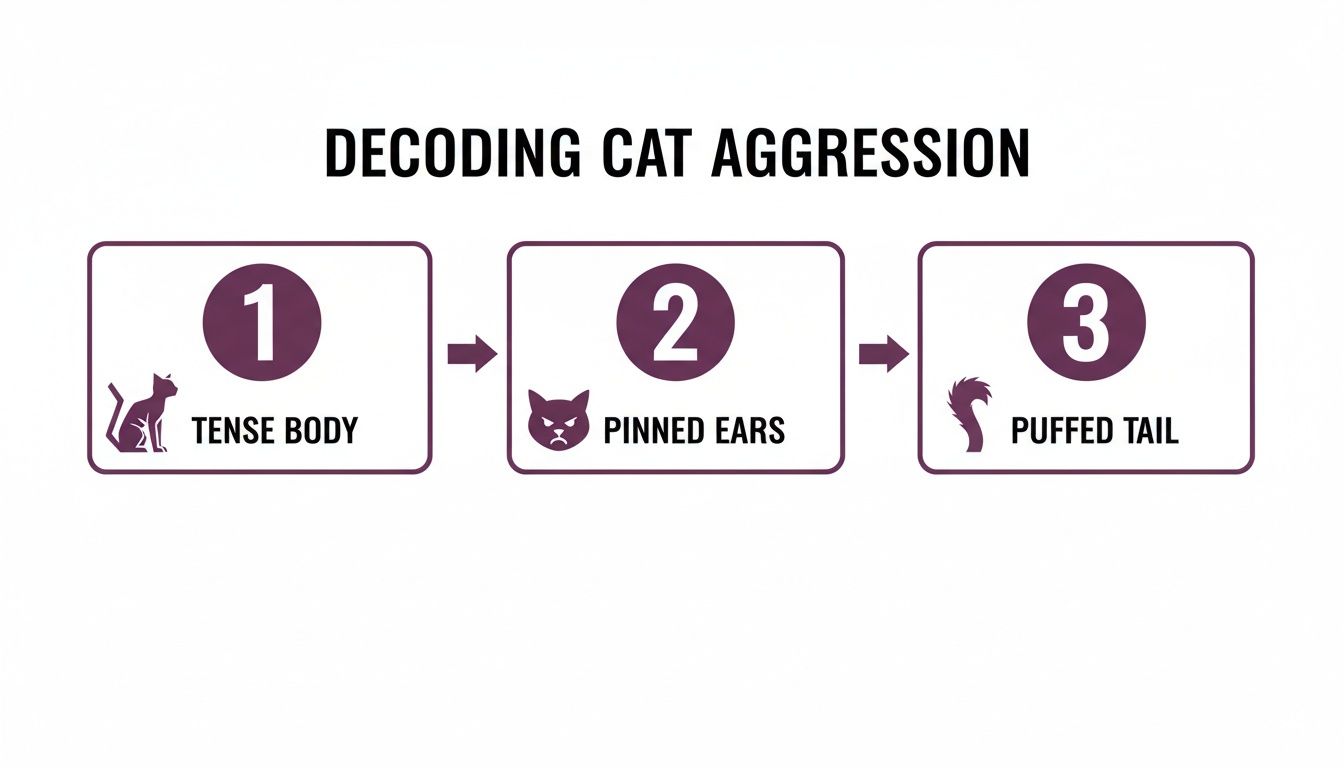
This handy infographic shows those escalating signs, from a tense body to pinned-back ears and a puffed-up tail. Spotting these early is your cue to slow things down.
The First Supervised Meetings
This is the big moment! ✨ Once your cats can eat peacefully right on opposite sides of the door, it’s time for their first face-to-face meeting. This has to be short, sweet, and heavily supervised. You can stack two baby gates in the doorway or just crack the door open enough for them to see each other.
The key is to keep these first visual interactions incredibly positive. Arm yourself with their absolute favorite high-value treats or get them both focused on a fun play session with a wand toy like the FloofChonk Interactive Teaser Wand. Keep the session very short—just a minute or two is perfect to start. Always end it on a high note, before anyone has a chance to get tense, and then separate them again.
Remember, every pair of cats is different. Some might fly through this process in a week, while others could take several months. For a more detailed walkthrough, be sure to check out our guide on how to introduce cats to each other. The most important thing is to always move at the pace of your most nervous cat. Rushing things is the number one reason reintroductions fail.
Creating a Home Environment That Reduces Conflict

Think of your home as a tiny kingdom. When you have more than one cat, you're not just a pet parent—you're a monarch managing multiple furry nobles, each believing they have a divine right to the throne (and that sunny spot on the rug). A huge number of cat squabbles aren't about personality clashes; they're about real estate disputes. 👑
To stop your cats from fighting, you need to become a master of interior design, feline-style. The secret is transforming your home into a land of plenty where resources feel so abundant that nobody needs to compete. When every cat feels like they have their own territory and easy access to life's essentials, the tension in your home will plummet.
Our mascot, Floofie, insists this is the most fun part of the peace-making process. It’s time to "catify" your space! 💖
Embrace the Golden Rule of Cat Resources
The single most powerful strategy for reducing conflict is what cat behaviorists call the "N+1 Rule." Floofie likes to call it the "one per cat, plus one extra" rule. It's simple: for every essential resource, you should have one for each of your cats, plus a spare.
This simple formula is a game-changer because it prevents a bossy cat from guarding a resource and blocking a more timid cat from getting what they need.
Here’s how to apply it:
- Litter Boxes: For two cats, you need three litter boxes. Got three cats? You need four. Place them in different, low-traffic areas so one cat can't possibly guard them all. Our FloofChonk Anti-Tracking Litter Mat can help keep those areas tidy!
- Food and Water Bowls: Each cat needs their own set. Please don't line them up side-by-side like a cafeteria tray! Separate their feeding stations to give them some personal space while they eat.
- Prime Napping Spots: This includes beds, perches, and cozy hideaways. Your goal is to have more awesome spots than there are cats to claim them.
Expand Their Kingdom Vertically
Cats don't just think horizontally; they live in a 3D world. When floor space feels limited, the best way to expand their territory is by going up! Adding vertical space is like building a new extension onto your home, exclusively for your felines.
This is a game-changer because it allows cats to share a room while maintaining their own personal space bubbles. One cat can be lounging on top of a cat tree, observing their kingdom from above, while another naps peacefully on the sofa below. This ability to create distance is crucial for preventing tense stare-downs and ambushes.
Consider adding these vertical treasures:
- Cat Trees and Condos: The bigger, the better! Look for multi-level trees with various platforms, scratching surfaces, and hiding spots. The FloofChonk Luxury Cat Tree is a paw-some choice.
- Wall-Mounted Shelves: Staggered shelves create a "cat superhighway" along your walls, giving them a fun and secure way to navigate a room without ever touching the floor.
- Window Perches: These give your cat a safe place to watch the world go by (Floofie calls it "Cat TV" 📺) and soak up some sun.
A well-catified home is a happy home. For more inspiration, check out our guide packed with awesome DIY cat enrichment ideas to get your creative juices flowing.
Use Visual Barriers to Prevent Stare-Downs
Sometimes, out of sight truly is out of mind. Long, open hallways or large rooms can become arenas for intimidating stare-downs, which are often the first step in a feline showdown. You can easily break up these long sightlines with some clever furniture placement.
Strategically placing a chair, a decorative screen, or even a tall plant can create a visual barrier. This forces the cats to navigate around it, preventing them from locking eyes from across the room and letting that tension build. It gives a more timid cat an easy escape route and reduces the chances of them feeling cornered—a major trigger for fights.
When to Call in the Pros for Cat Aggression
So you’ve set up separate kingdoms, you’re a scent-swapping wizard, and your house is basically a five-star resort for felines. But what happens if the peace treaty keeps getting shredded and the hissing hasn't stopped? First off, don't feel defeated. Floofie says knowing when to ask for help is a sign of a great pet parent, not failure.
Sometimes, the real reason for the conflict is something you simply can't see. If the fights are escalating, causing injuries, or if one of your cats is living in a constant state of fear, it’s absolutely time to call for backup. 🩺
First Stop: Your Veterinarian
Before you even start Googling "cat therapist," your very first call should be to your vet. A sudden spike in aggression is a massive red flag that something medical could be going on. Cats are notorious for hiding pain, and lashing out might be the only way they can tell you, "Hey, I don't feel so good."
Think about it: a cat with arthritis, a painful dental issue, or even a UTI feels vulnerable and might strike out defensively. Certain conditions like hyperthyroidism can also crank up their irritability. A thorough check-up is the only way to get to the bottom of it and rule out a physical cause.
Professionals who've completed veterinary nurse courses are often on the front lines, trained to spot those subtle signs of illness during routine exams that might otherwise go unnoticed.
When a Behaviorist Is Your Best Bet
Okay, so your vet gave both cats a clean bill of health. What now? Your next step is to find a certified cat behaviorist. These pros are like detectives for feline feelings—they go way beyond generic advice to dig into the unique social dynamics of your home.
A cat behaviorist can pinpoint the specific triggers and environmental pressures that are causing friction. They’ll give you a customized action plan that’s tailored to your cats, helping you rebuild the peace one paw at a time. It’s a powerful investment in your cats' long-term happiness.
It's probably time to reach out to a behaviorist if:
- You’ve tried the slow reintroduction process multiple times with no real progress.
- The aggression is serious and has led to injuries needing vet care.
- One cat spends most of its time hiding, clearly suffering from severe anxiety.
- The aggression is being redirected toward you or other people in the house.
A behaviorist can observe interactions you might be missing and create a specific plan for your unique crew. This could involve advanced behavior modification techniques, more environmental tweaks, or even discussing anxiety medication with your vet to support the behavioral plan.
And remember, proper health protocols are a key part of responsible ownership. For instance, in one study of aggressive incidents, only 38% of the cats involved were vaccinated for rabies, which points to a critical gap in preventive care. You are your cat's biggest advocate, and building a strong support team is the best thing you can do for them. ❤️
Your Top Cat Fight Questions, Answered
Still scratching your head over how to get your cats to just get along? You're not alone. Let's tackle some of the biggest questions Floofie and the team get from fellow cat parents trying to broker a truce in their own homes.
How Can I Tell If My Cats Are Playing or Actually Fighting?
This is the million-dollar question, isn't it? It can be tough to tell if you’re witnessing a friendly tussle or the start of World War III. The real secret is to pay attention to their body language and the sounds they're making.
Play-fighting is usually pretty quiet. Think of it like a clumsy, silent movie chase scene. You'll see some batting (with claws tucked away) and a lot of give-and-take where the cats switch roles between chaser and chasee.
A real fight is the opposite: it's loud, stiff, and genuinely scary. You’ll hear hissing, spitting, shrieking, and deep, guttural growls that sound like they come from the depths of their soul.
Keep an eye out for these tell-tale signs that it’s definitely NOT a game:
- Airplane Ears: Ears are pinned back flat against their head.
- Puffed-Up Fur: Their tail looks like a bottle brush, and the hair along their spine is standing straight up.
- Claws Are Out: You can clearly see their claws are extended.
- No Breaks: The chase is one-sided. One cat is desperately trying to get away while the other relentlessly pursues them.
When in doubt, it’s always better to err on the side of caution. Safely break it up by making a loud, sudden noise (like clapping your hands or dropping a book) or by sliding a piece of cardboard between them.
Will My Cats Ever Be Friends After Fighting So Much?
It's totally paw-ssible, but it's helpful to manage your expectations a bit. While some mortal enemies do end up becoming best cuddle buddies, the main goal here is peaceful coexistence. If they become friends, that's just a fantastic bonus! 😻
The success of your peace treaty hinges on your dedication to a slow and steady reintroduction process. This plan basically hits the reset button on their relationship, helping them forget the bad blood and build new, positive associations with each other.
Every single calm interaction is a huge win. Some cats will eventually learn to groom and nap together, while others might just learn to share the sunny spot by the window without drama. And honestly? That's a victory worth celebrating.
Floofie says patience and their individual personalities are the biggest factors here. Remember to celebrate the small stuff, like them eating on opposite sides of the room without a single hiss. That's real progress!
Do Calming Pheromone Diffusers Really Work?
They can be a surprisingly effective part of your peacemaking toolkit. Think of calming diffusers as mood lighting for your cats. Products that release synthetic feline pheromones, like our FloofChonk Calming Diffuser Kit, create a background vibe of safety and security.
These diffusers mimic the natural "happy" pheromones cats leave behind when they rub their cheeks on things (and you!). It's their way of sending a message to other cats that says, "This is a safe space, and I'm feeling good."
Now, they aren't a magic wand. A diffuser won't instantly stop a fight in its tracks. But what it does do is lower the overall stress and anxiety levels in your home, making your cats less likely to be on edge and fly off the handle at the smallest thing.
For the best results, use them as a support system alongside your other efforts, like enrichment and a slow reintroduction. They help create a calmer environment, which makes all your other hard work much more likely to stick.
At FloofChonk, we know that every cat deserves to feel safe and happy at home. From cozy cat beds that give everyone their own territory to fun, interactive toys that channel aggressive energy into playtime, we have everything you need to restore the peace. Check out our collection of paw-picked solutions and let's get your multi-cat household back to a state of harmony! Find the purr-fect gear at https://www.floofchonk.com.